Algeria
 Egypt
 Libya
 Morocco
 Sudan
 Tunisia
 Benin
 Burkina Faso
 Cabo Verde
 Côte d'Ivoire
 Ghana
 Guinea-Bissau
 Liberia
 Mali
 Mauritania
 Niger
 Nigeria
 Senegal
 Sierra Leone
 The Gambia
 Togo
 Cameroon
 Central African Republic
 Chad
 DR Congo
 Equatorial Guinea
 Gabon
 Republic of the Congo
 São Tomé and Príncipe
 Burundi
 Comoros
 Djibouti
 Eritrea
 Ethiopia
 Kenya
 Madagascar
 Malawi
 Mauritius
 Mozambique
 Rwanda
 Seychelles
 Somalia
 South Sudan
 Tanzania
 Uganda
 Angola
 Botswana
 Eswatini
 Lesotho
 Namibia
 South Africa
 Zambia
 Zimbabwe
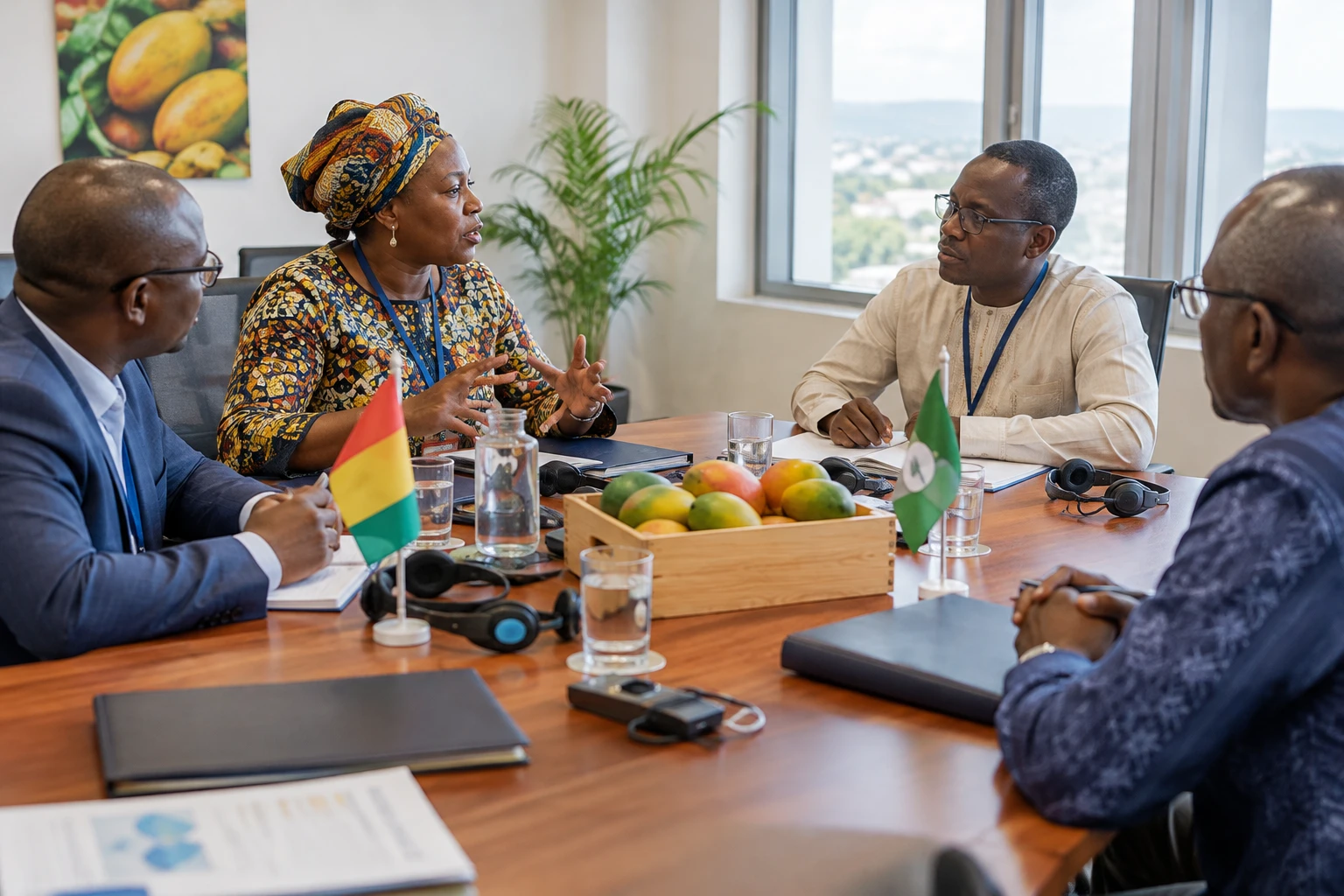
A mango harvested in Guinea can lose some of its value before it even reaches a market. Between picking, transport and sale, preservation remains one of the links in the chain that needs strengthening. It is in this context that studies into refrigeration equipment have been announced for the sector.
From agreement to studies: a project still to be defined
On 22 October 2026, Guinea’s agriculture ministry received a delegation from Faspol Africa, a company affiliated with the Polish Faspol group. The discussions led to a memorandum of understanding on modernising mango preservation infrastructure. The ministry presents the initiative as a public-private partnership linked to developing the sector and reducing post-harvest losses. The Guinean account of the meeting on 22 October says technical feasibility studies are due to begin in November 2026.
The announced timetable provides for identifying priority production areas, assessing storage and cold-storage needs, and then strengthening the skills of local stakeholders. At this stage, the aim is therefore to study needs, not to build cold rooms that have already been funded or sized. The project’s cost, capacity, funding and the localities concerned have not yet been specified.
This distinction matters to producers. A study can establish where to install equipment and which technology to use. On its own, it does not guarantee that units will be built, affordable or suited to the practices of farms and traders.
Preservation is about more than refrigeration
Losses of fresh produce often result from several obstacles that compound one another: a lack of equipment, poor roads, insufficient transport, difficulties accessing energy and limited packaging capacity. The cold chain refers to all the means used to keep food at an appropriate temperature, from harvest to sale. If one link is missing, refrigerated storage alone cannot solve the problem.
Available figures should also be treated with caution. An estimate cited by the Enhanced Integrated Framework, a partnership programme linked to the World Trade Organization, puts mango losses at between 60 and 85% depending on the region. This range, based on earlier work, does not measure current losses and does not make it possible to attribute them all to the lack of refrigeration. The assessment of the phytosanitary project focused on Guinea also refers to these losses, highlighting issues of quality and market access.
Guinean mangoes also depend on other conditions for successful marketing. Compliance with phytosanitary requirements, sorting, packaging and regular shipments are all important for exports. The agriculture ministry publishes, among other things, the steps required to obtain phytosanitary certificates for mangoes destined for the European Union. These export procedures underscore that competitiveness depends as much on product compliance as on preservation.
Producers, traders and regions affected
If the project goes ahead, its impact will depend on where it is based and its business model. Equipment close to production areas could help preserve fruit before it is transported. But producers will need to be able to access it at the right time and at a cost compatible with their incomes. Transporters, collectors, co-operatives and traders will also need clear rules on use, maintenance and the allocation of costs.
The issue is therefore not only relevant to exporters. The markets in Conakry and other urban centres also rely on supply chains capable of delivering fresh produce. Rural areas, meanwhile, could be disadvantaged if equipment is concentrated far from orchards or if roads make it difficult to supply them. Infrastructure that benefits the sector will need to be integrated with transport, energy and the places where producers actually sell their harvests.
The sector also supports activities beyond agricultural production. The Enhanced Integrated Framework programme on the mango value chain describes work carried out in several prefectures, particularly on processing, packaging and orchard improvement. It notes that value can be added at different points in the chain, not only at the export stage.
An African experience to adapt to Guinea’s context
Faspol Africa says its offering covers cold storage, milk cooling and ice production. The company says it has delivered projects in Kenya and Ghana, and offers equipment designed for sub-Saharan African markets. These examples are experience claimed by the company; they do not yet demonstrate that its solutions will suit Guinea’s orchards, roads and energy resources. Faspol Africa’s description of its activities outlines its various cooling offers.
For the Guinean authorities, the challenge will be to turn the protocol into a verifiable plan: selected sites, planned capacity, funding, timetable, operating costs and maintenance responsibilities. The announced training will also be crucial. Without technicians and available spare parts, a refrigeration installation risks quickly losing its usefulness.
The issue forms part of a West African regional challenge: preserving agricultural produce more effectively and facilitating its movement between production areas and markets. ECOWAS, the Economic Community of West African States, provides a framework for co-operation and trade among countries in the region, but national infrastructure remains essential to practical commerce. In Guinea, the next step to watch is the effective launch of the studies announced for November 2026. Their findings will show whether the initiative can address producers’ constraints or will remain at the stage of an agreement in principle.