Algeria
 Egypt
 Libya
 Morocco
 Sudan
 Tunisia
 Benin
 Burkina Faso
 Cabo Verde
 Côte d'Ivoire
 Ghana
 Guinea-Bissau
 Liberia
 Mali
 Mauritania
 Niger
 Nigeria
 Senegal
 Sierra Leone
 The Gambia
 Togo
 Cameroon
 Central African Republic
 Chad
 DR Congo
 Equatorial Guinea
 Gabon
 Republic of the Congo
 São Tomé and Príncipe
 Burundi
 Comoros
 Djibouti
 Eritrea
 Ethiopia
 Kenya
 Madagascar
 Malawi
 Mauritius
 Mozambique
 Rwanda
 Seychelles
 Somalia
 South Sudan
 Tanzania
 Uganda
 Angola
 Botswana
 Eswatini
 Lesotho
 Namibia
 South Africa
 Zambia
 Zimbabwe

In Conakry, gold reform is entering its decisive phase. From Tuesday 6 October 2026, Guinean producers must comply with a new rule: gold intended for export must have been refined and certified in Guinea. For industrial companies, the challenge is no longer simply to extract the metal. They must now secure its processing, certification and international sale within a tight timeframe.
A reform at the intersection of mining and economic sovereignty
The decision reflects the Guinean authorities’ desire to retain more value within the country. President Mamadi Doumbouya announced in June 2026 the gradual end of exports of unrefined gold. Under the scheme, gold produced in Guinea must pass through an authorised refinery before leaving the country.
The main facility expected to play this role is the Nimba Gold Refinery, located in Conakry. According to the Guinean presidency, it could process up to 2,000 kilograms of gold per day in its initial configuration, with capacity expandable to 4,000 kilograms. The authorities present the facility as a means of local processing, but also as a way to better track gold flows and increase public revenues.
This approach extends beyond the mining sector alone. For several years, Guinea has sought to process more of its resources before exporting them. Bauxite, which remains the mainstay of the national mining economy, occupies a central place in this strategy. Gold is now becoming another testing ground for a policy of local value addition.
Sales rise at Kiniero despite falling production
The Kiniero mine illustrates the complexity of the transition. In its operational update published on Monday 5 October, PDI Gold said it had sold 61,149 ounces of gold from the site in the third quarter of 2026. The volume was 38,470 ounces in the previous quarter, an increase of 59%.
This increase does not, however, reflect higher extraction. Kiniero produced 45,599 ounces between July and September, compared with 54,252 ounces in the second quarter. Quarterly production therefore fell by about 16%. The company attributes the difference to the timing of shipments and the sale of some of the gold it held in stock at the end of June.
In other words, PDI sold more without producing more. This reduction in stockpiles comes after a period of regulatory transition that had disrupted the pace of exports. Mining and ore processing continued, but shipments were temporarily suspended while the new framework was being finalised.
According to information provided by the company, exports resumed on 8 July 2026. Since then, PDI is said to have shipped about 33,838 ounces under existing agreements, for estimated provisional receipts of US$135.7 million. These figures come from the company’s own communications and will need to be checked against Guinean customs and mining statistics when available.
The real test begins with the 6 October deadline
The 90-day transitional period ends on Tuesday 6 October 2026. After that date, exports of unrefined gold with a minimum purity of 95.5% are to be prohibited, according to the provisions set out in the new regulatory framework. Only gold processed by an authorised Guinean refinery and certified for export will normally be allowed to leave the country.
The timetable leaves industrial companies facing several unknowns. First, they must establish whether the available facilities can handle the volumes produced. They must then ensure consistent quality, meet international buyers’ standards and organise the issuance of the certificates required for exports.
Commercial arrangements will also be crucial. Producers need to know the refining fees, processing times, liability in the event of loss or delay, and the guarantees governing the safekeeping of the metal. For an industrial mine, a few extra days in the logistics chain can affect cash flows, contractual deliveries and relations with buyers.
PDI says it is working with the Guinean authorities, the Chamber of Mines and other producers to organise a gradual transition. The company is also considering the possibility of developing refining facilities directly at its sites. This option could reduce reliance on a single facility, but would require substantial investment and a clearly defined regulatory framework.
A reform with different effects on different players
For the Guinean state, local refining could improve traceability and strengthen its ability to collect taxes and royalties. It could also support the training of technicians, the creation of specialised services and the development of an ecosystem around assaying, certification and secure transport.
For industrial companies, the issue is more immediate. They must preserve production continuity and access to international markets. Ambitious regulation can create value, but implementation that is too rapid can also cause logistical bottlenecks or delay sales.
The effects will also vary by location. Conakry is expected to concentrate activities related to refining, inspections and exports. Mining areas, meanwhile, are looking for tangible benefits: skilled jobs, local subcontracting, infrastructure and better-distributed revenues. Routing gold through the capital does not, in itself, guarantee greater benefits for communities near extraction sites.
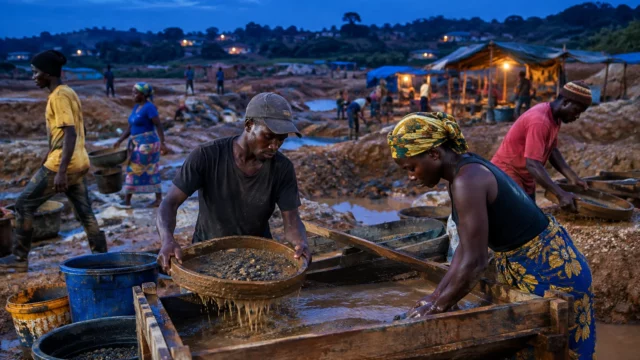
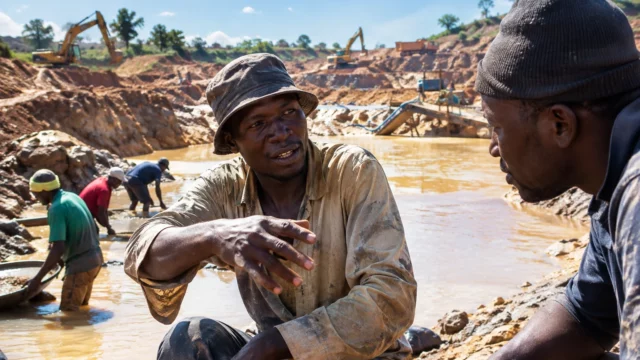
The artisanal sector will also have to be incorporated into the scheme. Guinea must avoid the refining requirement pushing some operators towards informal channels. This will require accessible mechanisms for buying counters, clear procedures and an approach to enforcement that does not rely solely on penalties.
A signal watched across West Africa
Guinea’s reform comes at a time when several West African states are seeking to capture more value from their mineral resources. Guinea remains a member of ECOWAS, the Economic Community of West African States, even as the regional organisation faces a period of acute political tensions with regimes that came to power following military takeovers in several neighbouring countries.
The Guinean case will therefore be watched beyond the country’s borders. It raises a question shared across the region: how can countries move from exporting minerals to building local value chains without undermining investment, public revenues and cross-border trade?
The next step will be practical. The actual capacity of the Nimba Gold Refinery will have to be measured, the rules applicable to industrial mines clarified, and the smoothness of the first refined-gold exports assessed. At Kiniero, strong third-quarter sales mainly enabled the company to draw down some of its available stock. The reform’s success will now be judged by another measure: Guinea’s ability to turn this requirement into a reliable, competitive and sustainable system.