Algeria
 Egypt
 Libya
 Morocco
 Sudan
 Tunisia
 Benin
 Burkina Faso
 Cabo Verde
 Côte d'Ivoire
 Ghana
 Guinea-Bissau
 Liberia
 Mali
 Mauritania
 Niger
 Nigeria
 Senegal
 Sierra Leone
 The Gambia
 Togo
 Cameroon
 Central African Republic
 Chad
 DR Congo
 Equatorial Guinea
 Gabon
 Republic of the Congo
 São Tomé and Príncipe
 Burundi
 Comoros
 Djibouti
 Eritrea
 Ethiopia
 Kenya
 Madagascar
 Malawi
 Mauritius
 Mozambique
 Rwanda
 Seychelles
 Somalia
 South Sudan
 Tanzania
 Uganda
 Angola
 Botswana
 Eswatini
 Lesotho
 Namibia
 South Africa
 Zambia
 Zimbabwe
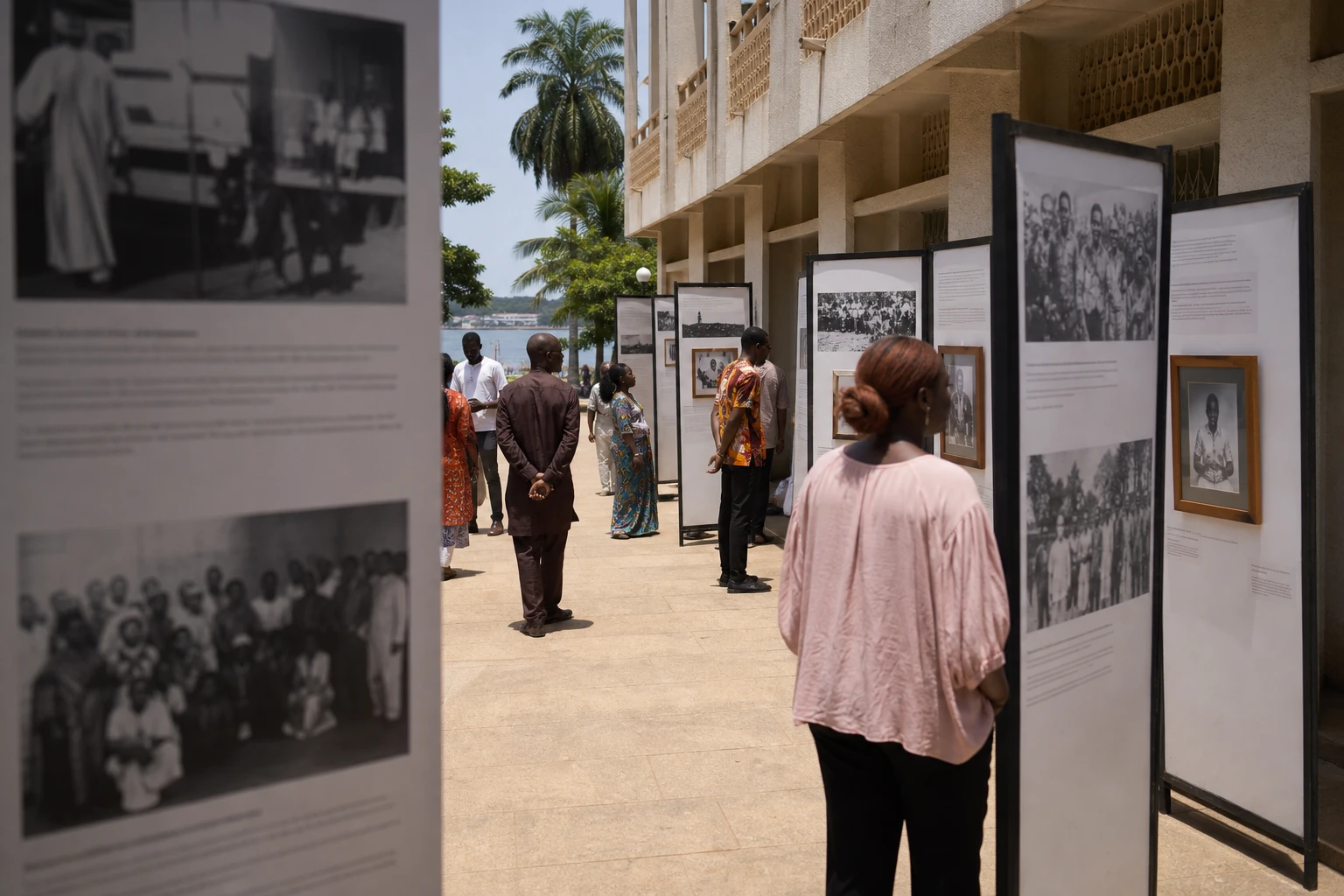
In Conakry, the memory of independence is not confined to the face of Sékou Touré. An exhibition near Lake Gbassikolo is bringing political leaders, trade unionists, artists and activists back into view after they were long relegated behind the official account of Guinea’s First Republic.
An independence movement with many strands
Guinea celebrates its accession to sovereignty on 2 October. Four days earlier, on 28 September 1958, Guinean voters had rejected the draft French constitution, which proposed integrating African territories into a new French Community.
Guinea was the only territory in French West Africa to vote “no”. Results published at the time showed a massive rejection, of more than 95%. The vote paved the way for the proclamation of the Republic of Guinea in Conakry on 2 October 1958.
This episode is often associated with Ahmed Sékou Touré, then leader of the Democratic Party of Guinea, the PDG-RDA. Yet the choice of independence also rested on temporary alliances between several political parties and networks. Trade union mobilisation, youth organisations and nationalist movements played an important role in this momentum.
The exhibition on the “companions of independence” is specifically intended to broaden this account. It features, among others, playwright Fodéba Keïta, trade unionist Koumandian Keïta, politician Saïfoulaye Diallo and activist Loffo Camara. Their lives show that political emancipation was built in public meetings, trade unions, political parties and cultural spaces.
The decisive rapprochement of September 1958
Among the figures highlighted is Diawadou Barry. A deputy for Guinea in the French National Assembly from 1954 to 1958, he led a political movement that competed with the PDG-RDA. His career illustrates the tensions that ran through Guinean public life before independence.
As the referendum approached, Diawadou Barry and Ibrahima Barry III, also known as Barry III, moved closer to Sékou Touré. On 17 September 1958, several political leaders adopted a common position in favour of rejecting the French proposal. This convergence reduced the risk of the Guinean vote being split between rival parties.
The regional context mattered greatly. In several neighbouring territories, the French authorities could rely on leaders who favoured a closer relationship with Paris. In Guinea, the rallying of the main nationalist forces made this strategy more difficult. The question was therefore about more than an institutional choice. It also concerned the ability of Guinean leaders to speak on behalf of a united political movement.
Historical archives describe this coordination between the PDG-RDA and leaders from other parties. They show that the “no” vote was not the result of a single campaign or a single party. It emerged from a political balance of forces built in the weeks before the vote.
Restoring recognition without erasing the darker chapters
These figures are being brought to the fore with the benefit of hindsight about the period that followed independence. Several figures in the anti-colonial struggle went on to become officials in the Guinean state. Some were later accused of plotting against Sékou Touré’s government. Opponents and former allies were imprisoned or executed during the First Republic, from 1958 to 1984.
This history demands a clear distinction. A leader’s contribution to independence does not define their entire political career. Likewise, recognition of Sékou Touré’s role must not lead to the erasure of the violence and exclusion that marked his rule. The work of remembrance is stronger when it holds these two realities together.
For the families concerned, the issue is also personal. Some names remain tied to interrupted stories, archives that are difficult to access or political convictions that have never been fully explained. Their return to public view is therefore a symbolic gesture, but also a way of reopening the debate on how Guinean history is passed on.
The National Library and cultural institutions can play a central role in this effort. They hold documents, photographs, testimonies and publications that can complement school accounts and official commemorations. Guinea’s National Audiovisual Institute also holds a collection on 1958 and the first months of the Republic.
A legacy that extends beyond Guinea’s borders
The Guinean case remains a major moment in West Africa’s political history. By choosing independence as early as 1958, Conakry followed a different path from the other territories of former French West Africa. The decision shaped its relations with France, as well as its ties with neighbouring states.
Guinea is now a member of the Economic Community of West African States, ECOWAS, which co-ordinates regional policies and responses to political crises. Its history is a reminder that the region’s national trajectories do not follow a single model. Independence was negotiated, won or proclaimed according to the circumstances of each territory.
The story of the “companions of independence” thus offers a different way of looking at 1958. The aim is not to replace one central figure with another, but to restore the plurality of actors who helped make Guinea a sovereign state.
This history is likely to remain a source of debate in Conakry. The next steps will depend on the preservation of archives, access to historical collections and the attention given to families’ testimonies. For Guinea, the challenge is to build a more complete national narrative that recognises the victories of independence without concealing the divisions that followed.