Algeria
 Egypt
 Libya
 Morocco
 Sudan
 Tunisia
 Benin
 Burkina Faso
 Cabo Verde
 Côte d'Ivoire
 Ghana
 Guinea-Bissau
 Liberia
 Mali
 Mauritania
 Niger
 Nigeria
 Senegal
 Sierra Leone
 The Gambia
 Togo
 Cameroon
 Central African Republic
 Chad
 DR Congo
 Equatorial Guinea
 Gabon
 Republic of the Congo
 São Tomé and Príncipe
 Burundi
 Comoros
 Djibouti
 Eritrea
 Ethiopia
 Kenya
 Madagascar
 Malawi
 Mauritius
 Mozambique
 Rwanda
 Seychelles
 Somalia
 South Sudan
 Tanzania
 Uganda
 Angola
 Botswana
 Eswatini
 Lesotho
 Namibia
 South Africa
 Zambia
 Zimbabwe
An agreement that means more than a number
In Conakry, potential financing of $425m is not just a budgetary lifeline. Above all, it tells us one thing: Guinea wants an influential partner in the international financial architecture to recognise its economic trajectory.
In a country where mining revenues underpin most of the growth, the real test is not the announcement of a deal. It is whether that deal translates into better schools, hospitals and roads, and whether the state can collect taxes without stifling economic activity. The World Bank noted again in 2025 that poverty remained high, despite growth driven by the mining sector.
Conakry puts public finances back at the heart of the agenda
The move is part of a broader sequence of events. Since the start of 2026, Guinea’s new economic team has held a series of discussions with the International Monetary Fund. In April, at the Spring Meetings in Washington, the Minister of Economy, Finance and Budget, Mariama Ciré Sylla, led the Guinean delegation in talks described as decisive for a future formal programme. In June, Prime Minister Amadou Oury Bah received an IMF mission in Conakry for Article IV consultations, the Fund’s annual economic surveillance exercise.
This technical framework is taking shape amid political sensitivities. Guinea’s authorities are seeking to close the chapter of transition that began after the 2021 coup and consolidate institutional legitimacy. At the same time, they want to show that the next phase will be about more than mining: it will also focus on public finances and social issues. The government has made Simandou 2040, a transformation programme built around the vast Simandou iron ore project, a central pillar of its economic narrative.
What the agreement provides for—and what it does not guarantee
According to the information available, the agreement reached with IMF staff on Monday 10 August is still subject to approval by the Fund’s executive board, which is expected in September. If approved, the programme would pave the way for around $425m for Guinea. The immediate goal is clear: strengthen public finances, support macroeconomic stability and lend credibility to Conakry’s reform strategy. The IMF notes that the Republic of Guinea has been a member of the Fund since 28 September 1963, with a quota of 214.2 million SDRs and a significant outstanding credit balance.
The government wants to show that it is not relying entirely on a disbursement. It points to fiscal discipline, transparency in public accounts, increased domestic revenue mobilisation and more prudent debt management. This approach is consistent with discussions held with the Fund in the spring and early summer. Guinea’s Ministry of Economy also stresses the IMF’s catalytic role with other donors, from the World Bank to the African Development Bank.
But an IMF agreement does not solve everything. It sets a framework, not an outcome. Guinea continues to face a longstanding problem: real economic growth is not reaching households quickly enough. The World Bank report published in Conakry in July 2025 put growth at 5.7% in 2024, 6.5% in 2025 and around 10% on average in 2026-2027, driven by the mining sector. At the same time, it noted that poverty stood at 52% and tax revenues remained low, at 13.1% of GDP.
Mining wealth: an accelerator and a point of vulnerability
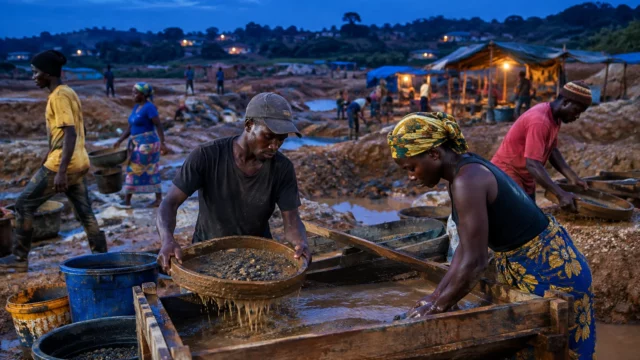
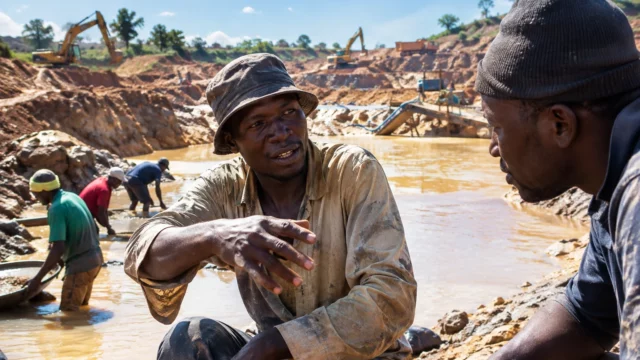
Guinea’s promise rests on a simple wager: to make mining a lever for fiscal sovereignty. It is a defensible approach, provided the country avoids the classic trap of extractive economies. A rise in exports can boost GDP without improving daily life quickly enough in secondary cities, rural areas or the informal economy. This is precisely where the credibility of the next programme will be tested. Guinea’s minister said as much in recent public discussions: growth driven by the expansion of mining must be turned into a lasting improvement in living standards.
The Simandou project has a particular place in this equation. The World Bank report notes that the revenues expected from the iron ore deposit should be used to strengthen domestic resource mobilisation and improve budget management. In other words, the deposit is not just an export asset. It is also a test of governance. If revenues are not properly captured or spent, Guinea could repeat a familiar pattern in West Africa: concentrated revenues, heavy infrastructure spending and then mounting social impatience.
The heart of the matter, then, is how the gains are distributed. For the executive, an agreement with the IMF can reassure creditors, stabilise public accounts and support planning. For households, it will mean something only if fiscal headroom finally creates room for education, healthcare, energy and jobs. The authorities’ stated priority of investing in human capital points in that direction. It remains to be seen whether budget decisions will follow through on that promise.
Regional significance for West Africa
This issue extends beyond Guinea. In a West Africa marked by political transitions, fiscal pressures and heavy dependence on commodities, an IMF programme approved for Conakry would be seen as a signal of credibility. It would also send a message to regional and continental partners: mining revenues can finance a development trajectory, but only if fiscal discipline, transparency and diversification advance together.
The next step now depends on a specific deadline: the IMF executive board’s decision in September. If it confirms the agreement, Guinea will have new external support at a time when its economy is moving to a new scale. If it delays approval, the government will have to keep making its case without formal backing, at a time when social expectations will not wait. Across West Africa, Guinea’s case will therefore serve as a test of a simple question: how to turn mining wealth into a stronger state without losing touch with the population.