Algeria
 Egypt
 Libya
 Morocco
 Sudan
 Tunisia
 Benin
 Burkina Faso
 Cabo Verde
 Côte d'Ivoire
 Ghana
 Guinea-Bissau
 Liberia
 Mali
 Mauritania
 Niger
 Nigeria
 Senegal
 Sierra Leone
 The Gambia
 Togo
 Cameroon
 Central African Republic
 Chad
 DR Congo
 Equatorial Guinea
 Gabon
 Republic of the Congo
 São Tomé and Príncipe
 Burundi
 Comoros
 Djibouti
 Eritrea
 Ethiopia
 Kenya
 Madagascar
 Malawi
 Mauritius
 Mozambique
 Rwanda
 Seychelles
 Somalia
 South Sudan
 Tanzania
 Uganda
 Angola
 Botswana
 Eswatini
 Lesotho
 Namibia
 South Africa
 Zambia
 Zimbabwe
In Forécariah, a discovery that goes beyond a crime story
In a border prefecture often associated with roads, construction sites and discreet movements, the discovery of six bodies with their hands tied and eyes blindfolded has brought a broader question to the fore: who protects citizens when investigators, magistrates and families are still waiting for answers? In Forécariah, in south-western Guinea, the case touches on security, justice and public trust.
The case comes as the country undergoes an institutional transition, with Guinea still under close scrutiny from ECOWAS, the ECOWAS Community Court of Justice and African human rights bodies. Forécariah prefecture, meanwhile, occupies a strategic position: close to Conakry, connected to economic routes towards the coast, and already marked by tensions over security and population movements.
What is known about the six bodies found
The bodies were discovered on 24 August in a forested area of the Allassoyah sub-prefecture, after young people who had gone to collect firewood raised the alarm. The victims have not yet been publicly identified. Consistent accounts indicate that they were found with their hands tied and eyes blindfolded, then taken to the morgue at Forécariah hospital pending autopsies.
At this stage, the Forécariah public prosecutor’s office has opened an investigation but has not disclosed any identities, suspects or causes of death. The National Defence and Security Commission, for its part, said on 29 August that “no definitive conclusion” could be drawn and called for speculation to be avoided. The body reports directly to the presidency.
This official caution does not put an end to the questions. It prolongs them. In a country where distrust of the security apparatus has remained acute since the coup d’état of 5 September 2021, the lack of detailed information is fuelling suspicion rather than dispelling it. Guinea has certainly made institutional progress, with a new electoral phase in 2026 and Mamadi Doumbouya’s inauguration on 17 January 2026 for a seven-year term, but human rights remain central to public debate.
Civil society turns up the pressure in Guinea and across the region
Twenty West African human rights organisations have called for an independent, impartial and transparent investigation. They include well-known transnational networks in the sub-region, such as Tournons la page, Y en a marre and Africtivistes. Their message is clear: without procedural safeguards, an investigation into a mass grave risks joining other cases that have never been solved.
The organisations also want to mobilise regional and continental frameworks. They have referred to ECOWAS, whose Court of Justice has jurisdiction to interpret community instruments, as well as the African Court on Human and Peoples’ Rights, which deals with serious violations of fundamental rights when a state has accepted its jurisdiction. In practice, these avenues serve as a reminder of a simple point: the issue concerns not only Guinea’s domestic politics, but also the country’s legal commitments in West Africa and within the African Union.
The regional dynamic matters all the more because ECOWAS continued its support for Guinea’s process in 2026, including through an election observation mission for the legislative and local elections on 31 May 2026. The organisation said it wanted to support a lasting return to constitutional governance. In this context, a mass-grave case affects not only the authorities’ image: it also tests the credibility of regional monitoring mechanisms.
Why Forécariah is a focus of so much tension
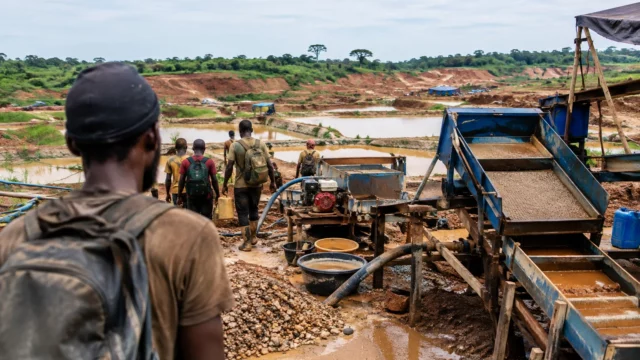
Forécariah is no incidental name in Guinean current affairs. The prefecture lies in an area where major mining projects, a security presence and routes towards Sierra Leone and the coastal zone intersect. Construction work linked to the Simandou project has raised the locality’s profile. The area is therefore both an economic corridor and a sensitive zone for the security forces.
The precedent set in 2025 has left its mark. Another mass grave was reported in the same prefecture in October 2025, but to date neither the victims’ identities nor the exact circumstances of their deaths have been publicly established. It is this accumulation of unresolved cases that is fuelling doubt today. When an investigation does not reach a conclusion, institutional silence itself becomes a political issue.
Families are waiting for tangible evidence: identification of the bodies, forensic examinations, a chain of custody for the remains, and the publication of clear findings. Without these, the risk is twofold. First, the possibility of extrajudicial violence will remain open in the public debate. Second, the perception of impunity will weaken a state that is nevertheless seeking to consolidate its legitimacy after the transition.
A test for Guinean justice and for West Africa
This case says something broader about the region: political transitions are judged not only by elections or inaugurations, but also by states’ ability to address their blind spots. In Guinea, the process that began in 2021 has produced institutional advances, but it remains vulnerable to a persistent criticism: that justice is still too slow on sensitive cases.
At the continental level, the Forécariah case resonates with other African cases in which the search for truth depends on transparent investigations, witness protection and judicial independence. It is also a reminder to regional mechanisms that their effectiveness is measured by their ability to support and document investigations and, where necessary, press states to account. What happens next will depend on concrete action by the public prosecutor’s office, forensic findings and the degree of public disclosure surrounding the investigations.