Algeria
 Egypt
 Libya
 Morocco
 Sudan
 Tunisia
 Benin
 Burkina Faso
 Cabo Verde
 Côte d'Ivoire
 Ghana
 Guinea-Bissau
 Liberia
 Mali
 Mauritania
 Niger
 Nigeria
 Senegal
 Sierra Leone
 The Gambia
 Togo
 Cameroon
 Central African Republic
 Chad
 DR Congo
 Equatorial Guinea
 Gabon
 Republic of the Congo
 São Tomé and Príncipe
 Burundi
 Comoros
 Djibouti
 Eritrea
 Ethiopia
 Kenya
 Madagascar
 Malawi
 Mauritius
 Mozambique
 Rwanda
 Seychelles
 Somalia
 South Sudan
 Tanzania
 Uganda
 Angola
 Botswana
 Eswatini
 Lesotho
 Namibia
 South Africa
 Zambia
 Zimbabwe
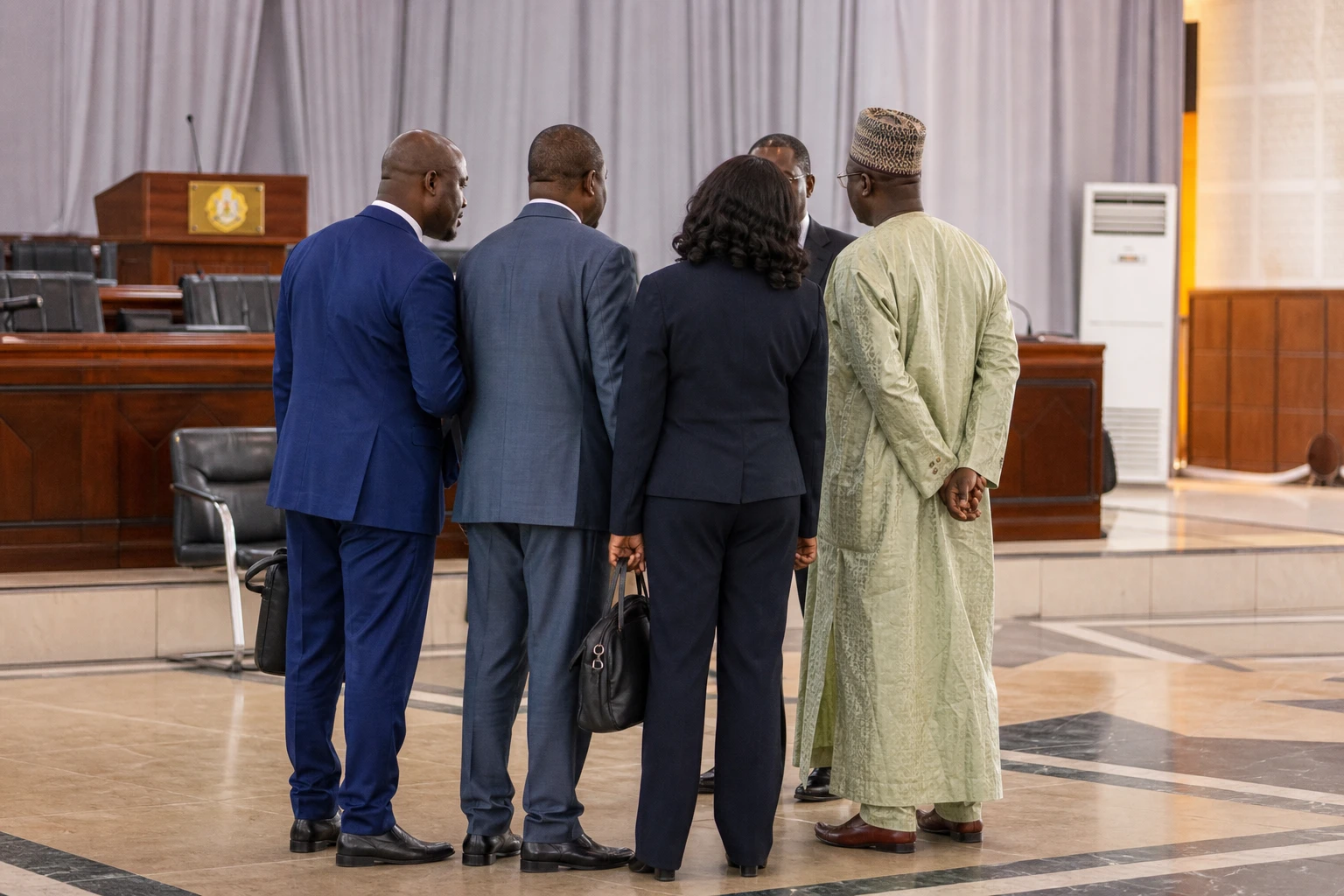
Conakry’s chamber returns after five years of transition
In Conakry, the People’s Palace has regained something Guinea had not had since the coup of 5 September 2021: a National Assembly elected at the ballot box. The signal is significant. It marks the return of an elected parliament, but it also says something else: Guinea’s transition is entering a phase in which the executive can no longer simply administer political life on its own.
This moment comes in a country whose institutional framework has changed in recent years. After the military seized power in 2021, legislative functions were exercised by the National Transitional Council, an unelected body set up to oversee the renewal of institutions. The period since then has included a new constitution, a presidential election in December 2025 and, now, the inauguration of an elected parliament.
A new political configuration, strongly favourable to the government
On Friday 17 July 2026, the 147 MPs officially took their seats in the National Assembly. The Supreme Court had validated the legislative election results on 20 June, confirming the composition of the future chamber. According to the African Press Agency (APA), the majority clearly belongs to parties supporting President Mamadi Doumbouya, with the movement backing him in a dominant position.
The National Assembly’s leadership was then appointed, with Dr Dansa Kourouma at its head. The secretariat, vice-presidencies and parliamentary groups were formed shortly afterwards. The first session of the new legislature therefore marks more than a simple ceremony: the institution has fully taken office.
The figures also offer a picture of the new chamber. APA says 18 women are among the elected list members, representing 36.73% of the seats concerned, and that five MPs are aged between 18 and 35. This is real progress in terms of representation, although the political dominance of a single camp currently limits the diversity of checks and balances.
What the return of an elected parliament changes
The return of an elected National Assembly does not resolve everything. But it closes an institutional chapter that began in 2021, when Guinea entered a military transition. Domestically, the stakes are clear: laws, the budget, scrutiny of government action and evaluation of public policy are once again at the heart of the institutional system. In practice, this could raise the state’s profile, particularly in a country where social expectations around public services, jobs and the redistribution of mining revenues are high.
But the impact will depend on the real balance of power. When an assembly is overwhelmingly aligned with the executive, it can speed up reforms. It can also narrow the space for debate and dissent. This matters all the more in Guinea, where the transition has been marked by a strong concentration of power, restrictions on some parties and a profound reshaping of the political landscape. Several observers have also highlighted in recent months the risk of an institutional structure dominated by a single force.
For ordinary Guineans, the stakes are not abstract. A functioning parliament can influence the cost of living, access to water, road management, healthcare and schools. It can also demand answers on the major modernisation programmes announced by the state. Conversely, if the chamber serves mainly to endorse political decisions, its practical impact will be more limited, both in Conakry’s neighbourhoods and in prefectures across the interior.
Conakry, ECOWAS and the return to constitutional order
Guinea’s political scene extends beyond its national borders. Guinea is a member of ECOWAS, the West African regional economic community, and its return to constitutional order is being closely watched in Abuja, Accra, Dakar and Abidjan. After the 2021 coup, the regional organisation suspended the country from its bodies, then supported the transition process under a negotiated timetable. In January 2026, the African Union, for its part, lifted Guinea’s suspension following the presidential election in December 2025.
The parliament’s inauguration therefore has regional political significance. It allows Guinea’s government to present the final piece of an institutional structure promised during the transition: a presidency, a government and a parliament. It also gives Conakry an argument for returning more firmly to diplomatic and African forums, at a time when West Africa remains divided between ECOWAS member states and countries in the Alliance of Sahel States.
The decisive question remains: will the return of elected institutions mark the start of genuine parliamentary oversight, or merely provide institutional validation for a power that is already consolidated? The answer will emerge over the coming months, as MPs consider legislation, the budget and the practical balance of power under Guinea’s Fifth Republic.