Algeria
 Egypt
 Libya
 Morocco
 Sudan
 Tunisia
 Benin
 Burkina Faso
 Cabo Verde
 Côte d'Ivoire
 Ghana
 Guinea-Bissau
 Liberia
 Mali
 Mauritania
 Niger
 Nigeria
 Senegal
 Sierra Leone
 The Gambia
 Togo
 Cameroon
 Central African Republic
 Chad
 DR Congo
 Equatorial Guinea
 Gabon
 Republic of the Congo
 São Tomé and Príncipe
 Burundi
 Comoros
 Djibouti
 Eritrea
 Ethiopia
 Kenya
 Madagascar
 Malawi
 Mauritius
 Mozambique
 Rwanda
 Seychelles
 Somalia
 South Sudan
 Tanzania
 Uganda
 Angola
 Botswana
 Eswatini
 Lesotho
 Namibia
 South Africa
 Zambia
 Zimbabwe
A detention that goes beyond the case of one magistrate
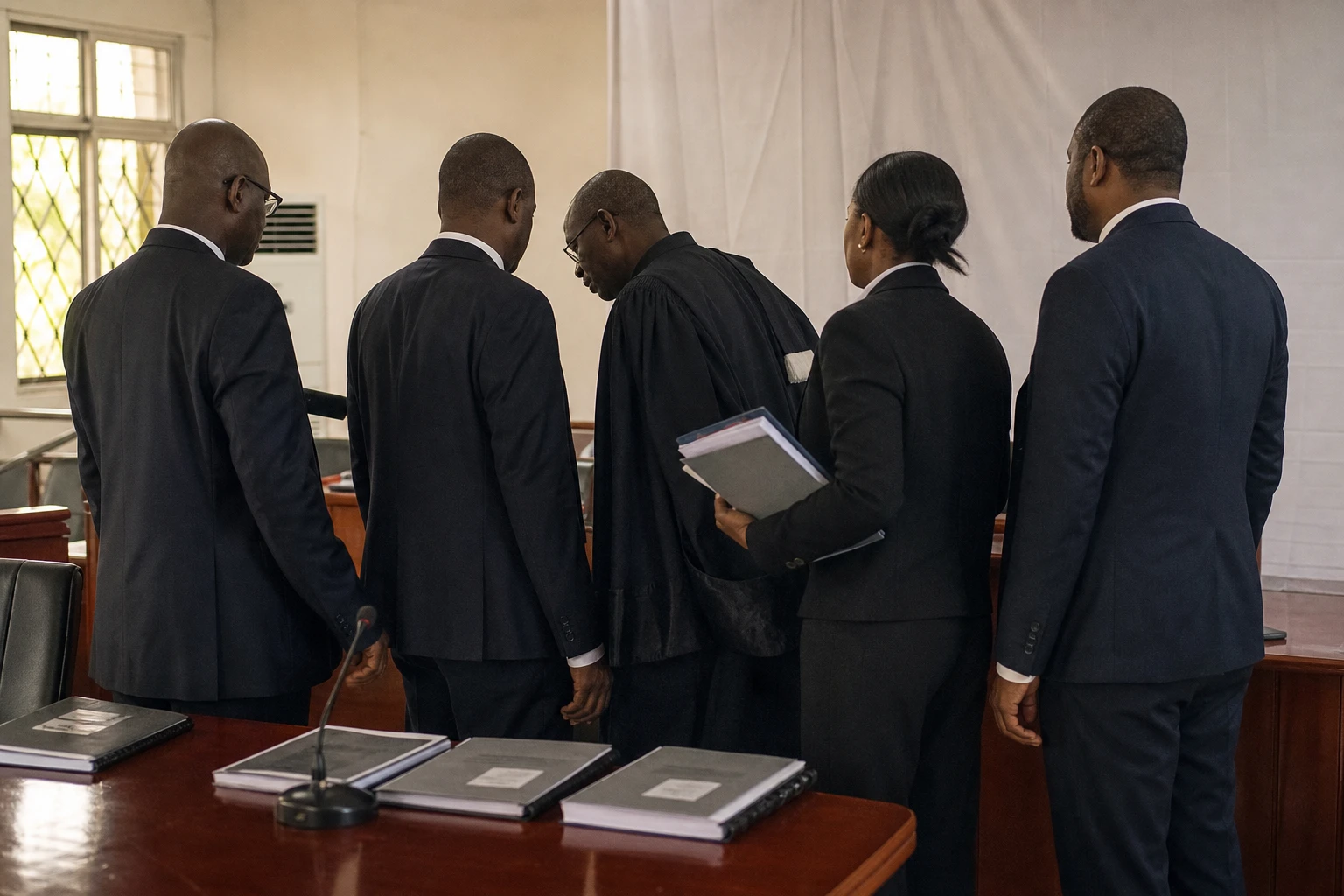
In Guinea, a judicial case raises a question broader than the fate of one man: where does institutional discipline end, and suspicion of political manipulation begin? In a country where the justice system remains a sensitive pillar of the transition, the case of Algassimou Diallo revives a familiar concern in Conakry and the regions: that proceedings must be clear, verifiable and protected from any partisan interpretation.
The case comes as Guinea has returned to the centre of West African affairs after the lifting, in January 2026, of the last ECOWAS sanctions. The Economic Community of West African States has fully readmitted the country to its decision-making bodies. This regional normalisation does not, however, resolve domestic disputes. On the contrary, it obliges the authorities in Conakry to show that institutional order is not just a matter of rhetoric, but is also embodied in the justice system and the treatment of detainees.
What the facts say about the transfer to Macenta
According to information published on 6 September 2026, Algassimou Diallo, a former magistrate recently dismissed from office, was first remanded in custody on 27 August 2026 at Coyah prison. He is charged with inciting discrimination, hatred or violence, discrimination and participation in a criminal association. On 5 September, he was transferred to Macenta prison, in the south-east of the country. The prison administration later explained the move as an administrative management measure.
The place of detention is no minor detail. Macenta is several hundred kilometres from Conakry, far from the country’s main judicial and political centre. For the defence, the move complicates contact with lawyers and family, particularly in a case already marked by concerns about the detainee’s whereabouts. Algassimou Diallo’s lawyers had said on 5 September that they no longer knew where he was after he was taken from his cell in Coyah.
At the heart of the case is also an audio recording attributed to a conversation between Algassimou Diallo and opposition figure Cellou Dalein Diallo, who is in exile. This alleged evidence prompted disciplinary proceedings, followed by legal proceedings. Several Guinean media outlets reported that the Supreme Council of the Judiciary had dismissed the magistrate following a disciplinary review linked to the case. The organic law governing the Supreme Council of the Judiciary gives it a central disciplinary role over magistrates.
What the case says about Guinea’s justice system
In Guinea’s institutional framework, the justice system is not merely a public service. It is also a measure of political trust. When a magistrate is dismissed, prosecuted and then transferred several hundred kilometres from the capital, the proceedings immediately become a test of transparency. The authorities have an interest in proving that each step has a clear legal basis, because any uncertainty fuels mistrust, especially at a time when the country is seeking to project a return to stability.
For citizens, the stakes are tangible. Detention far from Conakry can make visits more difficult, slow the defence and increase dependence on the prison administration. For lawyers, the question is straightforward: what is the precise basis for the transfer, and who is responsible for it? For the state, the risk runs in the opposite direction: turning a criminal case into a symbol of arbitrariness if the evidence, records and reasons for the transfer are not clearly set out.
The geography of the case also matters. Coyah, close to Conakry, allows judicial actors, families and lawyers to exercise more direct oversight. Macenta, by contrast, distances the detainee from the political and administrative centre. The choice may be presented as logistical. In public debate, it is also seen as a way of reducing attention on the case. That perception is not proof. But it shows how closely Guinea’s justice system remains subject to political scrutiny.
West African implications and scrutiny ahead
The case goes beyond Guinea because it is unfolding in a country still being watched by regional partners after the transition that began in 2021. ECOWAS did lift its last sanctions in January 2026, but it continues to monitor institutional balances across West Africa. In this context, every sensitive case sends a signal. It shows whether regional normalisation is accompanied domestically by a genuine strengthening of judicial safeguards.
The case also points to a broader question in West Africa: how can political-judicial disputes be handled without blurring the line between criminal prosecution and institutional score-settling? The answer is not decided in Conakry alone. It matters in Dakar, Abidjan, Bissau and Bamako, as well as wherever judicial systems are viewed as indicators of democratic stability. Proceedings seen as too opaque can undermine trust beyond national borders.
What happens next will depend on two very concrete points: the resumption of the trial, announced for 8 September 2026, and the authorities’ ability to document Algassimou Diallo’s detention, his access to his lawyers and the reasons for his transfer to Macenta. In a country that now wants to present itself as having returned to the regional fold, the strength of these answers will carry as much weight as the case itself.