Algeria
 Egypt
 Libya
 Morocco
 Sudan
 Tunisia
 Benin
 Burkina Faso
 Cabo Verde
 Côte d'Ivoire
 Ghana
 Guinea-Bissau
 Liberia
 Mali
 Mauritania
 Niger
 Nigeria
 Senegal
 Sierra Leone
 The Gambia
 Togo
 Cameroon
 Central African Republic
 Chad
 DR Congo
 Equatorial Guinea
 Gabon
 Republic of the Congo
 São Tomé and Príncipe
 Burundi
 Comoros
 Djibouti
 Eritrea
 Ethiopia
 Kenya
 Madagascar
 Malawi
 Mauritius
 Mozambique
 Rwanda
 Seychelles
 Somalia
 South Sudan
 Tanzania
 Uganda
 Angola
 Botswana
 Eswatini
 Lesotho
 Namibia
 South Africa
 Zambia
 Zimbabwe
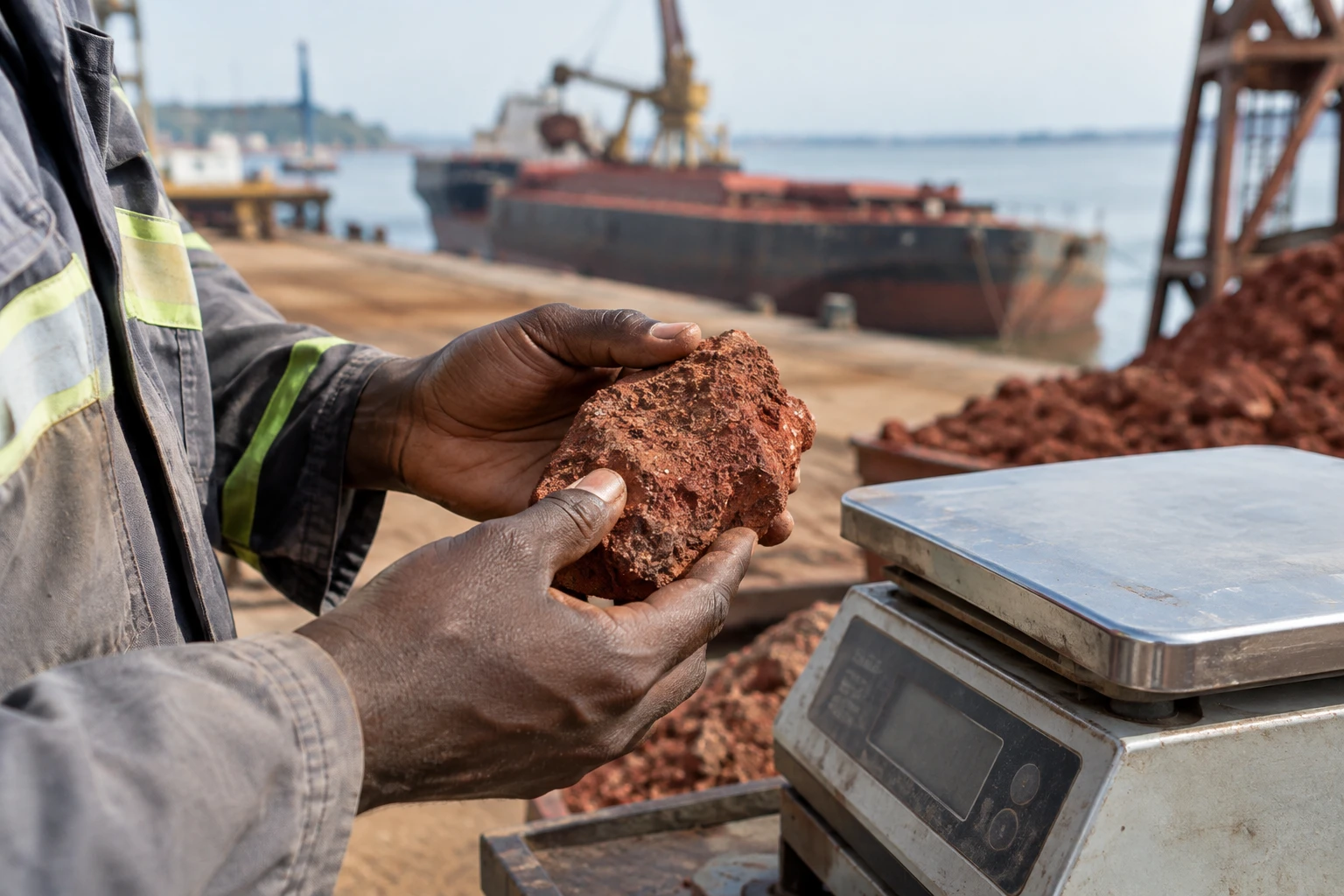
Guinean bauxite does not reach foreign markets by a single route. Between the mines of Boké and ships offshore, roads, railways, barges and ports form a logistics chain that affects costs, export volumes and the share of value retained in Guinea.
This system is becoming increasingly important. The country exported 182.8 million tonnes of bauxite in 2025, up 25% year on year, according to official data reported by Reuters and republished by Guinean media. Chinese customs, for its part, recorded 149 million tonnes from Guinea that same year. These figures confirm the importance of Chinese demand, but do not in themselves sum up the economic benefits for Guineans. Guinean bauxite export statistics for 2025 are consistent with the data reported by Reuters on exports and destinations.
Several routes link mines to the coast in Boké
In the country’s north-west, mining companies do not all share the same infrastructure. Some transport ore by train, others by truck. Several use both. The choice depends on the location of deposits, available equipment and access to maritime terminals.
The Compagnie des bauxites de Guinée (CBG), for example, transports ore from Sangarédi to Kamsar on a railway line of about 135 kilometres. Nimba Mining Company (NMC), a Guinean state-owned mining company, also relies on rail to reach Kamsar. The Société minière de Boké (SMB), meanwhile, uses a railway link between the Santou and Houda deposits and the Dapilon terminal, which was commissioned in 2021 according to information available on its infrastructure.
The road network remains crucial too. On 4 November 2026, NMC announced an agreement with the National Agency for the Development of Mining Infrastructure (ANAIM) to access a shared 56-kilometre mining road to Dapilon. This access supplements its railway link to Kamsar. The agreement broadens the company’s transport options and could reduce its dependence on a single corridor. Details announced about NMC’s new road access attribute the agreement to the company and ANAIM.
Barges before the large ships
On reaching the coast, ore is not always loaded directly onto an ocean-going vessel. At Kamsar, CBG prepares the bauxite before sending it by conveyor belt to a jetty. Other operators tip it into barges. These carry it to an area where floating cranes load large bulk carriers, some capable of carrying nearly 180,000 tonnes.
This transshipment system makes it possible to ship ore from river or coastal terminals that cannot be accessed directly by the largest vessels. It nevertheless depends on a succession of operations: extraction, inland transport, port handling, barge navigation and offshore loading. Each stage involves different infrastructure and operators. An interruption or insufficient capacity at any one link can slow the entire chain.
Nationally, the development of mining corridors is part of a broader trajectory in which the state is seeking to strengthen its control over resources and secure more local investment. In 2025, the authorities stepped up pressure on some companies to meet their obligations and move towards processing bauxite locally. Work on the first alumina refinery announced by China’s SPIC was officially launched in March 2025, according to Guinea’s Ministry of the Budget. The Guinean government describes SPIC’s refinery project as a step towards local processing.
The challenge: turning volumes into lasting value
Higher exports can increase mining revenues and activity around ports, railways and roads. But export volumes alone do not show what share of the value goes to the public purse, Guinean companies or communities near the sites. The effects vary by area: mining zones directly bear the passage of convoys and the impact of extraction, while Conakry concentrates some public decision-making and economic services.
Maritime transport is another issue alongside processing. In 2025, the state announced the creation of Guinéenne des transports maritimes (Guitram), with the aim of taking part in transporting minerals under the Guinean or an equivalent flag. Between 23 June and 1 July 2026, the Société guinéenne du patrimoine minier (Soguipami) held talks in China with COSCO Shipping Bulk about possible co-operation. Soguipami describes these discussions as a move towards national maritime capacity; they do not in themselves prove that Guitram already has an operational fleet. Soguipami’s account of its mission to China describes the talks with COSCO and the ambition behind Guitram.
This ambition responds to a concrete issue: freight is an additional activity in a chain where Guinea supplies the ore, but some transport and processing services may be provided by external operators. Control of these stages will depend on investment, commercial agreements, available infrastructure and the skills deployed. The announcement of a company does not yet guarantee an independent transport capacity.
A Guinean issue that extends beyond its borders
Guinea’s role in supplying China gives its logistics choices regional significance. Mining corridors connect the country’s interior to the Atlantic coast, while Asian demand influences investment and trade flows. For other West African countries, the case highlights the importance of shared infrastructure and the rules governing access to railways, roads and ports.
What happens next will depend on very practical decisions: the effective commissioning of new access routes, the progress of port and railway projects, the development of refineries and Guitram’s ability to move from ambition to actual transport. Conakry’s challenge is therefore not simply to get more bauxite out of the country. It is also to determine who controls the corridors, who provides the services and how much economic value stays in the country.