Algeria
 Egypt
 Libya
 Morocco
 Sudan
 Tunisia
 Benin
 Burkina Faso
 Cabo Verde
 Côte d'Ivoire
 Ghana
 Guinea-Bissau
 Liberia
 Mali
 Mauritania
 Niger
 Nigeria
 Senegal
 Sierra Leone
 The Gambia
 Togo
 Cameroon
 Central African Republic
 Chad
 DR Congo
 Equatorial Guinea
 Gabon
 Republic of the Congo
 São Tomé and Príncipe
 Burundi
 Comoros
 Djibouti
 Eritrea
 Ethiopia
 Kenya
 Madagascar
 Malawi
 Mauritius
 Mozambique
 Rwanda
 Seychelles
 Somalia
 South Sudan
 Tanzania
 Uganda
 Angola
 Botswana
 Eswatini
 Lesotho
 Namibia
 South Africa
 Zambia
 Zimbabwe
In Guinea, agricultural mechanisation is entering a more structured phase. The challenge is no longer simply to import a few tractors, but to build an ecosystem capable of supplying machinery, spare parts, technicians and services suited to the realities of farms.
This development is part of a national modernisation strategy. It is also taking place in a West African region where governments are seeking to address equipment shortfalls, improve yields and gain greater control over agricultural value chains.
Pilot project ahead of industrial operation
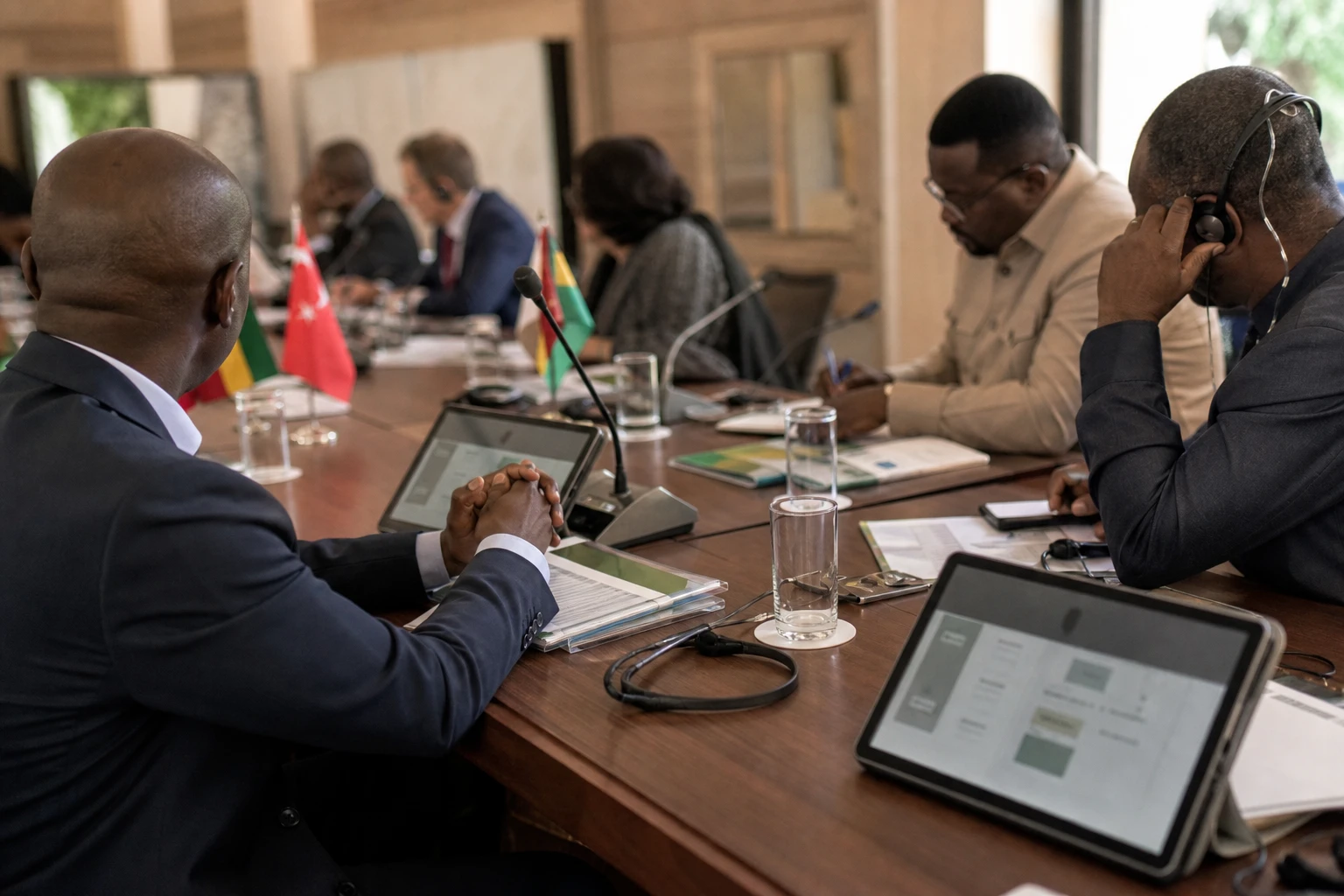
Turkish group Albayrak began discussions with Guinea’s Ministry of Agriculture and Livestock on Tuesday 29 September 2026. The talks concern an agricultural mechanisation project intended to support the transformation of the sector in Guinea.
According to information released by the ministry, the first phase is expected to take the form of a pilot project. It would include agricultural equipment, an after-sales service system and training for users. These three components are essential, because a tractor left idle for lack of a spare part or technician quickly loses its value to a farm.
Albayrak is also considering the eventual establishment of an agricultural equipment assembly plant in Guinea. The project would emphasise technology transfer and the development of local skills. At this stage, however, no detailed timetable or final investment has been made public.
The Turkish group already has an initial foothold in the country. Under the Presidential Initiative to Support Agricultural Mechanisation, it supplied the Guinean authorities with 75 tractors and accessories. The equipment was handed over in June 2026 to support agricultural professional organisations. Information published by Albayrak Guinea describes the operation as a public-private partnership linked to the country’s agricultural modernisation ambitions.
Guinea seeks to move beyond simply buying machinery
For Conakry, the central issue is now the long-term availability of equipment. A mechanisation policy is not measured simply by the number of tractors delivered. It also requires complementary equipment, trained operators, maintenance workshops and reliable access to spare parts.
The government has therefore discussed with the Arab Bank for Economic Development in Africa (BADEA) a credit line dedicated to purchasing agricultural equipment. A credit line is financing that can be drawn on under conditions set in advance to buy goods or support a specific programme.
According to Guinea’s Ministry of Agriculture, discussions on 6 May 2026 also covered the creation of a tractor assembly plant. Its proposed capacity would reach 200 units in the first year. The project would also include access to seed drills, harvesters and power tillers, as well as training for farmers. The report published by the Ministry of Agriculture places these measures within preparations for the 2026-2027 agricultural season and the Simandou 2040 vision.
This approach reflects a change in method. The state is seeking to link investment in equipment to producers’ practical needs. In rice-growing areas, machinery can reduce the time spent ploughing and transplanting. In market-gardening regions, power tillers and irrigation systems can make it easier to prepare plots. However, effective access will depend on prices, rental arrangements and the ability of farmers’ organisations to use machinery collectively.
A limited fleet still heavily reliant on imports
The small size of the existing fleet explains the interest in local assembly. A study of agricultural mechanisation in Guinea counted 3,818 tractors in 2018. It also said that all had been imported and that a significant proportion of the fleet had become obsolete.
These figures need to be considered in context. The number of tractors alone is not enough to measure actual mechanisation. Their condition, geographical distribution, utilisation rate and accessibility to small farms must also be taken into account.
The concentration of equipment around Conakry or major administrative centres could limit the programme’s impact. Producers in Upper Guinea, Forest Guinea, Middle Guinea and Maritime Guinea do not have the same agricultural calendars or needs. The transport of machinery, terrain and the condition of tracks will also affect the cost of services.
An assembly plant would not immediately eliminate reliance on foreign suppliers. Engines, transmissions, hydraulic systems and electronic components would probably still be imported at first. However, local assembly could shorten some lead times, help build up stocks of spare parts and create jobs in maintenance, logistics and technical training.
West African competition over agricultural equipment
Guinea is not alone in seeking industrial partners in this sector. In Senegal, the authorities announced on 27 August 2025 a project for a tractor and agricultural equipment assembly plant involving Albayrak, Türk Eximbank and several Senegalese companies.
The Senegalese project also includes maintenance, spare-parts supply and training. It initially targets the domestic market, with ambitions to serve the region. Available details of the Senegalese project show that competition between West African countries is now centred as much on services as on machinery sales.
This dynamic has direct implications for ECOWAS, the Economic Community of West African States. The movement of equipment, spare parts and skills could become a factor in regional co-operation. It could also intensify competition between national hubs if each country favours a closed market and separate imports.
Farmers’ access will be the real test
For the Guinean authorities, the project’s success will depend on its ability to reach farms, not just institutions or large operators. Large producers and agribusiness companies generally have greater investment capacity. Small farms, by contrast, will need rental services, machinery-use co-operatives or services charged per hectare.
Training will be just as important. A poorly trained operator can accelerate wear on a machine, increase fuel consumption or damage soils. Mechanisation must therefore be adapted to crops, farm sizes and local conditions. It cannot be conceived as simply replacing human labour with machines.
The ambitions of the Simandou 2040 programme add further pressure. The project notably envisages the development of 200,000 hectares of agricultural zones. If these areas are gradually brought into production, demand for tractors, seed drills, harvesters, irrigation systems and maintenance services will rise sharply.
The next step will be to clarify the financing, location, distribution model and timetable for the pilot project. For Guinea, the challenge goes beyond the arrival of a new foreign operator. The question is whether mechanisation can become a productive industry that creates skills and is accessible to farmers in the country’s different regions.