
 Algeria
 Egypt
 Libya
 Morocco
 Sudan
 Tunisia
 Benin
 Burkina Faso
 Cabo Verde
 Côte d'Ivoire
 Guinea
 Guinea-Bissau
 Liberia
 Mali
 Mauritania
 Niger
 Nigeria
 Senegal
 Sierra Leone
 The Gambia
 Togo
 Cameroon
 Central African Republic
 Chad
 DR Congo
 Equatorial Guinea
 Gabon
 Republic of the Congo
 São Tomé and Príncipe
 Burundi
 Comoros
 Djibouti
 Eritrea
 Ethiopia
 Kenya
 Madagascar
 Malawi
 Mauritius
 Mozambique
 Rwanda
 Seychelles
 Somalia
 South Sudan
 Tanzania
 Uganda
 Angola
 Botswana
 Eswatini
 Lesotho
 Namibia
 South Africa
 Zambia
 Zimbabwe
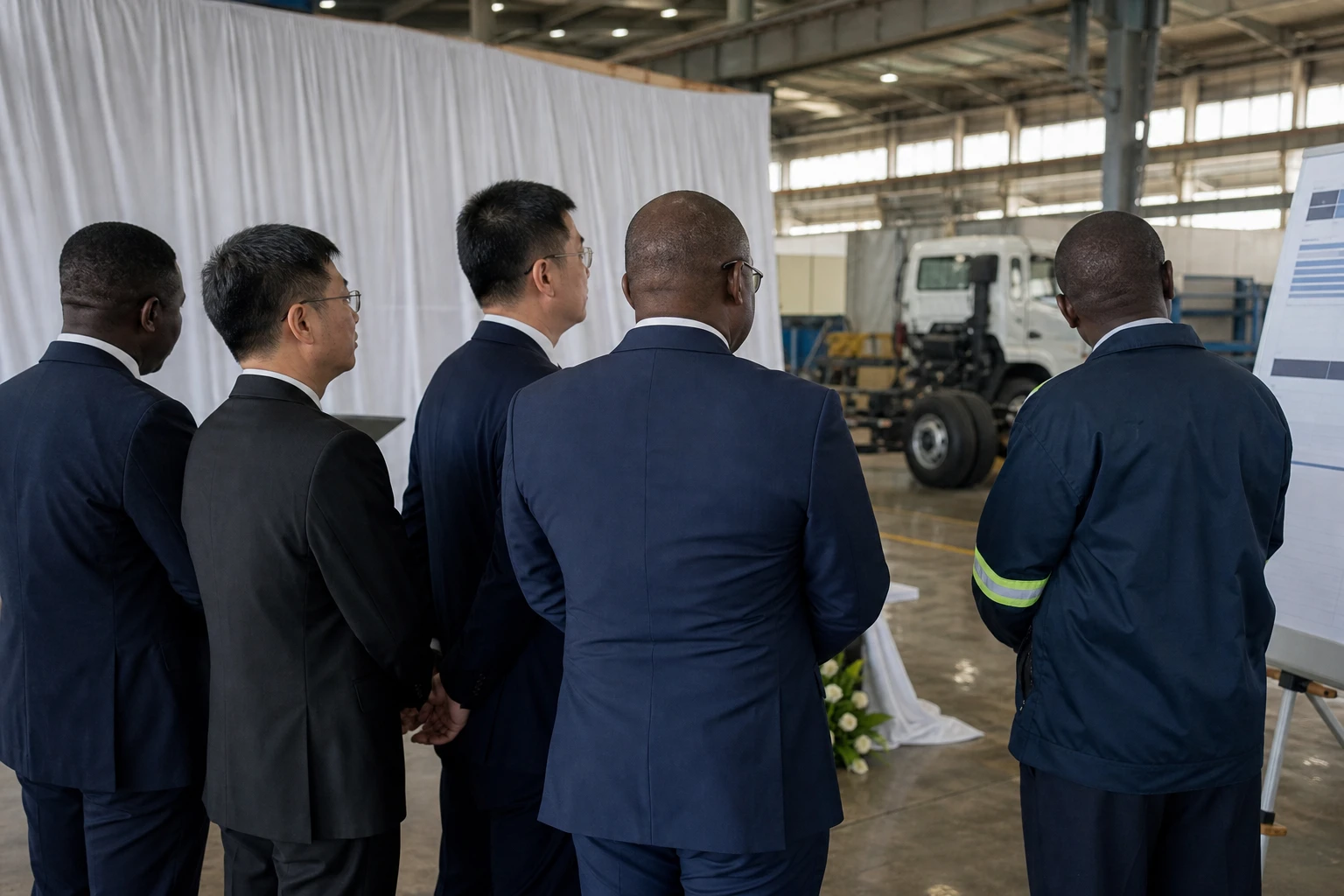
In Tema, the car industry is a test of industrial credibility
In Ghana, every new assembly line now tells a story that goes beyond simply ramping up production. It shows whether the country can turn imports into jobs, ports into workshops, and public policies into real output. In Tema, in the Greater Accra Region, the question is straightforward: does Ghana want to remain a vehicle market, or become a country that makes some of what it consumes?
This question forms part of a broader trajectory. Since 2019, the Ghana Automotive Development Policy has regulated local assembly, with SKD, ESKD and CKD categories, and tax incentives designed to attract investors while strengthening the national value chain. The country is also seeking to capitalise on the African Continental Free Trade Area Agreement, whose secretariat is based in Accra, to make the regional market a natural outlet.
What Zonda Tec’s expansion changes
On 15 September 2026, President John Dramani Mahama inaugurated phase III of the Zonda Tec Ghana Limited site in Tema. Ghanaian official sources and the national news agency GNA describe an expansion of industrial capacity, with an announced capacity of around 3,000 heavy and light vehicles a year, following phased development over several years. Other reports have cited a higher figure of 12,000 units a year for the project as a whole, but the figure best corroborated by official sources available at that date remains around 3,000 vehicles for phase III.
The distinction matters. In the car industry, stated capacity does not tell the whole story. It must be weighed against actual production rates, order books, imported inputs, the availability of local parts and the cost of financing. Zonda Tec already assembles heavy and light vehicles, including dump trucks, trailers, semi-trailers and tankers. The announced move upmarket should therefore be seen as a sign of consolidation, not automatic proof of structural transformation.
President Mahama used the inauguration to set out a clear position: Ghana must no longer be content with assembling vehicles from imported parts. He wants a more complete local supply chain, with components produced locally, Ghanaian technical services and more added value retained in the country. The parts in question are well known: batteries, tyres, wiring, seats, glass, plastics and metal components. This is where the difference between an assembly economy and an industrial economy lies.
The government has been making the same argument for several months. In July 2025, the executive formally launched the 24-Hour Economy initiative, presented as a means of enabling continuous production, employment and industrial logistics. The authorities place the car industry alongside textiles, pharmaceuticals and agro-industry: sectors capable of creating skilled jobs, as well as indirect employment among subcontractors, transport operators, technicians and service providers.
A sector driven by policy, but held back by the local supply chain
Ghana is not starting from scratch. The country already has a small group of assemblers, with Volkswagen, Toyota, Nissan, Suzuki, KIA, Mahindra and local players such as Kantanka mentioned in public statements and national reports. The state has supported this momentum through tax exemptions and a regulatory framework designed to attract global brands. But the challenge has remained the same since the programme began: assembling more is not enough if parts, batteries and equipment are still largely imported.
That is why the Zonda Tec development goes beyond the case of a single company. It highlights a fundamental struggle over Ghana’s industrial base. On one side, major foreign investors bring technology, capital and commercial networks. On the other, the government wants Ghanaian companies to enter component supply, maintenance and training, and eventually the manufacture of sub-assemblies. Without this next layer, added value remains incomplete and the most technical jobs stay concentrated upstream, outside the country.
The macroeconomic context also helps explain the executive’s urgency. Ghana is emerging from a difficult period of stabilisation, but the recovery is real. The IMF said real gross domestic product grew by 6% in 2025, with growth accelerating at the start of 2026, while Ghanaian authorities have stressed the gradual return of investor confidence. Against this backdrop, factories opening in Tema are being used as tangible evidence of industrial revival, beyond public finance figures.
West African significance far beyond a production site
For West Africa, the stakes are twofold. First, Ghana is seeking to position itself as a manufacturing base for the ECOWAS sub-region, where demand for utility vehicles, trucks and construction equipment remains strong. Second, the country wants to benefit from AfCFTA, the continental agreement intended to facilitate intra-African trade, and sell beyond its immediate borders. From this perspective, every factory in Tema also serves as a political showcase: it demonstrates that a country in the region can capture a share of global value chains.
But competition is fierce. Morocco and South Africa have more developed automotive ecosystems, while Rwanda and Kenya have also attracted assembly projects. Ghana must therefore go further than announcing capacity or holding an inauguration. It needs subcontractors, technical schools, reliable access to energy, quality standards and, above all, regional markets. Only then can local assembly become an industry rather than an enclave.
For Ghanaian households, the impact will be measured by vehicle prices, parts availability and the jobs actually created. For local businesses, the stakes are broader: entering a market that is initially protected, then becoming competitive across the region. For the state, the test will ultimately be one of coherence. If industrial policy, taxation, training and infrastructure advance together, Ghana can consolidate a genuine West African automotive hub. Otherwise, growth in the sector will remain visible but incomplete.



