Algeria
 Egypt
 Libya
 Morocco
 Sudan
 Tunisia
 Benin
 Burkina Faso
 Cabo Verde
 Côte d'Ivoire
 Guinea
 Guinea-Bissau
 Liberia
 Mali
 Mauritania
 Niger
 Nigeria
 Senegal
 Sierra Leone
 The Gambia
 Togo
 Cameroon
 Central African Republic
 Chad
 DR Congo
 Equatorial Guinea
 Gabon
 Republic of the Congo
 São Tomé and Príncipe
 Burundi
 Comoros
 Djibouti
 Eritrea
 Ethiopia
 Kenya
 Madagascar
 Malawi
 Mauritius
 Mozambique
 Rwanda
 Seychelles
 Somalia
 South Sudan
 Tanzania
 Uganda
 Angola
 Botswana
 Eswatini
 Lesotho
 Namibia
 South Africa
 Zambia
 Zimbabwe
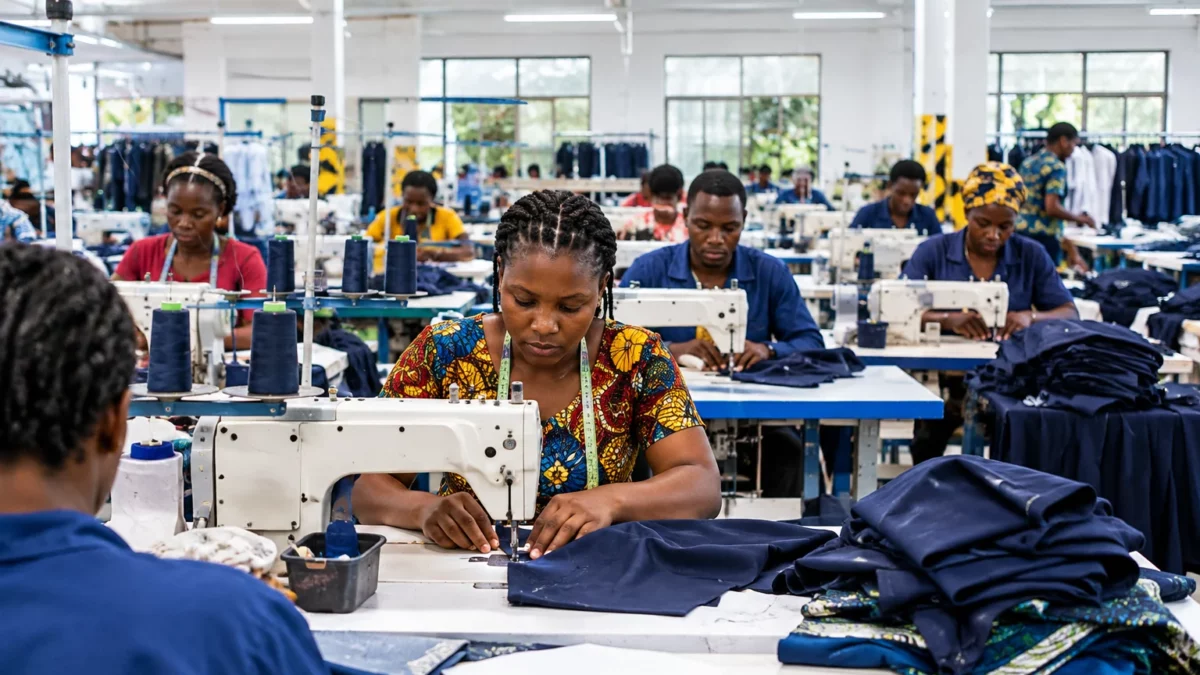
Reviving a textile industry takes more than reopening workshops. It also requires reliable electricity and water, orders and access to raw materials. Ghana plans to address these links in the supply chain, as well as the factories themselves, through a $1bn programme announced for 2027-2030.
Rebuilding an industry across the supply chain
Presented to Parliament on 12 November 2026 by Finance Minister Cassiel Ato Forson, the funding is the sixth pillar of the government’s “The New Economy, New Ghana” programme. The initiative plans $10bn of investment over four years across eight sectors, including agriculture, energy, pharmaceuticals and textiles. The official budget document confirms the funding envelope and its broad priorities.
The project aims to modernise spinning mills and textile plants, expand garment-making capacity and develop industrial zones. These are to bring together serviced land, electricity supply, industrial water, effluent treatment, laboratories and warehouses. The government also plans to provide equipment and technical support for designers, tailors and dressmakers, whose businesses are often small enterprises.
The funding is to combine public funds, private capital and development partners. The state is expected to prepare land and shared infrastructure. Private companies are being called on to build and operate the factories, while development institutions could provide concessional loans, guarantees and expertise. The official timetable envisages site selection in 2027, the start of shared infrastructure works in 2028, and capacity expansion and initial export steps before 2030.
The budget also plans to change public procurement rules. Uniforms, hospital textiles, bedding and protective clothing for public institutions are to be bought from Ghanaian manufacturers. This would make the state a lead buyer. Its impact, however, will depend on prices, quality, delivery times and local companies’ ability to fulfil contracts.
Plans confront documented industrial decline
The scale of the challenge is clear from production trends. A study published in 2025 in the journal Discover Global Society estimates that fabric production fell from about 130 million yards in 1977 to 65 million in 2000, then to 15 million in 2017. It reports that by the latter date only three industrial manufacturers remained in operation, using about 5% of their capacity. These figures refer to fabric production, not the entire sewing or garment-making sector.
Weak industrial demand remains another obstacle. In May 2026, the Ghana Garment Manufacturers Association said several factories were operating at less than 40% of capacity because of a lack of orders. It estimated Ghana’s annual clothing imports at more than $200m. These estimates come from the industry body and should be treated as such; they nevertheless illustrate the gap between available capacity and the markets accessible to producers.
The sector is not starting from scratch. In April 2025, Trade, Agribusiness and Industry Minister Elizabeth Ofosu-Adjare announced three garment factories in the Bono East, Central and Eastern regions. The project was linked to the potential creation of 27,000 direct jobs, a figure announced by the government rather than an outcome already achieved. The 2027 budget says that land has been secured and feasibility studies are under way.
The industrial framework has also taken shape. Cabinet approved a policy on textile and garment manufacturing in June 2026. In Juapong, in the Volta Region, President John Mahama announced in July the selection of a strategic investor to restart Volta Star Textiles. Ghana’s presidency says the factory could initially source cotton from Benin. This prospect underscores how a national revival also depends on regional supply chains.
Orders, jobs and purchasing power
A local procurement policy could give workshops more predictable demand, particularly for school uniforms and hospital supplies. It could support factory payroll jobs as well as small suppliers, transport operators and self-employed workers. The zero VAT rate on textiles made locally by approved producers has, meanwhile, been extended until December 2028, according to measures outlined in the sector programme.
Success, however, will not be measured by the amount announced alone. It will be necessary to establish how much funding is actually mobilised, what share comes from the public budget, which investors commit and how quickly infrastructure is delivered. The authorities will also need to report on the jobs genuinely created, their stability and working conditions. Garment workshops cannot grow sustainably if fabric, equipment or energy remain too costly.
The debate also affects consumers and informal-sector traders. More competitive local production could broaden the range of goods available, but imported and second-hand clothing play an important role in Ghanaian markets, particularly because of their affordability. Replacing them with domestic products therefore depends on more than public procurement rules: manufacturers will need to offer goods suited to buyers’ budgets and preferences.
A stake for ECOWAS and the AfCFTA
For Ghana, a member of the Economic Community of West African States (ECOWAS), a textile revival could extend beyond the domestic market. Factories able to produce at scale could target buyers across the sub-region and then benefit from the African Continental Free Trade Area (AfCFTA), which aims to facilitate trade between African countries. But this prospect depends on controlled costs, compliance with standards and reliable logistics networks.
The timetable for the coming years will therefore be decisive: selecting sites and investors in 2027, starting infrastructure work in 2028, then gradually bringing capacity online. The case of Volta Star is a reminder that announcing a partner is not enough to guarantee a factory’s restart. For workers, businesses and communities beyond Accra, the real test will be turning budgets and projects into regular orders, actual production and lasting jobs.
Sources consulted: Ghanaian Finance Ministry’s 2027 budget ; 2027-2030 implementation programme ; study on the evolution of Ghana’s textile industry ; Ghana News Agency on garment manufacturers and local procurement ; Ghana News Agency on the three planned factories ; Ghanaian presidency on Volta Star Textiles.