Algeria
 Egypt
 Libya
 Morocco
 Sudan
 Tunisia
 Benin
 Burkina Faso
 Cabo Verde
 Côte d'Ivoire
 Guinea
 Guinea-Bissau
 Liberia
 Mali
 Mauritania
 Niger
 Nigeria
 Senegal
 Sierra Leone
 The Gambia
 Togo
 Cameroon
 Central African Republic
 Chad
 DR Congo
 Equatorial Guinea
 Gabon
 Republic of the Congo
 São Tomé and Príncipe
 Burundi
 Comoros
 Djibouti
 Eritrea
 Ethiopia
 Kenya
 Madagascar
 Malawi
 Mauritius
 Mozambique
 Rwanda
 Seychelles
 Somalia
 South Sudan
 Tanzania
 Uganda
 Angola
 Botswana
 Eswatini
 Lesotho
 Namibia
 South Africa
 Zambia
 Zimbabwe

Coverage alone is not enough
In Ghana, the question is no longer just about installing masts. It is now about ensuring that connectivity genuinely serves people in rural areas, from pupils and small traders to farmers and users of public services. In a country where a significant share of the population lives outside major cities, the stakes are not merely symbolic: they affect education, healthcare, payments, administrative procedures and the flow of information. The World Bank puts Ghana’s rural population at around 41%, which gives an idea of the scale of the task.
This issue is also part of a broader trend in West Africa, where ECOWAS has been promoting digital integration for several years, even as gaps in coverage and usage remain marked between capitals, secondary cities and rural areas. In Accra, pressure comes from urban congestion and growing demand for data. In rural districts, the problem is easier to describe but harder to solve: networks are needed, but so are affordable devices, reliable electricity and useful services.
Ghana’s government wants to bring rural areas up to 4G
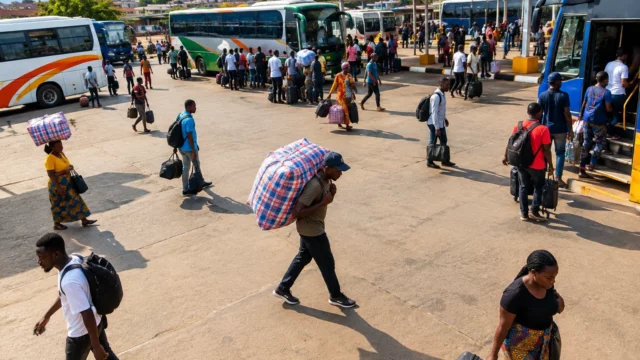
Ghana’s Minister for Communications, Digital Technology and Innovation, Samuel Nartey George, has announced that all sites under the rural programme will gradually be upgraded to support 4G. The announcement came after an inspection tour of several communities in the Eastern Region, including Dumpong, Nkumkrom, Nsakye and Obosono, as well as Koforidua bus station. The minister said 2G and 3G networks were no longer sufficient at a time when 5G and 6G technologies were being rolled out elsewhere.
The project is not starting from scratch. Ghana has for several years pursued a rural telephony and digital inclusion policy through GIFEC, the public fund tasked with extending access to electronic communications. In February 2024, the authorities said 1,010 rural sites had been completed. The new goal is therefore less about going back to square one than modernising an existing network, so that infrastructure built for voice and 3G does not fall behind the market.
The real obstacle often lies in usage
Better coverage does not guarantee adoption. That is the central point of the debate in Ghana. The GSMA notes that, in sub-Saharan Africa, the median price of an entry-level smartphone is still $39, a substantial cost for low-income households. Across the region, this price accounts for a large share of income on average, with a greater impact on women and the poorest households. In other words, a 4G mast is not enough if the phone remains out of reach.
Available data on Ghana show that mobile use is already widespread, but not necessarily through the latest smartphones or 4G. The World Bank Blog, drawing on data from Ghana’s census, notes that internet access has risen sharply, but the rural-urban gap remains clear. It also says that about 68% of internet access in the country is through smartphones, confirming the central role of phones in everyday connectivity. Yet this tells us nothing about the quality of devices or their compatibility with the latest networks.
The cost of services is also a barrier. The International Telecommunication Union says that the cost of data services remains one of the main obstacles to connectivity. Its benchmark for “affordable” access is that basic plans should cost no more than 2% of gross national income per capita. But the ITU’s 2025 data show that Ghana remains above this benchmark for mobile and fixed baskets, meaning that prices have yet to fall to levels that meet the needs of the most vulnerable households.
Practical uses can turn networks into value
This is the crux of the matter: 4G only makes sense if it changes everyday life. In rural areas, that means easier access to online lessons, agricultural platforms, healthcare services, digital payments and administrative procedures. When these services are unavailable or poorly adapted, connectivity remains a cost. When they are useful and reliable, it becomes a tool for income, learning and economic integration. This is particularly relevant in Ghana, where mobile money has already transformed payment practices in several regions.
The digital challenge is also a social one. Gaps in digital skills can hinder use, even when a signal is available. In rural areas, the smallest breakdown, power cut or drop in speed has an immediate effect. For a rural family, a slow connection is not a technical detail; it is an extra expense and sometimes a broken promise. For the state, by contrast, network upgrades can reduce the costs of distance and extend the reach of public services.
The implications extend beyond Ghana
Ghana is in effect testing a question relevant to much of the continent: how to move from coverage to meaningful use. The ITU says affordability remains one of the main barriers to connectivity, despite the progress made over the past decade. In several African countries, network coverage is expanding faster than device purchases, digital literacy and the production of local content. This gap explains why telecoms policies can no longer focus solely on masts and frequencies.
For Ghana, what comes next will be a matter of policy and budgets. The proposal still has to go through a ministerial review before being submitted to cabinet, while operators will have to follow through on the ground in areas where investment yields little in the short term. At regional level, Ghana could serve as a model in West Africa if rural upgrades are matched by access that people can genuinely use. The message is clear: in Africa’s digital economy, the battle is no longer just about coverage. It is about people’s ability to use it at an affordable cost, from Accra to the most remote communities.