
 Algeria
 Egypt
 Libya
 Morocco
 Sudan
 Tunisia
 Benin
 Burkina Faso
 Cabo Verde
 Côte d'Ivoire
 Guinea
 Guinea-Bissau
 Liberia
 Mali
 Mauritania
 Niger
 Nigeria
 Senegal
 Sierra Leone
 The Gambia
 Togo
 Cameroon
 Central African Republic
 Chad
 DR Congo
 Equatorial Guinea
 Gabon
 Republic of the Congo
 São Tomé and Príncipe
 Burundi
 Comoros
 Djibouti
 Eritrea
 Ethiopia
 Kenya
 Madagascar
 Malawi
 Mauritius
 Mozambique
 Rwanda
 Seychelles
 Somalia
 South Sudan
 Tanzania
 Uganda
 Angola
 Botswana
 Eswatini
 Lesotho
 Namibia
 South Africa
 Zambia
 Zimbabwe
An Atlantic route that changes the equation
Between Accra and Kingston, the stakes go beyond a simple trade announcement. The aim is to turn a historic relationship, shaped by the diaspora and the memory of the transatlantic slave trade, into a practical route for goods, services and people. Ghana is not merely seeking to engage with the Caribbean world. It also wants to reach it through ports, planes and jobs.
In this initiative, Tema matters as much as Kingston. Ghana’s port is the country’s largest and one of the main logistical engines on the West African coast. Ghanaian maritime authorities also present it as a strategic hub for a smoother and faster economy. At the same time, Kingston remains a major gateway to the English-speaking Caribbean. Bringing these two platforms closer therefore gives regional reach to cooperation that had until now remained largely diplomatic.
What the two governments have actually put on the table
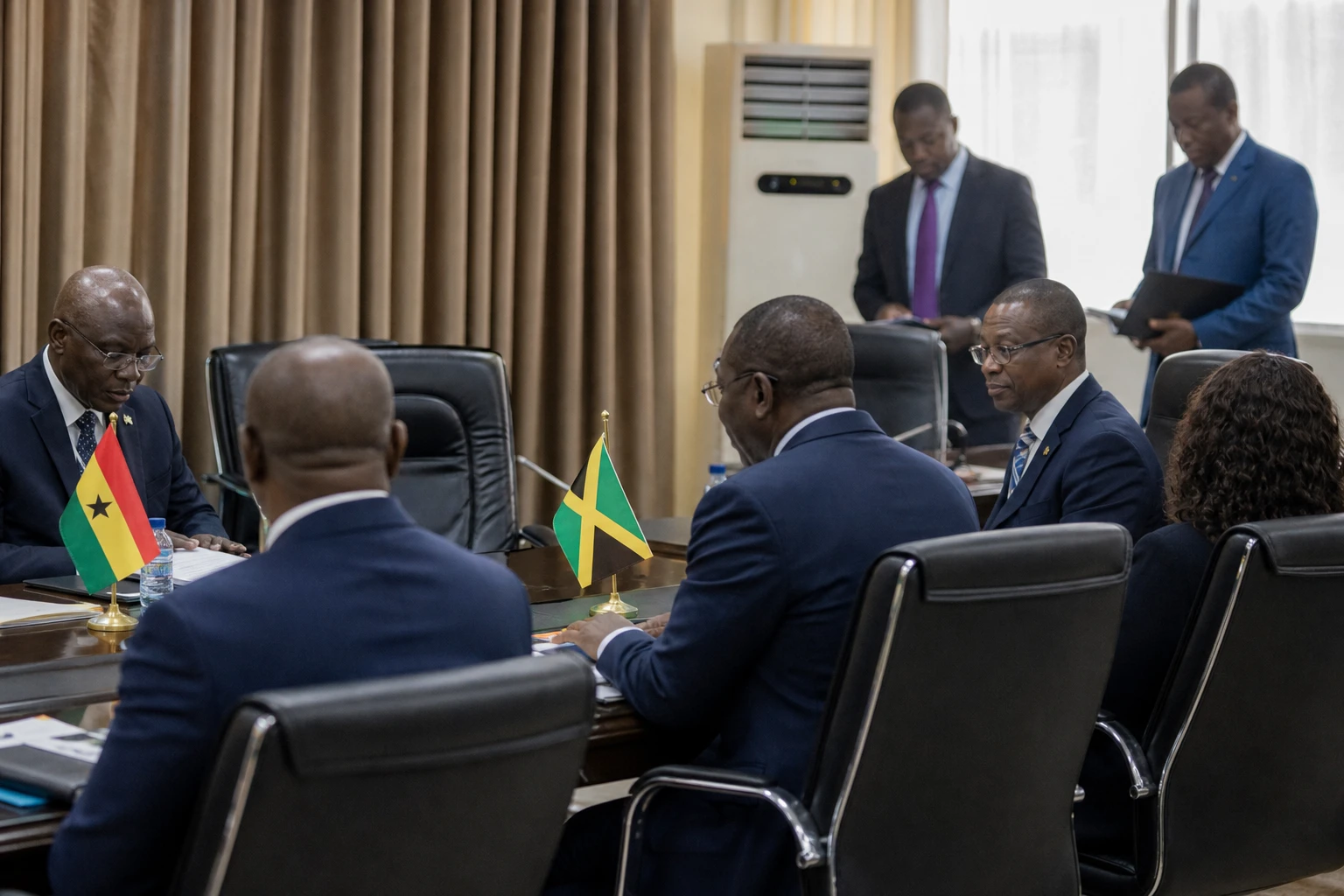
The most substantive developments took place in Accra, at the third session of the Ghana–Jamaica Permanent Joint Commission, held on 26 May 2026 after a 21-year interruption. The two countries relaunched more structured cooperation, with agreements on health and defence, as well as a broader agenda covering trade, air services, culture and education. Ghana’s Ministry of Foreign Affairs subsequently confirmed that a group of Ghanaian health professionals was due to travel to Jamaica from June 2026 under a framework described as voluntary and regulated.
It was in this context that the idea of a maritime corridor between Tema and Kingston was announced, with a timetable pointing to a launch by 2027. At this stage, the term refers less to an established route than to a structure still to be built: coastal shipping, port agreements, customs facilitation, insurance, warehousing and volumes to be secured. In other words, drawing a route on a map is not enough. It must also be made economically viable.
The project is also part of a broader relationship based on mobility. Ghana and Jamaica are working on a direct air link, the opening of permanent diplomatic missions and the movement of skilled workers. A first group of Ghanaian nurses is expected in Jamaica in the summer of 2026, while discussions are also under way about teachers. Jamaica, for its part, has said that this cooperation responds to its healthcare workforce needs.
An economic test, but also a political and symbolic one
For Ghana, the benefits are clear. Accra is seeking to diversify its export markets, strengthen its role as a trade hub and make Tema a gateway to other parts of the Atlantic. President John Dramani Mahama has also made logistics, industrialisation and the AfCFTA — the African Continental Free Trade Area — a central plank of his policy agenda. Ghanaian authorities believe the country can connect its Atlantic coastline to more distant markets without relying on traditional routes dominated by Europe and North America.
For Jamaica, the stakes are just as concrete. The country is facing staffing pressures in healthcare and has begun international recruitment to address shortages. Turning to Ghanaian professionals shows that Kingston wants to meet an urgent national need while building mobility agreements on a more structured basis than ad hoc recruitment. This could create jobs and income for the Ghanaians involved, but it also raises the question of whether Ghana’s own system can retain its skilled workers, particularly in healthcare and teaching.
The maritime dimension adds a broader perspective. A corridor between Tema and Kingston is not just a pan-African symbol. It is a bet on lower logistics costs, regular flows and the creation of commercial niches between West Africa and the Caribbean. Agricultural products, manufactured goods, maritime services and transhipment activities could all benefit. But success will depend on actual volumes, partner companies and suitable financial instruments. Without them, the corridor would remain largely a political idea.
This initiative should also be viewed at the continental level. Ghana hosts the AfCFTA Secretariat, giving it a distinctive position from which to promote trade links with the Caribbean. Mahama has said that when he assumes the African Union chairmanship in 2027, he intends to promote mechanisms that are more favourable to trade between Africa and the Caribbean. This goal resonates across the continent: it suggests that African integration can also extend to Atlantic partnerships, through economic diplomacy that is no longer confined to the immediate neighbourhood.
The timetable remains an open question. The next milestones are already known: the expansion of health-sector recruitment, further discussions on air services, the possible opening of diplomatic missions in 2027, and whether the announced maritime corridor will become a reality. In an Atlantic space long seen as a distance to be crossed, Ghana and Jamaica now want to move more than memories. They want goods, skills and shared interests to flow.



