Algeria
 Egypt
 Libya
 Morocco
 Sudan
 Tunisia
 Benin
 Burkina Faso
 Cabo Verde
 Côte d'Ivoire
 Guinea
 Guinea-Bissau
 Liberia
 Mali
 Mauritania
 Niger
 Nigeria
 Senegal
 Sierra Leone
 The Gambia
 Togo
 Cameroon
 Central African Republic
 Chad
 DR Congo
 Equatorial Guinea
 Gabon
 Republic of the Congo
 São Tomé and Príncipe
 Burundi
 Comoros
 Djibouti
 Eritrea
 Ethiopia
 Kenya
 Madagascar
 Malawi
 Mauritius
 Mozambique
 Rwanda
 Seychelles
 Somalia
 South Sudan
 Tanzania
 Uganda
 Angola
 Botswana
 Eswatini
 Lesotho
 Namibia
 South Africa
 Zambia
 Zimbabwe
Along Ghana’s coast, the sea is no longer sending the same signals
At dawn, canoes still return to Ghana’s beaches. But the baskets no longer tell the same story as before. When a rare fish disappears from the nets, an entire coastal economy is unsettled, from fishers to market traders. In the south of the country, this tension is now apparent in the hunt for a discreet, highly sought-after fish that is becoming increasingly difficult to find.
The issue goes beyond the conservation of a single species. Ghana depends heavily on fish for food, and the fisheries sector remains vital to coastal communities. Co-management of resources, set out in the national policy adopted in 2020, aims precisely to shift some decision-making to the communities whose livelihoods depend on the sea. In Accra, the authorities are seeking to move away from an overly centralised model, even as pressure on fish stocks intensifies.
The guitarfish: highly prized and highly vulnerable
The guitarfish belongs to the “Rhino Rays” group, comprising rays and shark-like species that the IUCN ranks among the ocean’s most threatened. In 2019, the organisation said that almost all assessed species in this family were critically endangered. Their decline is mainly due to intense, often unregulated coastal fishing, and sustained demand for their meat and fins.
In Ghana’s fishing communities, the fish is known locally and is still sold dried or salted for use in soups and stews. But the pressure does not come only from domestic consumption. Its fins also feed into highly lucrative international trade networks. This combination creates a powerful incentive to keep catching the species, even when catches are falling.
It is in this fragile environment that grassroots initiatives are taking action. Issah Seidu, a wildlife biologist turned marine conservationist, began working with coastal communities in 2018. His finding is simple: you do not protect a species from fishers; you protect it with them. This approach is in line with the course Ghana has pursued for several years, with co-management presented as a means of safeguarding marine resources.
Accra backs co-management and marine protected areas
The major turning point came in 2026 with the formalisation of Ghana’s first marine protected area. On 14 April 2026, the government announced a 703-square-kilometre zone in the Greater Cape Three Points Area, to be managed jointly with coastal communities. Ghana’s Ministry of Fisheries and Aquaculture described the move as a historic step towards protecting biodiversity, rebuilding fish stocks and strengthening the blue economy.
The decision did not come out of nowhere. Ghana’s 2022-2026 fisheries management plan already provides for the creation of marine protected areas to safeguard habitats, breeding areas and spawning grounds. It clearly links environmental protection to efforts to reverse the decline in landings. In other words, the government recognises that monitoring catches is no longer enough; the places where fish reproduce must also be protected.
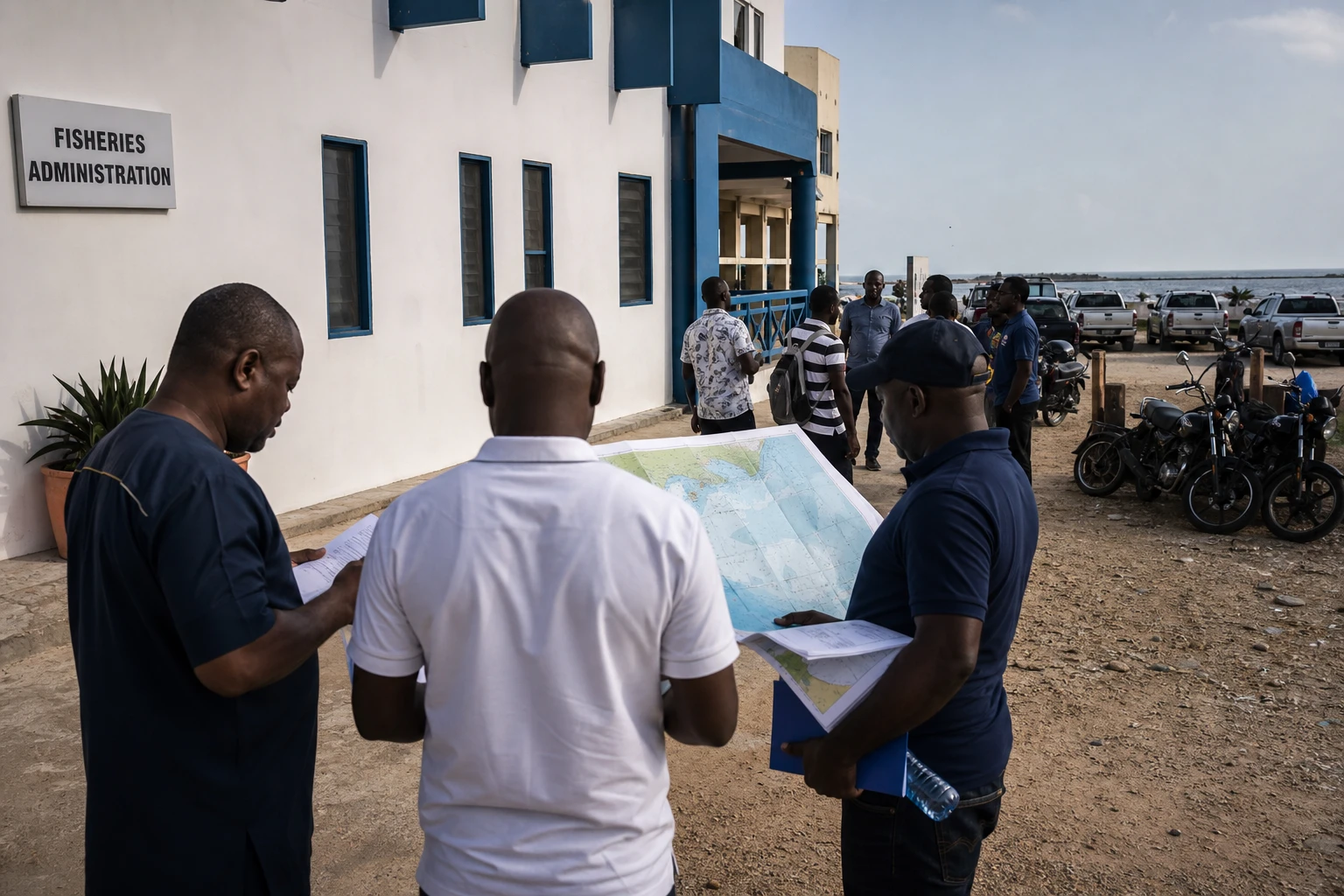
At the same time, communities in Adjoa and Apam have begun mapping their own fishing grounds. Seidu and his partners have equipped fishers with GPS trackers to identify guitarfish gathering and breeding sites. Around 15 square kilometres of essential habitat have already been identified through this local work. This is no token initiative. It is a way of giving co-management practical substance, using data gathered by those who know the coastline best.
The approach is also changing relations of trust. Rather than demanding an abrupt halt to a valuable fishery, the NGO AquaLife Conservancy and fishing families are testing alternative activities, such as farming African giant snails. This choice says much about the social context: when fuel is expensive and catches are falling, incomes have to be diversified, or conservation remains theoretical.
For families, conservation is also a matter of income
Ghana’s case illustrates a reality often underestimated in West Africa: protecting a species cannot succeed if it immediately undermines the households that depend on fishing. The sector employs more than 90% of the country’s artisanal marine fishers, and fish provides 60% of the animal protein consumed in Ghana. In other words, falling stocks are not just an environmental issue; they affect food security, the cost of living and the stability of coastal communities.
On the ground, this constraint is visible among women traders as well as men at sea. In Apam, sellers say catches fluctuate with the seasons, but have declined over the longer term. Destructive methods, pollution, pressure on habitats and climate change are making matters worse. When volumes fall, the entire downstream chain is affected: sales, processing, school fees and household expenses.
Ghana is therefore moving on two fronts. On the one hand, the state is building a stronger protection framework through the marine protected area and co-management. On the other, local actors are devising practical, more flexible solutions designed to last. This combination is crucial, because measures imposed without community support are often circumvented. Ghana is instead seeking to make fishers guardians of the coastline, rather than suspects by default.
A Ghanaian experiment with lessons for the entire West African coast
What is happening in Ghana resonates far beyond Accra. In several ECOWAS coastal countries, fish stocks face the same combination of pressures: overfishing, illegal fishing, habitat loss and growing competition for coastal areas. The struggle over the guitarfish is becoming a test of regional governance. Can a mobile, transboundary resource be protected without involving communities, scientists and the state? Ghana’s answer is to experiment locally, then use legal tools.
What happens next will depend on implementation. The coming months will show whether the new marine protected area has a real impact on vulnerable species and coastal incomes. They will also show whether community mapping, co-management plans and alternative solutions such as snail farming can be extended to other villages. For West Africa, the challenge is clear: preserve the sea without stripping the coast of its popular economy. The credibility of Ghana’s model will be decided there.