Algeria
 Egypt
 Libya
 Morocco
 Sudan
 Tunisia
 Benin
 Burkina Faso
 Cabo Verde
 Côte d'Ivoire
 Guinea
 Guinea-Bissau
 Liberia
 Mali
 Mauritania
 Niger
 Nigeria
 Senegal
 Sierra Leone
 The Gambia
 Togo
 Cameroon
 Central African Republic
 Chad
 DR Congo
 Equatorial Guinea
 Gabon
 Republic of the Congo
 São Tomé and Príncipe
 Burundi
 Comoros
 Djibouti
 Eritrea
 Ethiopia
 Kenya
 Madagascar
 Malawi
 Mauritius
 Mozambique
 Rwanda
 Seychelles
 Somalia
 South Sudan
 Tanzania
 Uganda
 Angola
 Botswana
 Eswatini
 Lesotho
 Namibia
 South Africa
 Zambia
 Zimbabwe
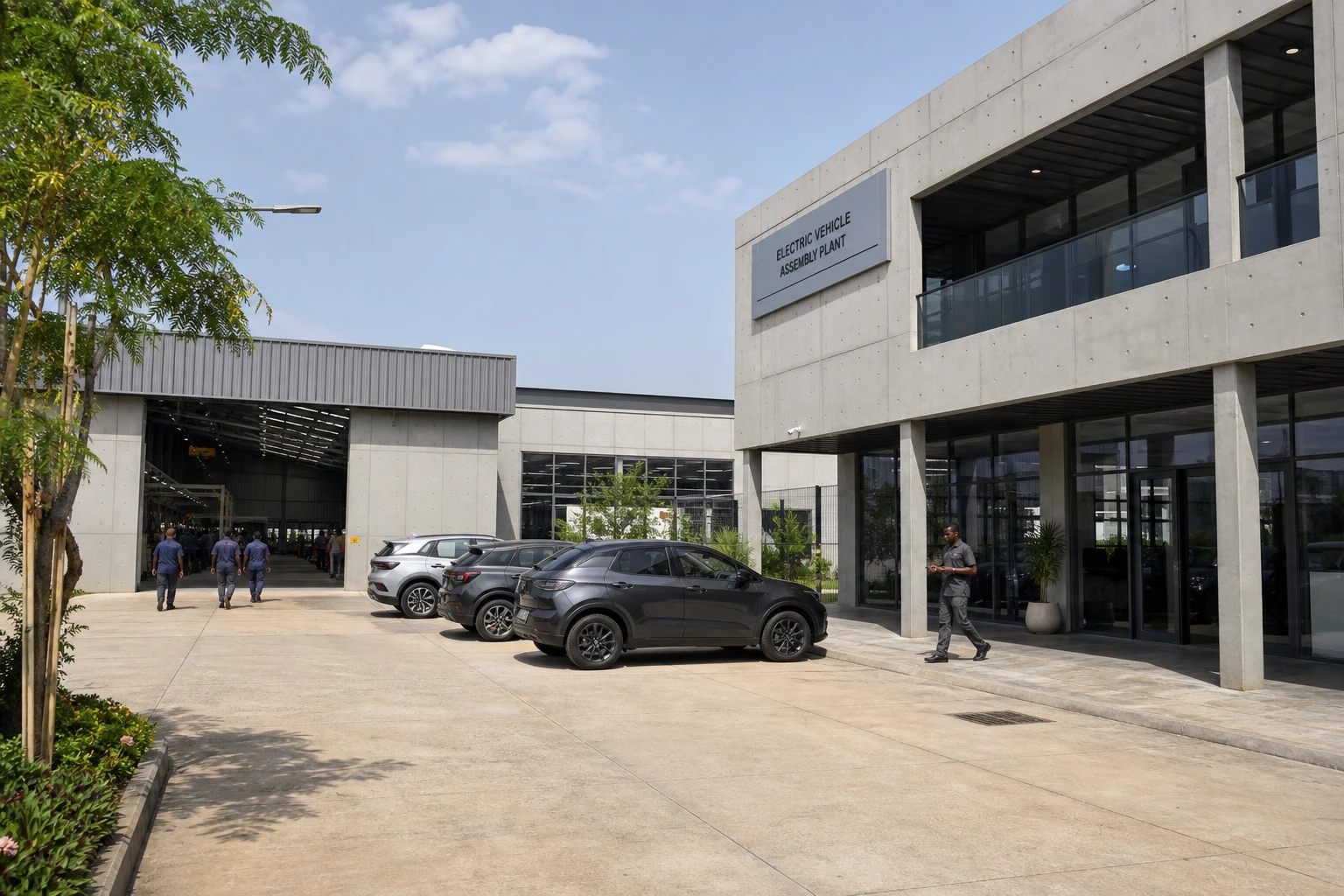
In Prampram, in Greater Accra, the stakes go beyond manufacturing electric vehicles. For ST Mobility, formerly SolarTaxi, the challenge is to prove that a vehicle assembled in Ghana can also embody genuine African value. This distinction will be decisive in securing access to the trade preferences of the African Continental Free Trade Area (AfCFTA).
Ghana aims to produce, not just assemble
ST Mobility’s project is part of the gradual transformation of Ghana’s automotive industry. Since 2018, the company has been developing electric two-wheelers, cars and buses. It now combines assembly, financing, charging and maintenance in a single model.
At its Prampram campus, the company plans several production lines for cars, motorbikes, tricycles and buses. Its stated target is 5,000 vehicles a year, with a planned investment of $4.5 million spread across three stages.
This capacity is more than a simple industrial indicator. It also corresponds to the threshold set out in the Ghana Automotive Development Policy, Accra’s policy for attracting manufacturers and developing a local industry. Companies that meet the stipulated conditions can benefit from tax and customs incentives.
The Ghanaian government is, however, seeking to tighten these requirements. On 15 September 2026, President John Dramani Mahama announced that a minimum local production threshold would henceforth be linked to access to VAT exemptions. The percentage is to be specified in the next national budget.
The change addresses a specific concern: preventing a vehicle that is almost fully assembled abroad from qualifying as locally assembled after a few operations in Ghana. The government wants assembly to be a step towards an industry built on components, skills and services.
The reform comes as Ghana implements a new VAT framework, in force since 1 January 2026. The effective rate announced by the Ghana Revenue Authority is 20%, combining VAT with certain earmarked levies. For assemblers, the stability and clarity of tax incentives are therefore becoming as important as their value.
A model built around the Ghanaian market
Before targeting exports, ST Mobility must consolidate domestic demand. The company is targeting, in particular, ride-hailing drivers, private fleets and public transport operators. For these users, the main selling point is not simply environmental performance.
Fuel costs have a direct impact on the income of drivers and transport companies. An electric vehicle can reduce running costs, but its purchase price is often higher. ST Mobility is therefore seeking to resolve this contradiction through financing and hire purchase.
The Truzt platform brings together several services: vehicle selection, credit, payment, maintenance and charging. This approach aims to lower the upfront cost for customers. It also addresses a common weakness in African electric vehicle markets: the lack of a complete ecosystem around the vehicle.
Ecobank is supporting this strategy with an announced $8.35 million asset-financing facility. The pan-African banking group can also help connect the company with customers and partners in several countries. Its regional presence is therefore a business tool, beyond simply providing finance.
This regional footing matters for a Ghanaian operator. Ghana is a member of the Economic Community of West African States (ECOWAS), which facilitates the movement of goods and capital between its members. However, regional free movement does not automatically guarantee access to AfCFTA preferences.
The 40% rule changes the equation
Rules of origin determine a product’s economic nationality. They specify the share of processing or value that must be created within the relevant trading area to qualify for preferential tariffs.
For vehicles and their components, the framework adopted under AfCFTA sets a requirement of 40% African content under the sector’s general rule. The value of materials and components sourced from outside the continent must therefore not exceed 60%. This rule is documented in key studies on African automotive rules of origin and in African Union resources.
The key point is often misunderstood. The 40% does not necessarily have to be produced in Ghana. It can come from several African countries. A battery made in South Africa, wiring harnesses produced in Côte d’Ivoire or metal components sourced from another country can count towards the calculation, depending on the applicable criteria.
This possibility offers ST Mobility a realistic path forward. The company does not need to manufacture every component itself in Prampram. It must, however, build a network of African suppliers and carefully document the value added in each country.
The challenge lies in the current model used by many African assemblers. Vehicles often arrive in kits from Asia. The more complete the kit, the more limited the local processing is likely to be. Fitting the wheels, battery or certain body components may not be enough to create the value required under the rules of origin.
The economic divide between “assembled in Ghana” and “originating in Africa” is therefore clear. The first describes where an operation takes place. The second determines whether a product qualifies for a continental customs benefit.
Competition is not just about borders
ST Mobility is targeting Nigeria, Côte d’Ivoire, Senegal, Togo and Benin, among other markets. But customs duties will not always be enough to provide an advantage. Some countries are already sharply reducing tariffs on imported electric vehicles, regardless of their origin.
In these markets, a Chinese model can arrive directly without incurring the cost of intermediate assembly in Ghana. Competition then comes down to price, volumes and immediate availability. Asian manufacturers often have greater industrial capacity and more mature supply chains.
ST Mobility highlights other selling points: shorter delivery times, financing in local currency, available spare parts and nearby after-sales service. These arguments can appeal to professional fleets, companies and public operators, which assess a vehicle over its entire operating life.
Infrastructure remains central to the issue. An electric vehicle market cannot grow without charging points, trained technicians, battery maintenance and available spare parts. Ghana is making progress on these fronts, but the gaps between Accra, other cities and less well-equipped areas will remain decisive for adoption.
A test for West African industry
The Prampram project illustrates a broader tension within AfCFTA. The continent wants to develop internal trade, but must ensure that African preferences do not mainly benefit imported products that undergo only minor processing.
The 40% rule seeks a balance. A threshold that is too high could exclude new assemblers. One that is too low would create few industrial jobs and little technology transfer. Its effectiveness will therefore depend on customs enforcement, component traceability and states’ ability to foster regional suppliers.
For Ghana, the stakes are also domestic. Accra wants to attract investment, reduce dependence on imports and develop technical jobs. But these goals will be sustainable only if batteries, electrical systems, software, metal parts and related services advance alongside assembly.
The next steps will be watched in two arenas: Ghana’s budget, which must specify the new local production threshold linked to VAT, and the practical implementation of AfCFTA’s rules of origin. ST Mobility’s success will therefore not be measured solely by the number of vehicles leaving the factory. It will be measured by the share of African value they genuinely contain.