Algeria
 Egypt
 Libya
 Morocco
 Sudan
 Tunisia
 Benin
 Burkina Faso
 Cabo Verde
 Côte d'Ivoire
 Guinea
 Guinea-Bissau
 Liberia
 Mali
 Mauritania
 Niger
 Nigeria
 Senegal
 Sierra Leone
 The Gambia
 Togo
 Cameroon
 Central African Republic
 Chad
 DR Congo
 Equatorial Guinea
 Gabon
 Republic of the Congo
 São Tomé and Príncipe
 Burundi
 Comoros
 Djibouti
 Eritrea
 Ethiopia
 Kenya
 Madagascar
 Malawi
 Mauritius
 Mozambique
 Rwanda
 Seychelles
 Somalia
 South Sudan
 Tanzania
 Uganda
 Angola
 Botswana
 Eswatini
 Lesotho
 Namibia
 South Africa
 Zambia
 Zimbabwe

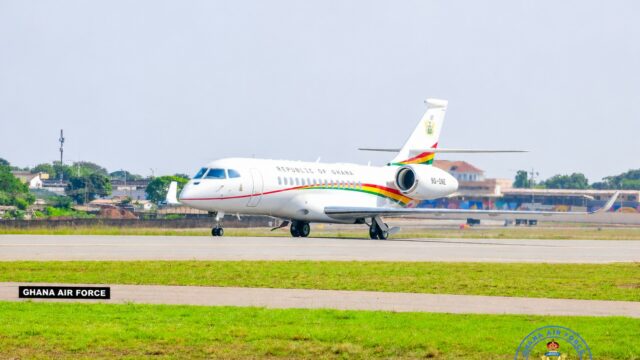
In Accra, reviving a national airline is no longer just about putting aircraft back in the sky. Ghana is now seeking to build a complete industry around the project, capable of supporting trade, training and aircraft maintenance in West Africa.
A project within Ghana’s connectivity strategy
The Ghanaian government revived preparatory work in 2025 to establish a new national carrier. A dedicated task force was set up in May to prepare the business model, partnerships, regulatory approvals, fleet and future route network.
The Ministry of Transport then launched a process to select a strategic partner on 28 April 2026. The future carrier is expected to be based in Accra and operate as a hub for regional and intercontinental connections. The plan under consideration includes flights to Europe, North America, the Middle East and Asia, as well as a West African network and cargo operations.
This direction reflects Ghana’s geographical and economic position. Accra is home to Kotoka International Airport, and the country has an economy open to the Gulf of Guinea and a growing role in regional trade. Ghana also hosts the secretariat of the African Continental Free Trade Area, AfCFTA, which aims to increase trade between African economies.
But competition is fierce. In West Africa, foreign airlines already serve the main capitals and handle a large share of connecting traffic. Nigeria, Côte d’Ivoire and Senegal are also seeking to strengthen their airport hubs. In this environment, a Ghanaian airline will need to offer reliable schedules, competitive fares and a sufficiently extensive network to attract connecting passengers.
From Ghana Airways to a more private-sector-led model
Ghana is familiar with the difficulties facing an undercapitalised national carrier. Ghana Airways, established in 1958, ceased operations in 2004 after years of losses, restructuring and debt. Ghana International Airlines succeeded it in 2005, before halting operations a few years later.
These precedents explain the caution shown by the authorities. The current project does not necessarily envisage an airline wholly controlled by the state. The strategic partner is expected to hold a majority stake in the future joint venture, while the government would retain a minority interest. The stated aim is to limit political interference in day-to-day management and entrust operations to a professional team.
The model has yet to be finalised. The ownership structure, investment amount, choice of aircraft and launch schedule will depend on the partner selected. The ministry said candidates must already have experience in airline operations, management, marketing or network development.
This approach marks a departure from several previous attempts. Since 2016, Accra has explored partnerships with various African, European and Middle Eastern players. None of these initiatives has yet managed to keep a national airline operating over the long term. The new project will therefore need to learn from these failures, particularly on governance, financial discipline and the ability to fill aircraft.
Accra targets maintenance and skills with Boeing
Discussions with Boeing add an industrial dimension to the project. On 27 September 2026, on the sidelines of the United Nations General Assembly in New York, President John Dramani Mahama spoke with executives from the US manufacturer about reviving the national carrier and developing an aviation ecosystem.
According to information released after the meeting, the discussions were not limited to aircraft purchases. They also covered aircraft maintenance, repair and overhaul, known as MRO. A regional centre of this kind could serve several airlines operating in West Africa and reduce their reliance on technical facilities outside the continent.
Ghana is also exploring cooperation on aviation training, technology transfer and skills development. These activities require certified mechanics, engineers, avionics technicians, safety specialists and staff able to manage ground operations.
For young Ghanaians, the stakes therefore extend beyond the jobs created directly by the airline. A maintenance and training industry can provide qualifications that are useful to several operators. It can also encourage the emergence of local service providers in logistics, digital services, airline catering and spare-parts management.
This ambition complements initiatives already under way in cargo. Private airline Air Ghana announced in April 2026 that it had acquired a Boeing 737-400 Freighter, an aircraft intended for transporting goods. This activity could complement future passenger routes and strengthen Accra’s role in the movement of regional goods.
The timetable remains an aspiration, not a guarantee
Industry officials have cited a return to the skies about 18 months after the necessary structures are in place. This timeframe should, however, be treated as a working assumption. It will depend on the choice of partner, the airline’s certification, flight approvals, fleet financing and crew availability.
Ghana will also need to secure demand. A national airline cannot rely solely on the prestige of flying the flag. It must fill its aircraft throughout the year, manage fluctuations in tourism, meet businesses’ needs and withstand swings in fuel prices. Intercontinental routes also require commercial strength and a fleet suited to each market.
Redeveloping Kotoka Airport is part of the equation. The government plans, among other measures, to reorganise Terminal 2, strengthen connections with Terminal 3 and improve capacity. These facilities will need to keep pace with traffic growth without placing an excessive burden on passengers and airlines.
A test for West African aviation integration
The Ghanaian project comes as the Economic Community of West African States, ECOWAS, seeks to facilitate trade and regional mobility. An airline based in Accra could improve links between West African capitals, but it will have to contend with traffic rights, national regulations and visa-related constraints.
Its success will also depend on its ability to complement existing carriers rather than duplicate their networks. A strategy combining regional routes, cargo, intercontinental connections and technical services would give Ghana a chance to stand out.
The next step will be selecting the strategic partner and publishing a credible operational plan. The financial commitments, certification timetable and precise role of local maintenance will then need to be assessed. For Accra, the question will not simply be whether to revive an airline. It will be whether it can demonstrate that an African carrier can become the anchor of a sustainable industry.