
 Algeria
 Egypt
 Libya
 Sudan
 Tunisia
 Benin
 Burkina Faso
 Cabo Verde
 Côte d'Ivoire
 Ghana
 Guinea
 Guinea-Bissau
 Liberia
 Mali
 Mauritania
 Niger
 Nigeria
 Senegal
 Sierra Leone
 The Gambia
 Togo
 Cameroon
 Central African Republic
 Chad
 DR Congo
 Equatorial Guinea
 Gabon
 Republic of the Congo
 São Tomé and Príncipe
 Burundi
 Comoros
 Djibouti
 Eritrea
 Ethiopia
 Kenya
 Madagascar
 Malawi
 Mauritius
 Mozambique
 Rwanda
 Seychelles
 Somalia
 South Sudan
 Tanzania
 Uganda
 Angola
 Botswana
 Eswatini
 Lesotho
 Namibia
 South Africa
 Zambia
 Zimbabwe
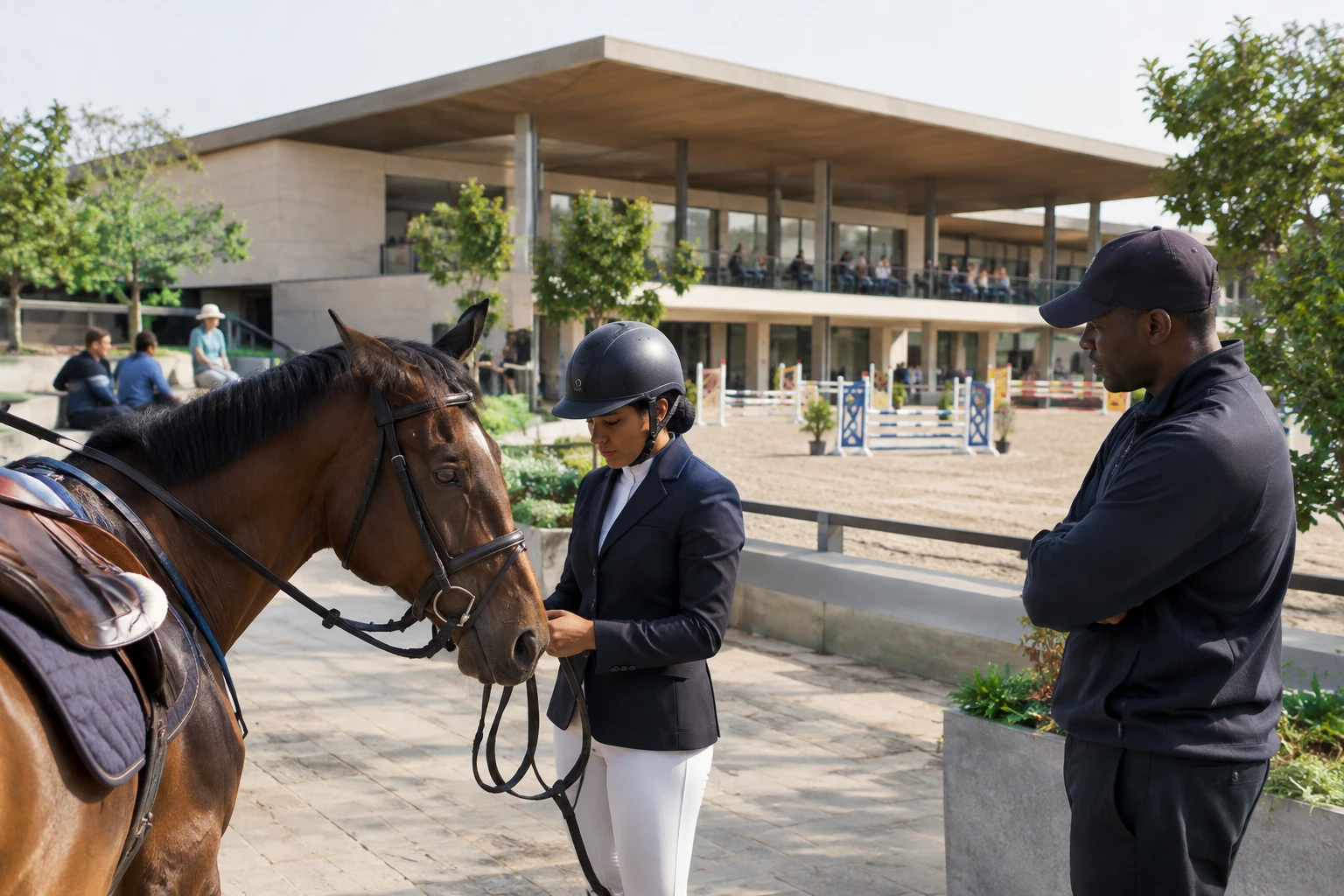
In Diamniadio, Senegal, the journey of a young Moroccan rider highlights a discipline in which success depends as much on technique as on working with the horse. At 16, Ghali Bougja represents Morocco in showjumping at the Dakar 2026 Youth Olympic Games (YOG), a historic edition being held on the African continent for the first time.
An African event, a test of precision
The YOG take place from 31 October to 13 November 2026. Events are spread across Dakar, Diamniadio and Saly. Showjumping is held at the Diamniadio equestrian centre. Riders must clear a series of jumps without fault and within the allotted time: an error, a fall or exceeding the time limit can affect the result.
For this edition, Morocco has entered Ghali Bougja in the individual event. The Royal Moroccan Equestrian Sports Federation (FRMSE) announced his participation on 23 October. The qualifying rounds were scheduled for 3 and 5 November, ahead of the individual final on 6 November. The dates place the competition within a week in which young African riders compete before spectators in the host country.
Dakar 2026 is the first Olympic sporting event to be held in Africa. The gathering brings together delegations from many countries and puts the continent’s infrastructure, sporting organisation and young talent in the spotlight. For Senegal, it is also an opportunity to host events in several cities, beyond the capital alone.
A career built in Morocco
The Moroccan federation describes Bougja as a rising talent in national showjumping. It says he has won several gold medals in youth categories, including U13 and U18. His selection for Dakar builds on training provided by clubs, coaches and the federation, with support from families.
His career is part of an established Moroccan equestrian pathway built around national competitions and clubs. The FRMSE lists him as a member of Étrier de Casablanca. The International Equestrian Federation also records his entries in showjumping competitions, including in Morocco in 2025. These details document his competition experience without prejudging the result in Dakar.
Morocco’s presence in this discipline at the YOG is not a first. The FRMSE recalls that Lilia Maamar represented Moroccan showjumping in Nanjing in 2014. Twelve years later, Bougja’s selection offers another opportunity to gauge the progress of the next generation and young riders’ ability to compete against international rivals.
Showjumping requires special preparation. Riders learn to anticipate the course, manage their pace and communicate with their mount. The horse, its training and the relationship established with it are therefore essential to performance. The event is not simply a test of the young athlete’s individual skill.
From the opening rounds to the next stage
In the first qualifying round, held on 3 November, Bougja finished 14th, according to information published by Maroc Diplomatique on the Moroccan rider’s performance. That position kept him in contention for the second round scheduled for 5 November. It should not be confused with the final result in the individual event, whose final is due to take place the following day.
On 5 November, another event added a collective dimension to his participation. The Senegalese daily Le Soleil reported a bronze medal for Team Africa in the team event. The squad included Senegal’s Eden Kazoum, South Africa’s Bo Reed, Egypt’s Yassin El Bassiuony and Morocco’s Ghali Bougja. This team medal is not an individual ranking: the two competitions have separate results.
The participation of young riders from several African countries in the same team gives the event a different significance. It brings sporting co-operation between nations into view, even as they compete against one another in the individual rankings. The result reported by the Senegalese outlet highlights this dimension, but on its own does not make it possible to assess each rider’s performance.
What Dakar reveals about the next generation
For Morocco, the stakes go beyond the performance of a single athlete. The YOG give young sportspeople an international platform and provide a benchmark for national training structures. In equestrian sport, this support requires qualified coaches, suitable facilities and regular access to horses and competitions. Performance therefore depends on a sporting ecosystem, not just individual potential.
The Moroccan federation said Bougja was accompanied in Dakar by Thierry Klein, assistant showjumping coach. His presence is a reminder of the role of support staff in a competition where preparing the rider and the horse go hand in hand. It also helps put results in context over time: a qualification and a medal do not replace the daily work of clubs and technical teams.
At continental level, the Games are a test of Africa’s capacity to organise major sporting events and a showcase for national federations. The Diamniadio competition makes it possible to follow both individual results and team dynamics. The next milestone for Bougja is the individual final scheduled for 6 November; his ranking will show how far the Moroccan rider has been able to progress in Dakar.



