Algeria
 Egypt
 Libya
 Morocco
 Sudan
 Tunisia
 Benin
 Burkina Faso
 Cabo Verde
 Côte d'Ivoire
 Ghana
 Guinea
 Guinea-Bissau
 Liberia
 Mali
 Mauritania
 Niger
 Nigeria
 Senegal
 Sierra Leone
 Togo
 Cameroon
 Central African Republic
 Chad
 DR Congo
 Equatorial Guinea
 Gabon
 Republic of the Congo
 São Tomé and Príncipe
 Burundi
 Comoros
 Djibouti
 Eritrea
 Ethiopia
 Kenya
 Madagascar
 Malawi
 Mauritius
 Mozambique
 Rwanda
 Seychelles
 Somalia
 South Sudan
 Tanzania
 Uganda
 Angola
 Botswana
 Eswatini
 Lesotho
 Namibia
 South Africa
 Zambia
 Zimbabwe
A modest sum for a state, but one with great significance for victims
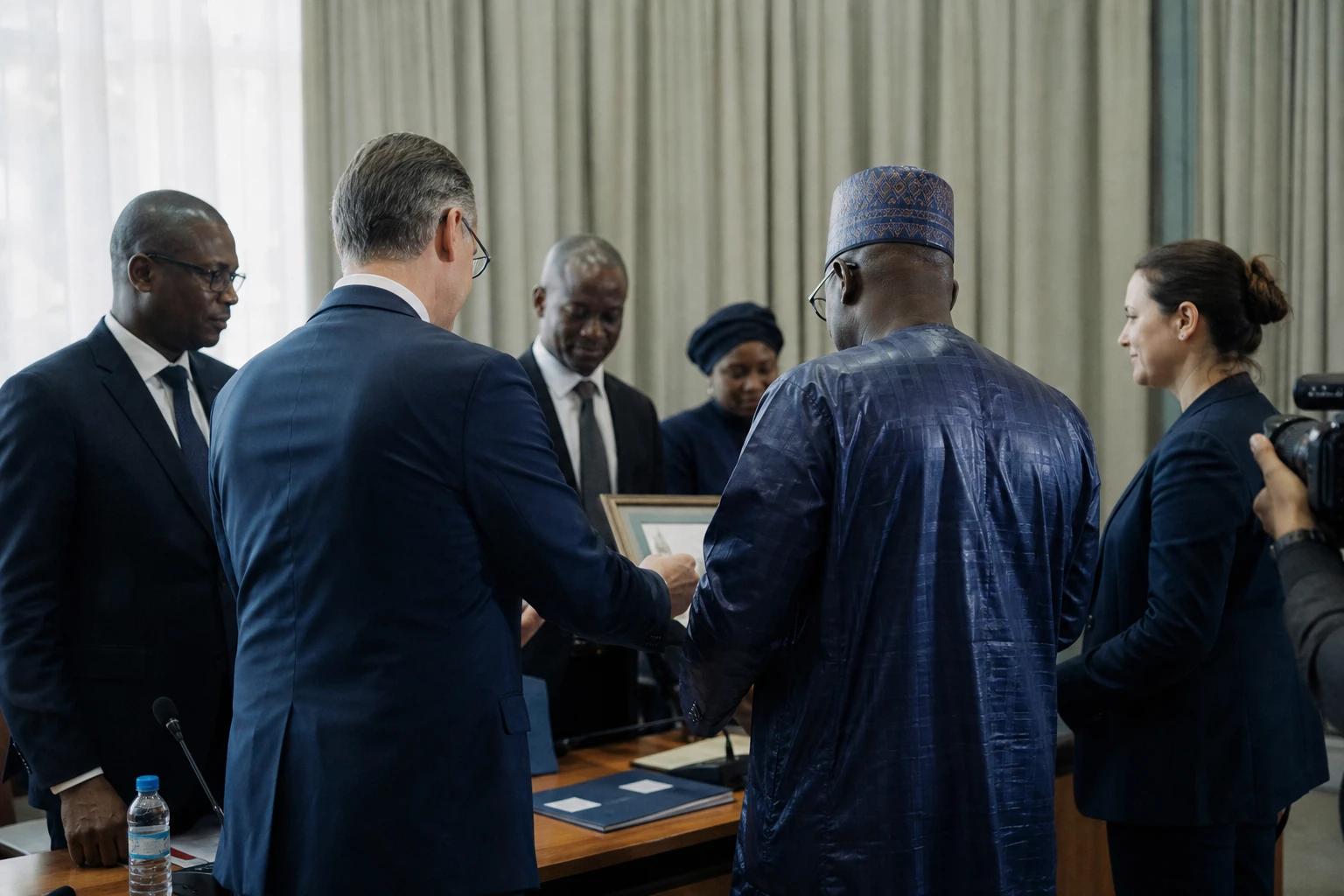
In The Gambia, money recovered abroad is more than just an accounting entry. It touches on a broader question: how can the years of fear, disappearances, torture and abuses attributed to Yahya Jammeh’s regime be repaired in practical terms? On 18 September 2026, Banjul and Washington formalised the transfer of $2,507,911.73, proceeds from the sale of a property in Potomac, Maryland, to fund the victims’ compensation scheme.
The amount may seem limited given the scale of the harm documented in The Gambia. But its significance is symbolic and political. It confirms that property acquired outside the country can eventually be returned, at least in part, to those who suffered under a system of predation and state violence.
A country still navigating its transition, between reparative justice and demands for transparency
The Gambia remains engaged in a post-Jammeh transition that is advancing in stages. The Truth, Reconciliation and Reparations Commission, established after the regime ended in January 2017, laid the foundations for prosecutions, reforms and reparations. Its work led to the creation of a reparations fund, followed by the adoption of the Victims Reparations Act, 2023, which now provides for a dedicated mechanism for victims of violations committed between July 1994 and January 2017.
This legal framework matters. It moves the process beyond one-off announcements and establishes a long-term structure. According to Gambia’s Ministry of Justice, the government had already made 50 million dalasis available for interim reparations before announcing plans for an independent fund to administer payments. The principle is clear: victims must be at the centre of the scheme, not the administrations managing the money on their behalf.
The regional context also matters. The Gambia is a member of ECOWAS, which closely monitors issues of constitutional stability, transitional justice and human security in West Africa. In a sub-region marked by several incomplete political transitions, the Gambian case is often seen as a point of reference: that of a small state seeking to turn its emergence from crisis into lasting public policy.
What the restitution agreement signed in Banjul entails
According to Gambian authorities and US sources, the agreement signed in Banjul on 18 September 2026 provides for the transfer of the net proceeds from the sale of a residence in Potomac, Maryland, linked to Yahya Jammeh and his wife, Zineb Jammeh. US courts had already ordered the property’s forfeiture in 2022, after establishing that it had been acquired with about $3.5 million in funds allegedly linked to corruption. The Department of Justice later said the sale was ultimately intended to benefit Gambians affected by the former president’s actions.
Documents from Gambia’s Ministry of Justice note that the Potomac property is among the assets identified by the Commission of Inquiry into the Finances and Assets of the Former President. The commission concluded that the purchase had been funded with money for which Yahya Jammeh had no known legitimate source. That finding provided the basis for the return of the sale proceeds years later.
Restitution does not erase the legal process. It is part of a specific sequence: a Gambian investigation, US civil proceedings, forfeiture, sale and then a transfer agreement. For Gambian institutions, it is a test of credibility. For victims, it is a promise that must still be delivered in terms of timing, eligibility criteria and the amounts actually paid.
Reparations, yes. But how, and for whom?
The sensitive issue is not just recovering funds. It is how they are distributed. The 2023 law provides for a reparations fund administered by an independent commission. Authorities have also said the mechanism should remain open to victims identified at a later stage, including those unable to participate fully in the TRRC’s work. This reflects a simple reality: in The Gambia, the effects of the Jammeh regime are not limited to a handful of emblematic cases. They affect families, communities and survivors with varying needs, from healthcare and psychological support to lost income.
The timetable is also a central issue. In 2026, Gambian authorities reported that payments had already begun for some victims. This shows that the system is in place, but also highlights the scale of the task: identifying beneficiaries, verifying applications, preventing fraud and, above all, building trust in the institution administering payments. In a country where the memory of abuses remains vivid, transparency matters as much as the amount transferred.
There is also an economic dimension. The sum recovered remains small relative to the country’s social needs, but it could fund targeted compensation, healthcare or some of the costs associated with searching for the disappeared. Conversely, opaque management would undermine the entire process and fuel mistrust. That is why asset restitution is not an end in itself; it has value only if it strengthens the rule of law.
A signal for West Africa and continental debates on stolen assets
This case extends beyond The Gambia. It shows that an African state can, with the support of foreign partners, secure the return of assets located outside the continent, provided it has a legal framework, traceable assets and a sustained legal strategy. In a region where scandals involving the capture of public resources remain frequent, the Gambian example feeds into debate on the return of stolen assets and their direct allocation to the people harmed.
The case’s continental significance also lies in its approach. Gambian authorities have brought together transitional justice, institutional reforms and material reparations. This is precisely the combination of measures that interests other African countries facing transitions away from authoritarian rule, truth commissions or disputes over misappropriated assets. In Banjul, the challenge is therefore not just to receive money. It is to prove that, with patience and strong institutions, the proceeds of predation can be put back to public use.
The next steps will be closely watched. It remains to be seen how the Gambian commission implements the Victims Reparations Act, 2023, how it categorises beneficiaries, and whether repatriated funds will be added to other assets already seized or returned. In The Gambia, the Jammeh case is no longer playing out only in the courts. It is now about the state’s ability to turn confiscated assets into tangible justice for Gambians.