Algeria
 Egypt
 Libya
 Morocco
 Sudan
 Tunisia
 Benin
 Burkina Faso
 Cabo Verde
 Côte d'Ivoire
 Ghana
 Guinea
 Guinea-Bissau
 Liberia
 Mali
 Mauritania
 Niger
 Nigeria
 Senegal
 Sierra Leone
 The Gambia
 Togo
 Cameroon
 Central African Republic
 Chad
 DR Congo
 Equatorial Guinea
 Republic of the Congo
 São Tomé and Príncipe
 Burundi
 Comoros
 Djibouti
 Eritrea
 Ethiopia
 Kenya
 Madagascar
 Malawi
 Mauritius
 Mozambique
 Rwanda
 Seychelles
 Somalia
 South Sudan
 Tanzania
 Uganda
 Angola
 Botswana
 Eswatini
 Lesotho
 Namibia
 South Africa
 Zambia
 Zimbabwe
One railway, two commodities, one test for Libreville
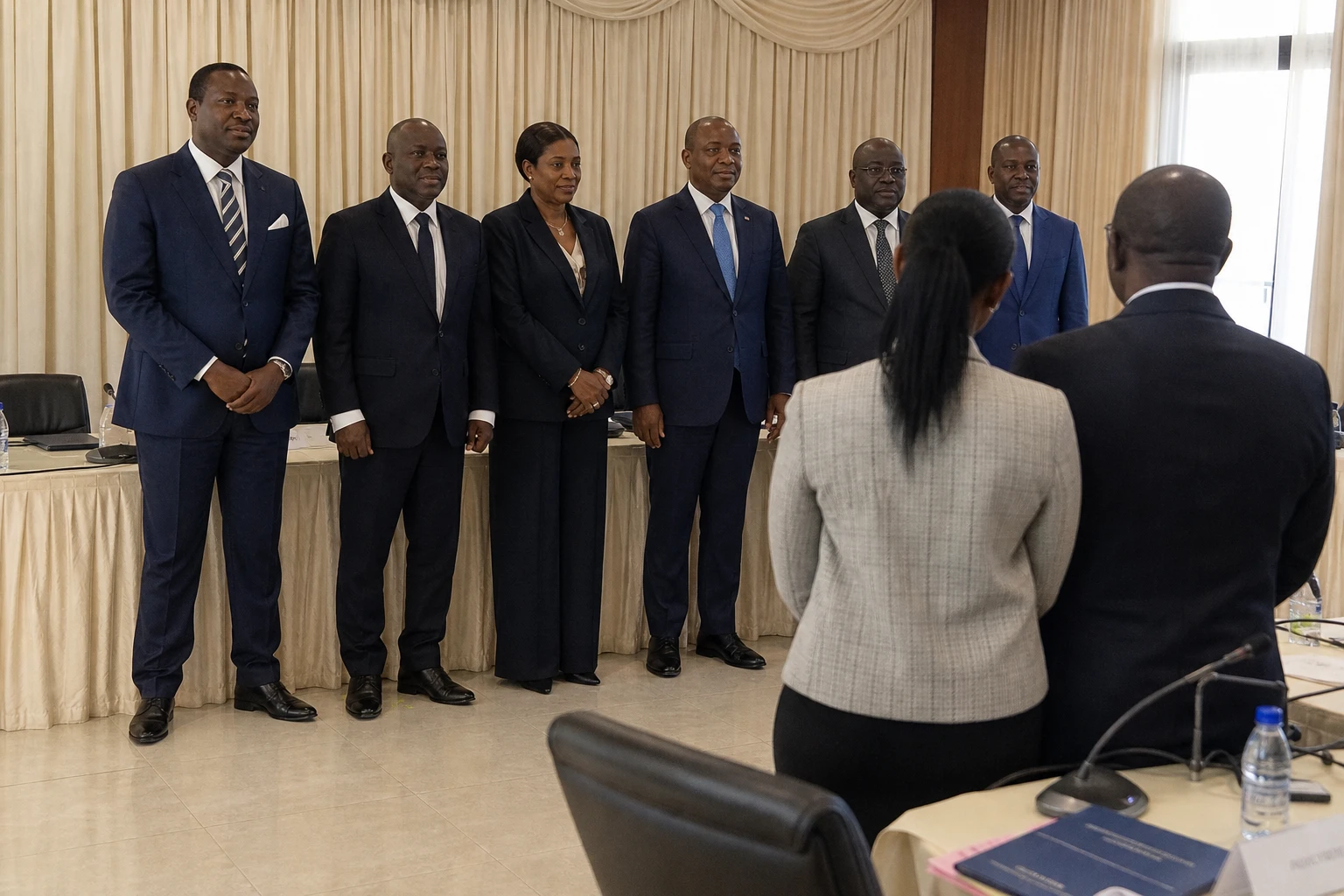
In Libreville, Brice Clotaire Oligui Nguema’s state visit to France did more than reopen a diplomatic chapter. Above all, it highlighted a distinctly Gabonese reality: if a country wants to do more processing at home, it first needs reliable railways, stable electricity and transparent financing. In a country where manganese, oil and timber still account for most exports, the economy is shaped not only in the mines but also by the logistics linking them to the port, the factory and the market.
Gabon remains on a delicate path towards rebalancing. The country is part of CEMAC, the Economic and Monetary Community of Central Africa, alongside Cameroon, Congo, the Central African Republic, Equatorial Guinea and Chad. In this bloc, fiscal discipline, regional infrastructure and the movement of goods weigh heavily on growth. Work on the Transgabonais railway therefore concerns a national priority, but also a link that could support Central African economic integration.
What Paris actually agreed
The visit, announced by Gabon’s presidency as taking place from 19 to 22 July 2026, concluded with two major economic agreements. First, €312 million in funding to modernise the Transgabonais, through Proparco, the IFC and the Société d’exploitation du Transgabonais, known as SETRAG. Second, a memorandum of understanding with Eramet to deepen the local processing of manganese. Both developments were confirmed in official Gabonese communications and in statements by Eramet and Proparco.
The railway is central to the issue because the Transgabonais is no branch line. SETRAG describes it as a 648-kilometre route between Owendo and Franceville, crossing five provinces and serving both mining freight and passenger transport. Proparco says the modernisation also aims to improve the safety and flow of traffic and facilitate the transport of manganese, a strategic material for industry and the energy transition. In other words, the project concerns not only mining companies but also passengers, traders and inland communities that depend on this railway backbone.
On manganese, the protocol signed with Eramet sets out a gradual expansion. The group says it is examining several industrial scenarios to process up to 700 kilotonnes of ore a year by the end of 2031, while making the projects’ viability conditional on access to energy, which the Gabonese state has undertaken to ensure. This is decisive. Without available, plentiful and competitively priced electricity, the promise of local processing remains a slogan. With it, that promise can become a value chain, bringing jobs, skills and more added value captured in Gabon.
This timetable differs from the more ambitious target set by the Gabonese authorities, who had already set 2029 as the deadline for ending exports of unprocessed manganese. Eramet had acknowledged that intention while stressing the scale of the investment and the industrial conditions that would need to be met. The new July 2026 protocol therefore looks less like a definitive victory than a negotiating milestone, with reciprocal commitments still to be delivered.
Political gains still disputed amid tight budgets
The heart of the debate is not only industrial; it is also fiscal and political. Gabon is still discussing support with the IMF, while a comprehensive debt audit is due to be made public. Fund documents show that IMF staff met in Libreville with the authorities, the presidential debt task force, BEAC and other economic stakeholders in early 2026. At the same time, IMF reports put Gabon’s public debt at a high level, at around 70.5% of GDP in the 2026 projections in the country report.
Against this backdrop, the announcement of a potential new $1.5 billion loan, raised during the July 2026 visit, has prompted questions about debt sustainability. The issue matters all the more because the authorities must fund major infrastructure while preserving social spending and external balances. The challenge, then, is not to sign more deals, but to sign the right ones: prioritising projects that genuinely create value without placing a lasting burden on public liabilities.
This is where the criticism makes sense. Some Gabonese observers consider the results of the Paris visit too meagre given the diplomatic pageantry and the delegation’s lavish display. Others argue that the president secured what mattered: putting local manganese processing at the centre of discussions and locking in railway funding that had already been prepared in advance. The disagreement is not trivial. It reflects two views of the pace of economic reform: one wants visible results quickly; the other accepts technical steps, but only if they genuinely change the country’s productive structure.
For households, the difference will be measured less in press releases than in the quality of rail services, fewer logistical disruptions and, in time, the creation of economic activity around the railway and industry. For the state, the test will be whether industrial ambition is consistent with the debt audit and the ability to secure low-cost energy. For industry, the point is clear: local processing does not advance by decree, but through the combined provision of infrastructure, electricity and stable rules.
What the deal says about Gabon and Central Africa
The issue goes beyond the bilateral relationship with France. It says something about a Gabon seeking to move away from an economy based on raw exports without giving up its mining assets or longstanding partnerships. It also says something about Central Africa: resource-rich countries will succeed not through extraction alone, but through their ability to process, transport and generate electricity on their own territory. This is where part of today’s economic sovereignty is at stake.
The next test will be delivery. Attention will focus on the implementation of the railway funding, energy decisions linked to industrial projects, and budgetary measures accompanying the debt audit and negotiations with the IMF. At regional level, CEMAC partners will also watch to see whether Gabon can turn its resources into a driver of industrialisation rather than simply a source of foreign currency.