Algeria
 Egypt
 Libya
 Morocco
 Sudan
 Tunisia
 Benin
 Burkina Faso
 Cabo Verde
 Côte d'Ivoire
 Ghana
 Guinea
 Guinea-Bissau
 Liberia
 Mali
 Mauritania
 Niger
 Nigeria
 Senegal
 Sierra Leone
 The Gambia
 Togo
 Cameroon
 Central African Republic
 Chad
 DR Congo
 Equatorial Guinea
 Republic of the Congo
 São Tomé and Príncipe
 Burundi
 Comoros
 Djibouti
 Eritrea
 Ethiopia
 Kenya
 Madagascar
 Malawi
 Mauritius
 Mozambique
 Rwanda
 Seychelles
 Somalia
 South Sudan
 Tanzania
 Uganda
 Angola
 Botswana
 Eswatini
 Lesotho
 Namibia
 South Africa
 Zambia
 Zimbabwe
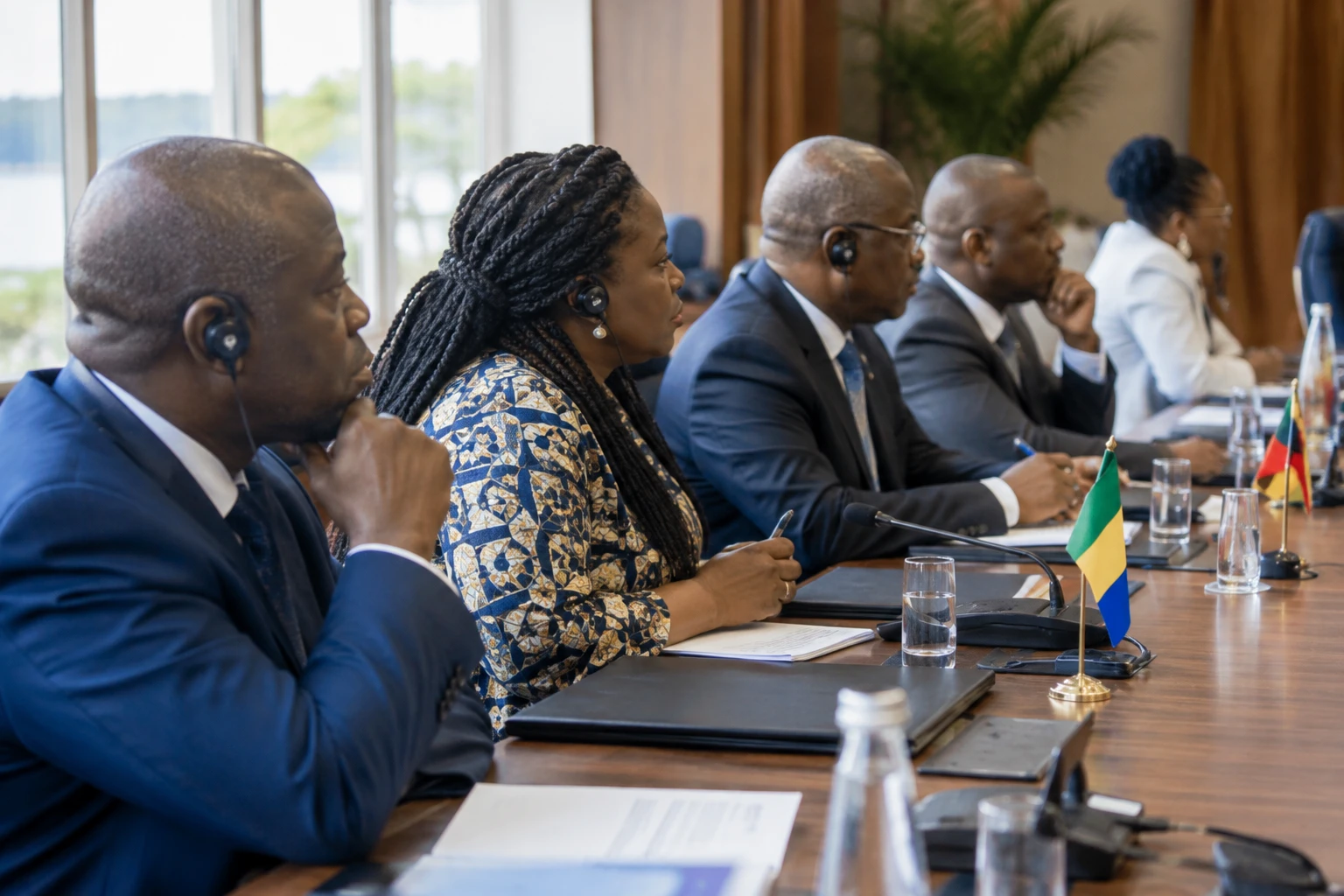
In Gabon, the battle to lead the Gabonese Democratic Party (PDG) has reopened a broader question: who can speak for the former dominant party since the end of the regime that brought it to power? In Libreville, the dispute is playing out in a political landscape transformed since the 2023 coup.
A party unsettled since the end of Bongo rule
The PDG long shaped Gabonese political life. The overthrow of Ali Bongo Ondimba on 30 August 2023 ended its time in power and ushered in a military-led transition. The change of regime also opened a period of realignment for the party, whose structures and legitimacy are now the subject of internal disputes.
The crisis concerns more than the leadership. For activists, elected representatives and local officials, the choice of leader will determine the PDG’s ability to maintain a national organisation and influence public debate. For Gabonese people, the question is also whether the former ruling party can become a structured opposition or will remain consumed by internal disputes.
Gabon belongs to the Central African Economic and Monetary Community (CEMAC), which brings together six countries under shared economic institutions. Politically, it is also a member of the Economic Community of Central African States (ECCAS) and the African Union. The course of its transition and the space afforded to pluralism are therefore being watched beyond its borders.
Ali Bongo contests his withdrawal and the current leadership
In an address broadcast from abroad on 20 October, Ali Bongo said he had not left political life and continued to claim the PDG presidency. The Gabonese daily L’Union reports that he is calling for an inclusive congress and disputes the legitimacy of the executive committee led by Blaise Louembé.
The former head of state argues that the statement announcing his withdrawal, published on 18 September 2024, did not reflect a free decision. He says he was under house arrest at the time and that his wife and son were detained. This is his account of the circumstances at the time: the evidence consulted does not independently confirm that he was coerced into announcing his withdrawal.
In September 2024, Ali Bongo had indeed announced his withdrawal from political life. The statement was reported at the time by several media outlets, including L’Observateur. His October address therefore reverses a previous public commitment and puts him back at the centre of the dispute over the PDG leadership.
Ali Bongo also disputes the way the current leadership took office. According to his account, a meeting held at his residence on 7 March 2024 was intended to organise the party’s continuity, not his succession. He says he proposed a temporary structure, then sought to negotiate with Blaise Louembé. He claims that his proposal for a meeting in Paris went unanswered. These points form part of his account of events; on their own, they do not settle the statutory validity of decisions taken by the various bodies.
The Gabonese outlet GabonReview also reported on the address. Cross-checking confirms the main points: Ali Bongo rejects his withdrawal, claims the party leadership and calls for an inclusive resolution. It does not independently confirm his allegations of coercion.
A dispute over party rules with real political consequences
The question of who leads the PDG is primarily an internal one, but its consequences could extend beyond the party’s offices. A disputed leadership risks complicating the mobilisation of activists, the selection of candidates and the development of a common political platform. Conversely, a congress recognised by the party’s different factions could clarify who makes decisions and under what rules.
Ali Bongo proposes a three-step process: restore what he considers to be compliance with the party statutes, establish an inclusive transitional organisation, and then convene a congress open to the different factions. He also says the PDG should sit in opposition on the grounds that the party has lost power. This is a political proposal, not a decision already endorsed by all its senior figures.
The balance of power remains uncertain. Ali Bongo led Gabon from 2009 to 2023, but his former status as head of state is not enough to establish that he still has effective control of the party. The leadership of Blaise Louembé, for its part, is directly challenged by the former president. It is up to the relevant bodies, party members and, if necessary, Gabonese courts to determine which decisions are valid.
Ali Bongo’s personal circumstances have also changed since 2023. In May 2025, he left Gabon for Angola with his family, following an agreement facilitated by Angolan President João Lourenço, then the African Union’s chairperson, according to the Associated Press. This development sheds light on the significance of his address from abroad, without resolving the dispute over the party.
The next test: the ability to organise a congress
For Gabonese people, the battle will not be measured solely by the leaders’ statements. It will depend on the PDG’s ability to set accepted rules, hear its different components and make its decisions public. Party members in the regions, as well as those in Libreville, will be affected by the choice of representatives and the party’s future platform.
The issue touches on a regional concern: after political ruptures in recent years in Central Africa and the Sahel, transitions are also judged by the space they leave for political parties and checks and balances. Gabon is following its own course, but the way its former dominant party handles its internal succession will offer an indication of the strength of its political pluralism.
The next concrete step will therefore be the response of Blaise Louembé’s executive committee to the call for an inclusive congress, and whether such a meeting is held. Until then, Ali Bongo’s claim remains a political challenge, not an officially established change of leadership.