Algeria
 Egypt
 Libya
 Morocco
 Sudan
 Tunisia
 Benin
 Burkina Faso
 Cabo Verde
 Côte d'Ivoire
 Ghana
 Guinea
 Guinea-Bissau
 Liberia
 Mali
 Mauritania
 Niger
 Nigeria
 Senegal
 Sierra Leone
 The Gambia
 Togo
 Cameroon
 Central African Republic
 Chad
 DR Congo
 Equatorial Guinea
 Republic of the Congo
 São Tomé and Príncipe
 Burundi
 Comoros
 Djibouti
 Eritrea
 Ethiopia
 Kenya
 Madagascar
 Malawi
 Mauritius
 Mozambique
 Rwanda
 Seychelles
 Somalia
 South Sudan
 Tanzania
 Uganda
 Angola
 Botswana
 Eswatini
 Lesotho
 Namibia
 South Africa
 Zambia
 Zimbabwe
A strategic metal at the heart of a longstanding, but now more demanding, relationship
In Libreville and Moanda alike, the same question has been asked for months: how can Gabon retain the value of its manganese instead of exporting almost all of it in raw form? The issue goes beyond mining. It affects rail, energy, industrial jobs and Gabon’s place in the value chain for critical minerals. The country is now the world’s second-largest manganese producer, accounting for a significant share of global output, while the Moanda complex remains a mainstay of the sector.
This latest development is also part of a closely watched Franco-Gabonese relationship, bringing together diplomacy, mining and infrastructure. The state visit to Paris by Brice Clotaire Oligui Nguema, announced and confirmed by the Gabonese authorities, is taking place as Libreville adopts a firmer line on mining sovereignty. Since 2025, Gabonese authorities have announced plans to end exports of raw manganese from 1 January 2029.
What was agreed in Paris
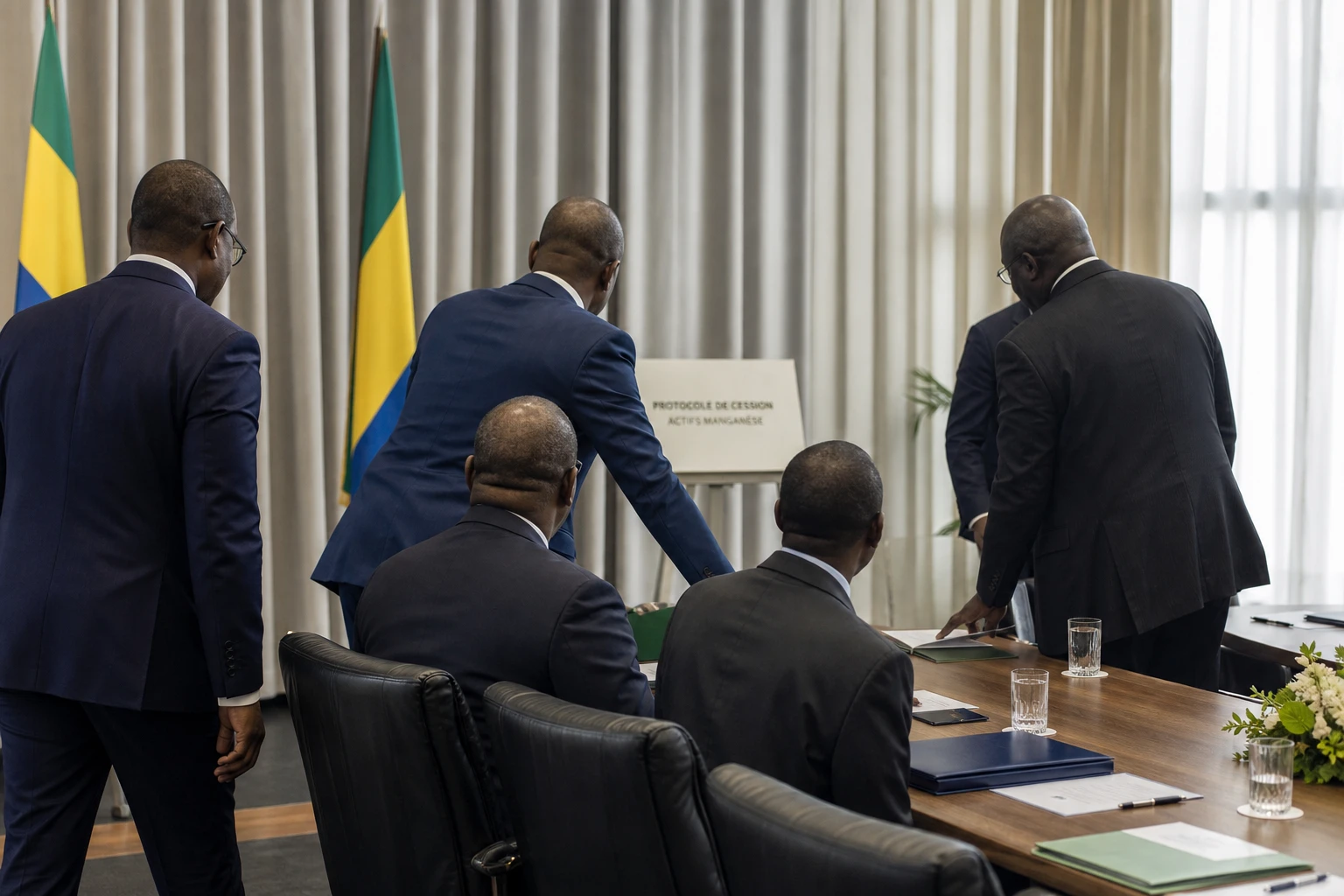
On the first day of the president’s visit, 20 July 2026, an initial memorandum of understanding on manganese was approved. The principle is clear: Eramet, through its industrial operations in Gabon, is to invest in boosting local ore processing, while the Gabonese state promises conditions deemed necessary to make projects viable, particularly access to energy. The roadmap envisages processing capacity of up to 700,000 tonnes of manganese by 2031.
The proposed industrial timetable is based on three scenarios. The first envisages a manganese oxide plant in the Libreville metropolitan area by 2028. The second involves modernising the Moanda metallurgical complex, which is already operating. The third, and most ambitious, aims to build a new manganese alloy plant in 2031. Alloy production is a more advanced processing stage than exporting raw ore, and its main market is steelmaking.
The Trans-Gabon Railway at the centre of the equation
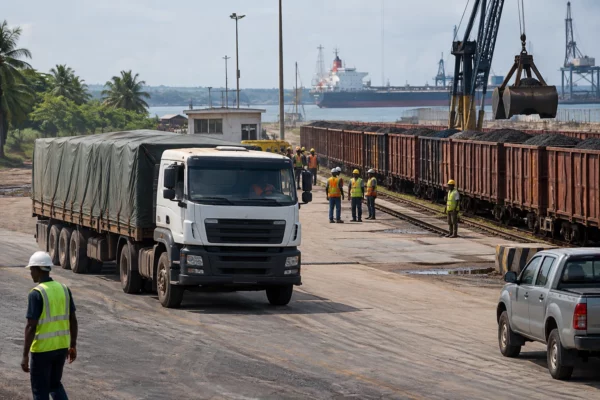
The memorandum is not just about mining. It also has logistical implications. The Trans-Gabon Railway, the country’s rail backbone, links Owendo, near Libreville, to Franceville over approximately 648 to 650 kilometres, according to institutional and financial sources. It carries passengers, but mainly mining freight. For years, its modernisation has been key both to keeping exports moving and to connecting the interior.
In this scheme, the railway is not merely an export pipeline. It serves the coast, the capital and eastern Gabon, as well as linking industry to the ports. That is why discussions on manganese intersect with those on rail investment. Financial partners already involved in modernising the Trans-Gabon Railway have framed the project in terms of safety, performance and freight transport.
What Libreville seeks, what Paris safeguards
For Libreville, the stakes are political and budgetary. The government wants to show that it is no longer content to sell a resource, but is building an industrial base. Manganese has become a symbol of economic sovereignty. The Gabonese head of state has reiterated this in several public appearances since 2025, linking local processing to jobs, revenue and moving the country up the value chain.
For Eramet, the priority is to secure a strategic asset in a country where its presence remains substantial. The group’s statements underline the weight of its mining and rail operations in Gabon, which transported 1.6 million tonnes of ore in the first quarter of 2026. The group also says it wants its presence to be part of a strategy of sustainable processing and cooperation with the Gabonese state. In other words, investment is needed, but without undermining the project’s economic balance.
Energy remains the sensitive issue. The memorandum explicitly refers to the need for reliable access to electricity. This is central. An oxide plant, a modernised metallurgical complex or an alloy facility cannot run on political promises. They need a stable power supply, controlled costs and a robust transport network. Without these, local processing could remain an industrial slogan.
A Gabonese development with implications for all of Central Africa
The issue goes beyond the Franco-Gabonese relationship. In the CEMAC sub-region, where industrial diversification remains a recurring goal, Gabon is testing an unusual approach: using a major mining resource to build a shorter, more local and more profitable value chain. If the project moves forward, it will serve as a model for Central African economies seeking to move beyond the simple export of raw materials.
The continental significance is clear. Gabonese manganese is central to the energy transition, specialist steels and some battery technologies. In this context, the question is no longer simply how much Gabon exports, but how much it processes, controls and captures in added value. This is the shift Libreville wants to accelerate, with Paris as an industrial partner but also as a negotiating partner attentive to the timetable and pace of investment. The next stage will be about turning agreements into action: financing, energy, permits and the start of construction.