Algeria
 Egypt
 Libya
 Morocco
 Sudan
 Tunisia
 Benin
 Burkina Faso
 Cabo Verde
 Côte d'Ivoire
 Ghana
 Guinea
 Guinea-Bissau
 Liberia
 Mali
 Mauritania
 Niger
 Nigeria
 Senegal
 Sierra Leone
 The Gambia
 Togo
 Cameroon
 Central African Republic
 Chad
 DR Congo
 Equatorial Guinea
 Republic of the Congo
 São Tomé and Príncipe
 Burundi
 Comoros
 Djibouti
 Eritrea
 Ethiopia
 Kenya
 Madagascar
 Malawi
 Mauritius
 Mozambique
 Rwanda
 Seychelles
 Somalia
 South Sudan
 Tanzania
 Uganda
 Angola
 Botswana
 Eswatini
 Lesotho
 Namibia
 South Africa
 Zambia
 Zimbabwe
In Libreville, mining diversification is no longer just talk. It is now taking shape through several projects still in development, with one central question: how can Gabon’s underground resources be turned into revenue, jobs and lasting industrial capacity ?
The Banio potash project in south-western Gabon is moving towards a new stage. At the same time, the state is seeking to revive Maboumine, an asset containing niobium and rare earths, among other resources. The two projects expand the mining map of a country still heavily dependent on oil and manganese.
An extractive sector concentrated on a few resources
In 2023, extractive activities accounted for 22.6 % of Gabon’s gross domestic product and 91.2 % of export revenue, according to the 2023 report by the Extractive Industries Transparency Initiative in Gabon. This high contribution nevertheless masks a heavy concentration.
Hydrocarbons provided about 81 % of extractive revenues that year. The mining sector is still driven mainly by manganese, extracted on a large scale around Moanda, and by gold. This structure leaves the economy sensitive to fluctuations in global prices and limits the impact of resource rents on local processing.
The Gabonese government is therefore seeking to broaden the country’s mining base. A roadmap for the sector identifies niobium, rare earths, uranium and zinc as resources that could support a new phase of development, alongside manganese and gold.
Banio reaches the technical studies stage
The Banio project is being developed by Canadian company Millennial Potash. The company plans to begin production by 2029, subject to completion of the studies, receipt of permits and mobilisation of the necessary financing.
The company launched a definitive feasibility study in January 2026. The document is expected to set out technical choices, investment costs, logistical requirements and the future site’s profitability. An environmental and social impact assessment is being conducted in parallel.
Both studies are due to be completed in the second half of 2026. They will then be used to prepare an application for an operating permit from the Gabonese authorities. A final investment decision, meanwhile, is expected in early 2027. These dates remain industrial targets, not guaranteed deadlines.
The project has also received financial support of up to 3 million dollars from the US Development Finance Corporation. This funding covers preparatory studies. It is not yet the full financing for the mine.
Potash is used in the manufacture of fertiliser. At Banio, Millennial Potash is considering a production scenario of up to 800 000 tonnes a year of potassium chloride, also known as MOP. The site is presented as a future source of supply for several markets, including Africa, Brazil and the United States.
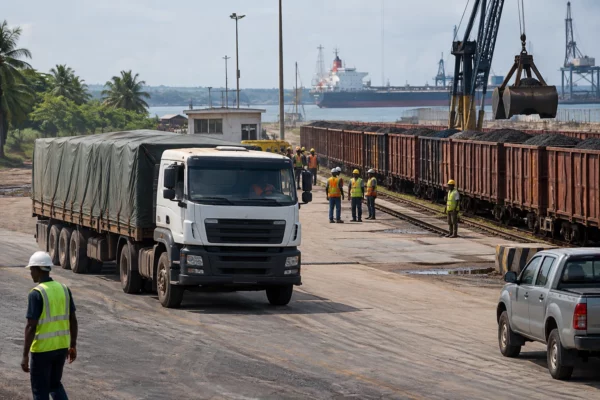
This focus gives the project an international commercial dimension. It should not, however, obscure the challenges specific to Gabon: access to the site, port infrastructure, transport, energy, water management and integration into local economies.
Maboumine, the other strategic project
The Maboumine project has a different role. It concerns a deposit containing niobium and rare earths. Niobium is used, among other things, to manufacture strong metal alloys. Rare earths, meanwhile, comprise several elements used in electronics, magnets and certain energy technologies.
The asset returned to Gabonese state ownership after several years under the control of Eramet. Since 2024, its development has been linked to New Energy Metals Holdings, a company backed by investors based in Abu Dhabi.
On 16 February 2026, New Energy Metals and Indonesian state mining company PT Perminas signed a memorandum of understanding. The stated aim is to conduct new feasibility studies and examine the conditions for an integrated value chain for niobium and rare earths.
At this stage, Maboumine is therefore not a producing mine. The memorandum opens an assessment phase. The quality and volume of the resources still need to be established, processing methods determined, infrastructure costs calculated and the industrial structure clarified.
Value will be created beyond extraction
For Libreville, the challenge is not simply to attract new operators. It is above all to make better use of the country’s resources. A mine can boost exports without creating significant industrial processing. It can also generate limited public revenue if costs, exemptions and revenue-sharing arrangements are not clearly regulated.
The debate is therefore about how value is distributed. The authorities will need to negotiate tax terms, employment obligations, training for Gabonese people and the participation of local businesses. They will also need to monitor the effects on the areas concerned, particularly those far from Libreville.
For local populations, the benefits are not measured only by the number of jobs created at the mine site. They also include roads, access to electricity, health services, commercial activity and the protection of livelihoods. Formal-sector workers and informal-economy actors may be affected differently by the arrival of a major project.
Transparency will be another test. Contracts, public payments, social spending and environmental commitments must be open to scrutiny. The 2023 report by EITI Gabon provides a useful basis for measuring the extractive sector’s real weight and the revenues associated with it.
An issue that extends beyond Gabon’s borders
Gabon is part of the Economic and Monetary Community of Central Africa, CEMAC, which brings together six countries that share, among other things, the Central African CFA franc. Gabon’s mining diversification could therefore influence regional flows of transport, energy, services and capital.
It is also taking place amid global competition for so-called critical minerals. The term refers to resources considered essential to industry and exposed to supply risks. The priorities of the United States, Europe and several Asian economies may make financing easier to access. They may also increase pressure on producer countries to secure volumes quickly.
Gabon will therefore need to avoid replacing one dependency with another. The success of Banio and Maboumine will be measured less by project announcements than by their ability to produce under controlled conditions, diversify the economy and retain more value within Gabon.
The next milestones are clear: completion of Banio’s feasibility and impact studies in the second half of 2026, followed by a possible investment decision in early 2027. For Maboumine, the new studies will chiefly establish whether its geological potential can become a viable industrial project.