Algeria
 Egypt
 Libya
 Morocco
 Sudan
 Tunisia
 Benin
 Burkina Faso
 Cabo Verde
 Côte d'Ivoire
 Ghana
 Guinea
 Guinea-Bissau
 Liberia
 Mali
 Mauritania
 Niger
 Nigeria
 Senegal
 Sierra Leone
 The Gambia
 Togo
 Cameroon
 Central African Republic
 Chad
 DR Congo
 Equatorial Guinea
 Gabon
 Republic of the Congo
 São Tomé and Príncipe
 Burundi
 Comoros
 Djibouti
 Eritrea
 Ethiopia
 Kenya
 Madagascar
 Malawi
 Mauritius
 Mozambique
 Rwanda
 Seychelles
 Somalia
 South Sudan
 Tanzania
 Uganda
 Angola
 Botswana
 Eswatini
 Lesotho
 Namibia
 Zambia
 Zimbabwe
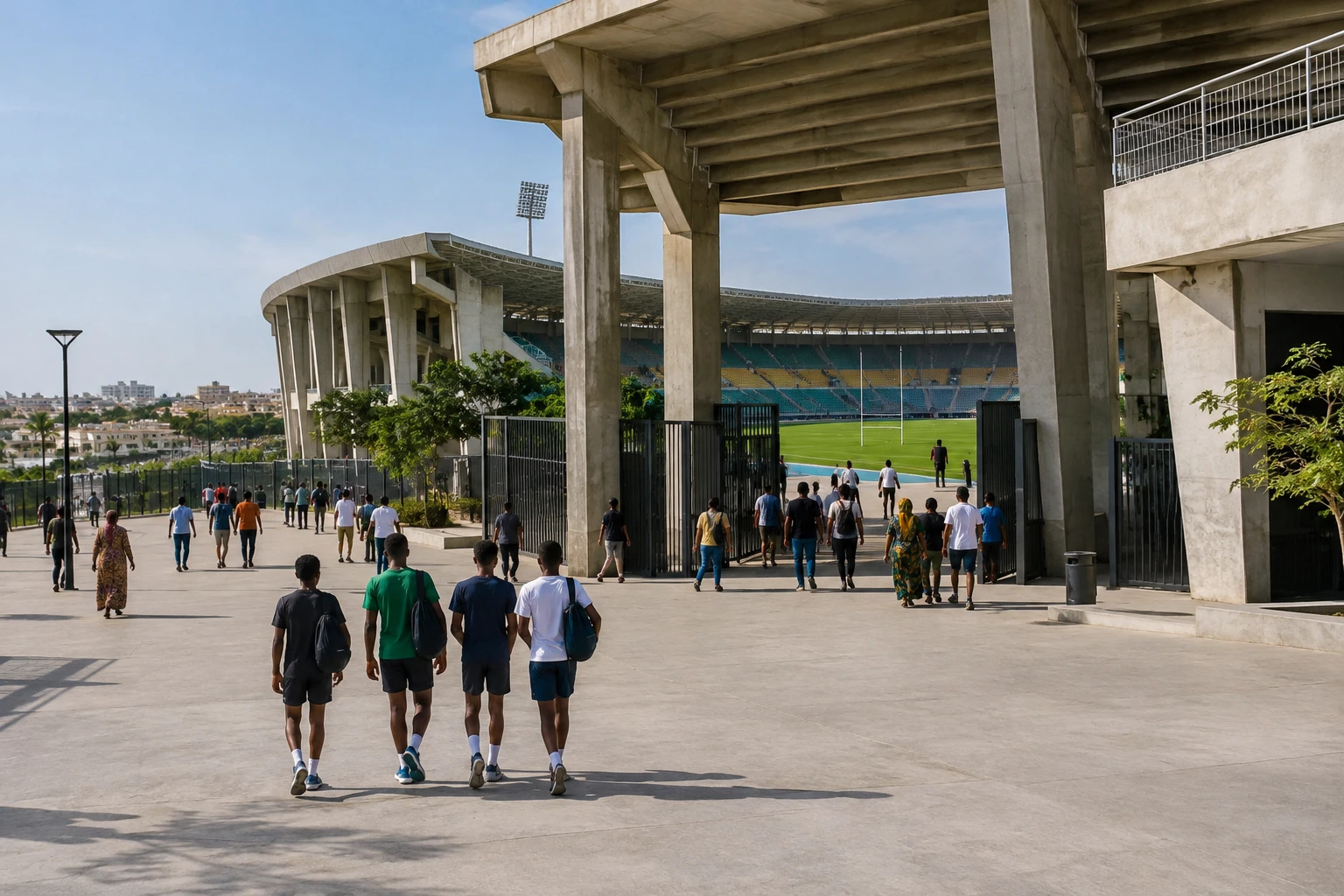
In Dakar, the rugby sevens tournament gave France’s young players a test of character as well as a title. They held on to their lead against South Africa after their opponents fought back, winning the final 26-19 on Monday 2 November 2026. For Senegal, host of the first Olympic Games to be held on the African continent, the match also put Iba Mar Diop Stadium at the heart of a competition followed far beyond the capital.
A commanding tournament, a hard-fought final
The final victory capped a campaign largely dominated by France. Les Bleuets beat Uganda 58-0 and Japan 48-0 in the group stage, then Canada 58-0 in the semi-final. Those scores show their effectiveness, but do not tell the whole story of the final.
France took the lead in the first half, going 21-5 ahead. South Africa then closed to within two points. The pressure shifted, and the final no longer looked like a one-sided display. France nevertheless kept enough control to win 26-19. The result and the stages of the campaign are listed in the competition’s official records, while France’s account of the opening matches confirms the scores against Japan and Uganda. The official Dakar 2026 rugby sevens results and the French Olympic team’s report corroborate these details.
Captain Pablo Garbajosa and his team turned a comfortable lead into a title at the end of a match in which concentration mattered as much as speed. In this discipline, every possession can quickly shift the balance of power: a team in the lead must keep defending and attacking, without assuming it is safe.
Dakar hosts a continental sporting event
The Youth Olympic Games run from 31 October to 13 November 2026. Their staging in Senegal marks a first: the country is hosting the first Olympic event to be held in Africa. Events are spread across Dakar, Diamniadio and Saly. The rugby sevens tournament is being played at the Iba Mar Diop complex in the capital. The International Olympic Committee outlines the framework and significance of the Dakar Games.
This matters for Senegal and the African sporting movement. Hosting an international competition of this scale showcases the country’s infrastructure, organisational capacity and audiences. But the stakes go beyond Dakar’s image. The event’s lasting value will also depend on what remains after the finals: young people’s access to sport, support for clubs and the use of facilities.
Rugby sevens has particular regional resonance. Senegal is a member of ECOWAS, the Economic Community of West African States, and part of a region where sporting exchanges bring federations and young people closer together. The presence of African teams in the tournament, including South Africa, Uganda and the host nation, also shows that youth competitions are not merely a showcase for the major sporting nations.
A legacy to pass on, not just celebrate
For the French squad, the victory continues the momentum of the men’s team’s Olympic title at Paris 2024. Players from that team, including Paulin Riva and Stephen Parez, as well as coach Jérôme Daret, spoke with the young players before the Games. Their message was about solidarity and resilience in difficult moments, rather than a single tactical formula.
This passing on of experience does not guarantee future success. It does, however, give young players practical reference points: how to stay united when opponents come back, manage the pressure of a final and trust the team. The match against South Africa put precisely these principles to the test. The legacy of older players becomes useful to the young when it informs decisions on the pitch.
The family dimension mentioned by several players adds to this story. Some come from families already connected to French rugby. That environment can foster a feel for the game, but the title belongs to a team built through daily work and bonds between team-mates. Reducing the victory to a name or family lineage would overlook the collective performance.
What the title changes — and what it does not resolve
For France, this gold medal confirms the ability of its development system to pass the demands of rugby sevens on to the next generation. On its own, it cannot measure the depth of that system or predict the careers of Dakar’s champions. Youth tournaments are stages in development, not guarantees of success at the highest level.
For Senegal, the tournament gives tangible visibility to a sport seeking to broaden its participation and audience. Staging the events in Dakar brings young audiences closer to an international competition and offers a point of comparison with experienced teams. The question remains how this attention can be sustained in clubs and local organisations beyond the Games schedule.
At continental level, the most striking image is therefore not only that of a French trophy. It is also that of a tournament hosted in Africa, where teams from several regions meet and young Senegalese can watch rugby sevens at the highest level in their age group. The challenge for organisers and federations will be to sustain this momentum after the competitions close, without confusing short-term visibility with established sporting development.