Algeria
 Libya
 Morocco
 Sudan
 Tunisia
 Benin
 Burkina Faso
 Cabo Verde
 Côte d'Ivoire
 Ghana
 Guinea
 Guinea-Bissau
 Liberia
 Mali
 Mauritania
 Niger
 Nigeria
 Senegal
 Sierra Leone
 The Gambia
 Togo
 Cameroon
 Central African Republic
 Chad
 DR Congo
 Equatorial Guinea
 Gabon
 Republic of the Congo
 São Tomé and Príncipe
 Burundi
 Comoros
 Djibouti
 Eritrea
 Ethiopia
 Kenya
 Madagascar
 Malawi
 Mauritius
 Mozambique
 Rwanda
 Seychelles
 Somalia
 South Sudan
 Tanzania
 Uganda
 Angola
 Botswana
 Eswatini
 Lesotho
 Namibia
 South Africa
 Zambia
 Zimbabwe
A show of strength in the New Capital
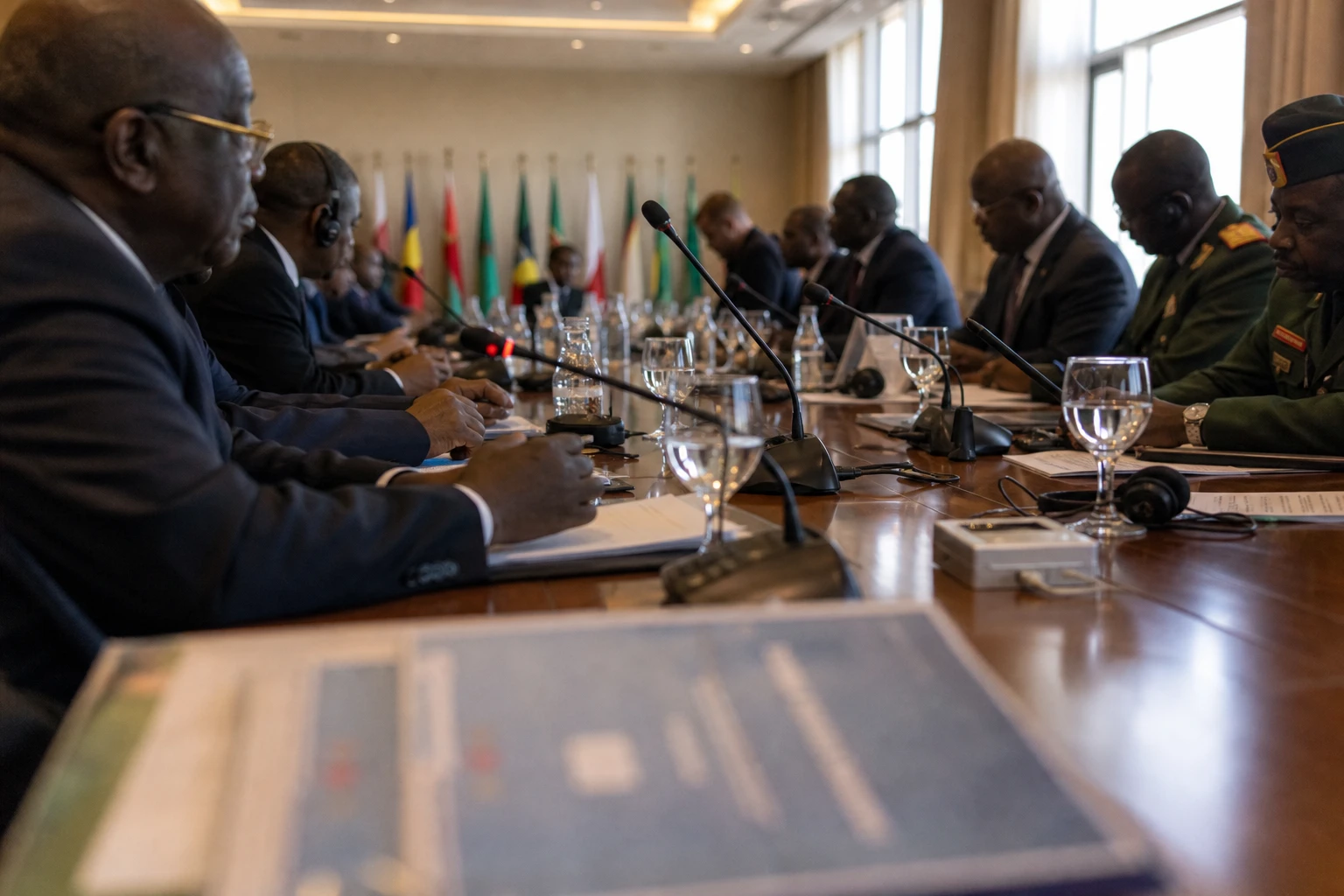
In the shadow of the official stands, Egypt sent a clear message: its air defences are not merely modern, but designed as an instrument of sovereignty. The display of the S-300VM system at the heart of the inauguration of the State Strategic Command headquarters in the New Capital turned a military demonstration into a political declaration. On 4 July 2026, the Egyptian presidency confirmed that the ceremony had taken place, featuring a troop review, Apache helicopter flypasts and presentations of military equipment.
In Global Firepower’s 2026 ranking, Egypt is listed as the continent’s leading military power and 19th in the world. It is worth recalling that this is a methodological index based on several estimated parameters, not an official audit of armed forces. But the ranking still says something: Cairo remains one of North Africa’s major military powers, in a regional environment shaped by the war in Gaza, tensions in the Red Sea and persistent instability around Libya and Sudan.
What Cairo displayed, and what it confirmed
The main point was not the setting, but the equipment on display: a 9A83ME launcher and its fire-control radar, associated with the S-300VM system, also known as the Antey-2500. Russian defence exporter Rosoboronexport describes the system as designed to defend strategic sites, deployed units and sensitive infrastructure against aircraft, ballistic missiles and cruise missiles. Its specifications list a maximum range of 350 kilometres against aerodynamic targets and a maximum altitude of 30 kilometres.
The public appearance of the S-300VM ends years of uncertainty. In 2014, several media outlets and news agencies reported a wider arms deal between Russia and Egypt worth about $3.5 billion, with the S-300VM reportedly accounting for around $1 billion for four batteries, command posts, launchers and logistical support. Sources at the time also said deliveries had begun or were being prepared from 2015, with images of equipment being unloaded at the port of Alexandria later cited.
In other words, the July 2026 presentation does not prove that the purchase took place; above all, it confirms the operational integration of a system long discussed, sometimes disputed, but never publicly acknowledged so explicitly. The message is significant for Egypt’s military communications: it presents an army seeking to show that it can integrate equipment from several sources while retaining control over when it is revealed.
Diversifying suppliers and balancing the region
The move reflects Cairo’s well-established strategy of avoiding dependence on a single supplier. Over the years, Egypt has acquired Russian, American and French equipment. This diversification serves a technical imperative, but also a diplomatic one. It avoids putting all combat, maintenance and modernisation capabilities in the hands of one partner. At a time when sanctions, export restrictions and delivery delays can weigh on arms supply chains, this approach has become central for several African capitals.
The issue remains sensitive at regional level. The Sinai remains politically charged, with Egypt’s military room for manoeuvre constrained by the 1979 peace treaty with Israel. This explains why any advance in air defences, especially if presented as a leap in capability, immediately draws the attention of neighbours and Western partners. Egypt, for its part, has long maintained that its acquisitions are primarily intended to protect its borders, bases and strategic routes.
The choice of the New Capital is also significant. By establishing its Strategic Command in the complex known as “the Octagon”, the Egyptian government is showcasing a greater centralisation of military decision-making, at the intersection of politics, security and logistics. The presidency described a ceremony combining a flag-raising, a troop inspection and a presentation of the armed forces’ operations centre. Such a display tells us as much about the state as it does about the military: it signals the institution’s place in the organisation of power in Egypt.
A perspective that extends beyond Egypt
For North Africa, the moment matters because it reveals a broader trend: states able to invest in layered defence systems are seeking to secure their airspace against increasingly hybrid threats. Drones, missiles, electronic warfare and precision strikes mean the continent’s armed forces must now think in terms of integrated systems, not just troop numbers. Egypt presents itself here as a testing ground for this shift, with an arsenal combining different origins and doctrines of use.
At continental level, the issue also points to the African defence market. Russia retains a foothold in several of the continent’s armed forces, despite competition from China, Türkiye, the United States and several European manufacturers. For African states, the question is not simply one of prestige or raw power. It concerns maintenance, training, spare parts and strategic autonomy. In this field, the real issue is not owning an advanced system, but being able to keep it operational over the long term.
By bringing the S-300VM into the spotlight, Cairo did more than exhibit an air-defence battery. Egypt has reiterated that it intends to remain a major military actor, able to engage with Moscow, Washington and Paris without being locked into a single alignment. And in a region where the security of straits, borders and major air corridors is becoming a daily concern, this kind of signal matters far beyond Egypt itself.