
 Algeria
 Egypt
 Libya
 Morocco
 Sudan
 Tunisia
 Benin
 Burkina Faso
 Cabo Verde
 Côte d'Ivoire
 Ghana
 Guinea
 Guinea-Bissau
 Liberia
 Mali
 Mauritania
 Niger
 Nigeria
 Senegal
 Sierra Leone
 The Gambia
 Togo
 Cameroon
 Central African Republic
 Chad
 Equatorial Guinea
 Gabon
 Republic of the Congo
 São Tomé and Príncipe
 Burundi
 Comoros
 Djibouti
 Eritrea
 Ethiopia
 Kenya
 Madagascar
 Malawi
 Mauritius
 Mozambique
 Rwanda
 Seychelles
 Somalia
 South Sudan
 Tanzania
 Uganda
 Angola
 Botswana
 Eswatini
 Lesotho
 Namibia
 South Africa
 Zambia
 Zimbabwe
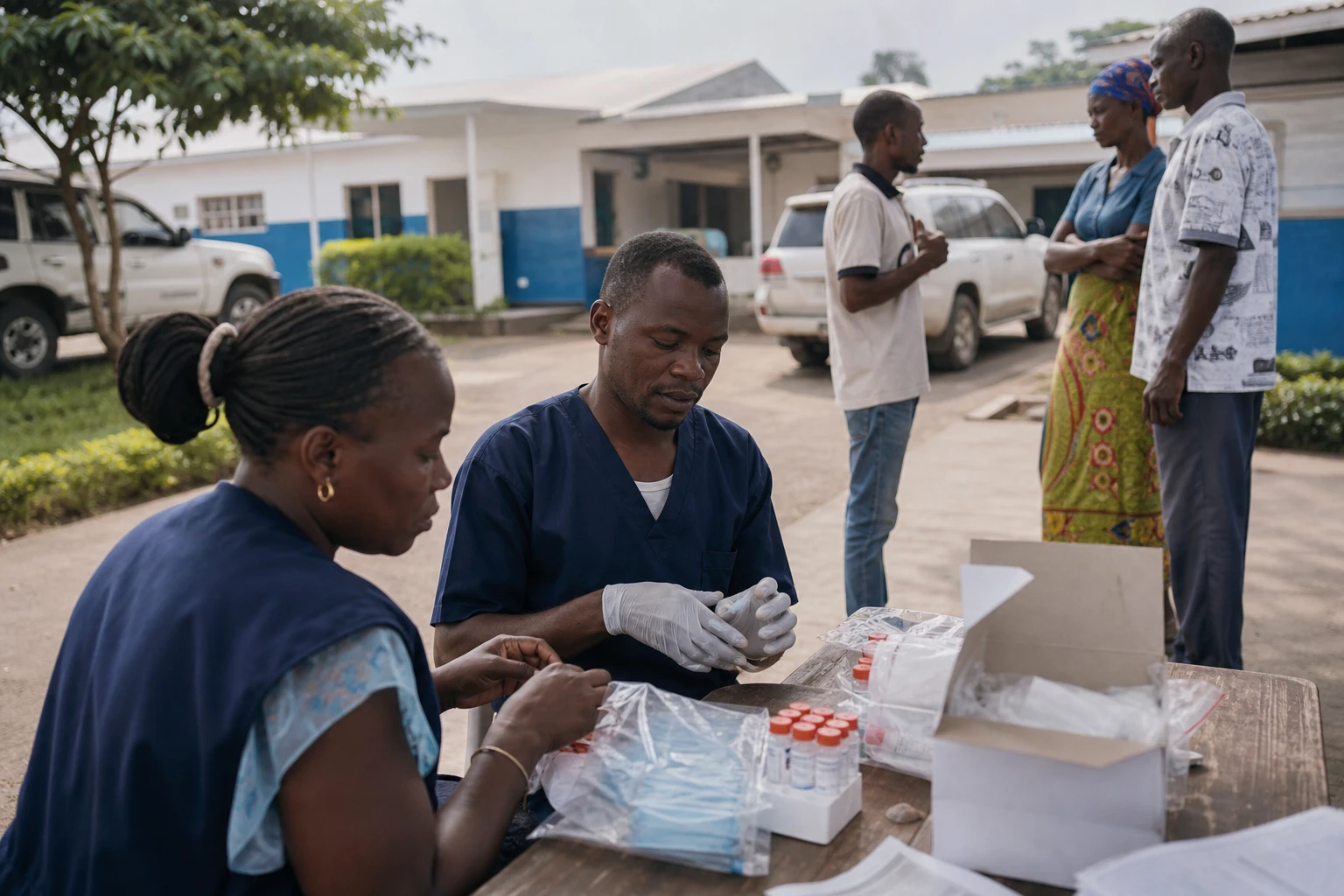
In the east of the Democratic Republic of the Congo, the fight against Ebola depends as much on medical resources as on the ability to reach communities. At the end of September 2019, new US aid was set to strengthen a response challenged by the virus’s spread, long distances and insecurity.
An epidemic concentrated in eastern DR Congo
The outbreak began on 1 August 2018 in North Kivu province, before spreading to Ituri. Both provinces are in a densely populated area, marked by population movements and proximity to Uganda. Cross-border movement therefore required constant coordination between Kinshasa, Kampala and regional health actors.
The security situation complicated every step. In several areas, health teams had to work with escorts or suspend their movements after attacks. This situation slowed the identification of contacts, access to treatment centres and vaccination operations.
The Democratic Republic of the Congo nevertheless had considerable experience in responding to Ebola. Its laboratories, investigation teams and community health workers had already helped contain several outbreaks. But the scale of the epidemic and its presence in areas affected by violence made the response longer and more costly.
Washington announces an additional $267 million
On 23 September 2019, the United States announced an additional $267 million contribution to support the health and humanitarian response. Most of the funding was to benefit DR Congo, while some was allocated to preparedness in neighbouring countries.
The announcement brought the US commitment since the start of the outbreak to $886 million, according to US authorities. The funding was to support treatment centres, laboratories, epidemiological surveillance, the protection of health workers and communication with communities.
The funds formed part of a broader international appeal, whose target stood at about $2 billion. The response required more than medicines and equipment. It also needed resources to pay teams, transport samples, secure routes and maintain routine health services.
Previous US announcements included $13 million released in spring 2019, followed by an additional $80 million. In August, Washington had added $242 million for the response in DR Congo, preparedness in Uganda and related humanitarian needs.
Figures should be treated with caution
Data shared around the announcement sometimes conflated different periods or geographic areas. Figures of several thousand cases and deaths attributed to 23 September 2019 do not correspond to the epidemiological reports published at that time.
The benchmark figures published by the World Health Organization put the number of cases in the ongoing epidemic at about 3,175 as of 24 September 2019, including nearly 2,120 deaths. The West African Health Organization report published a few days later recorded 3,191 cases and 2,129 deaths as of 29 September, including confirmed and probable cases in the affected provinces.
These discrepancies are a reminder of an essential rule during a health crisis: figures are meaningful only if they specify their date, geographic area and counting method. Provisional figures can change after community deaths are verified and samples analysed.
North Kivu remains under intense pressure
Ituri remained the province with the highest cumulative number of cases. However, North Kivu accounted for a significant share of new infections. In the three weeks before 23 September, 567 new cases were reported there, according to data cited in situation reports at the time.
Transmission was advancing in areas where movement was difficult. Teams sometimes had to search for a patient’s relatives in crowded neighbourhoods, remote villages or among families who had left their homes. Every delay increased the risk of new chains of transmission.
Trust was another challenge. In some communities, fear of isolation or mistrust of responders delayed people from seeking care. Response teams therefore increased the involvement of local leaders, associations, survivors and community health workers.
This approach was not simply a matter of communication. It determined whether vaccines would be accepted, symptoms reported promptly and safe, dignified burials organised. It also had to ease tensions between public health requirements and family practices.
A regional response, not just a Congolese one
Uganda was affected at the start of the outbreak. Kampala declared the end of local transmission on 28 July 2019, after 42 days without a new case. This showed that a rapid response could interrupt a chain of transmission, but it did not remove the risk of reintroduction while the virus was circulating in DR Congo.
The two countries had strengthened checks at crossing points, traveller surveillance and the preparedness of health facilities. These measures also concerned South Sudan and Rwanda, neighbours of DR Congo exposed to population movements from the eastern areas.
Across Africa, the epidemic highlighted the need to fund national capacities rather than limit aid to emergency intervention. Congolese laboratories, local teams and surveillance networks were enduring infrastructure. Strengthening them could also help tackle other infectious diseases and future health alerts.
The US contribution therefore provided immediate support, but did not address the underlying causes of the response’s fragility. What happened next depended on continued funding, humanitarian access in North Kivu and Ituri, and coordination between the Congolese authorities, neighbouring countries, the World Health Organization and local communities.



