
 Algeria
 Egypt
 Libya
 Morocco
 Sudan
 Tunisia
 Benin
 Burkina Faso
 Cabo Verde
 Côte d'Ivoire
 Ghana
 Guinea
 Guinea-Bissau
 Liberia
 Mali
 Mauritania
 Niger
 Nigeria
 Senegal
 Sierra Leone
 The Gambia
 Togo
 Cameroon
 Central African Republic
 Chad
 Equatorial Guinea
 Gabon
 Republic of the Congo
 São Tomé and Príncipe
 Burundi
 Comoros
 Djibouti
 Eritrea
 Ethiopia
 Kenya
 Madagascar
 Malawi
 Mauritius
 Mozambique
 Rwanda
 Seychelles
 Somalia
 South Sudan
 Tanzania
 Uganda
 Angola
 Botswana
 Eswatini
 Lesotho
 Namibia
 South Africa
 Zambia
 Zimbabwe
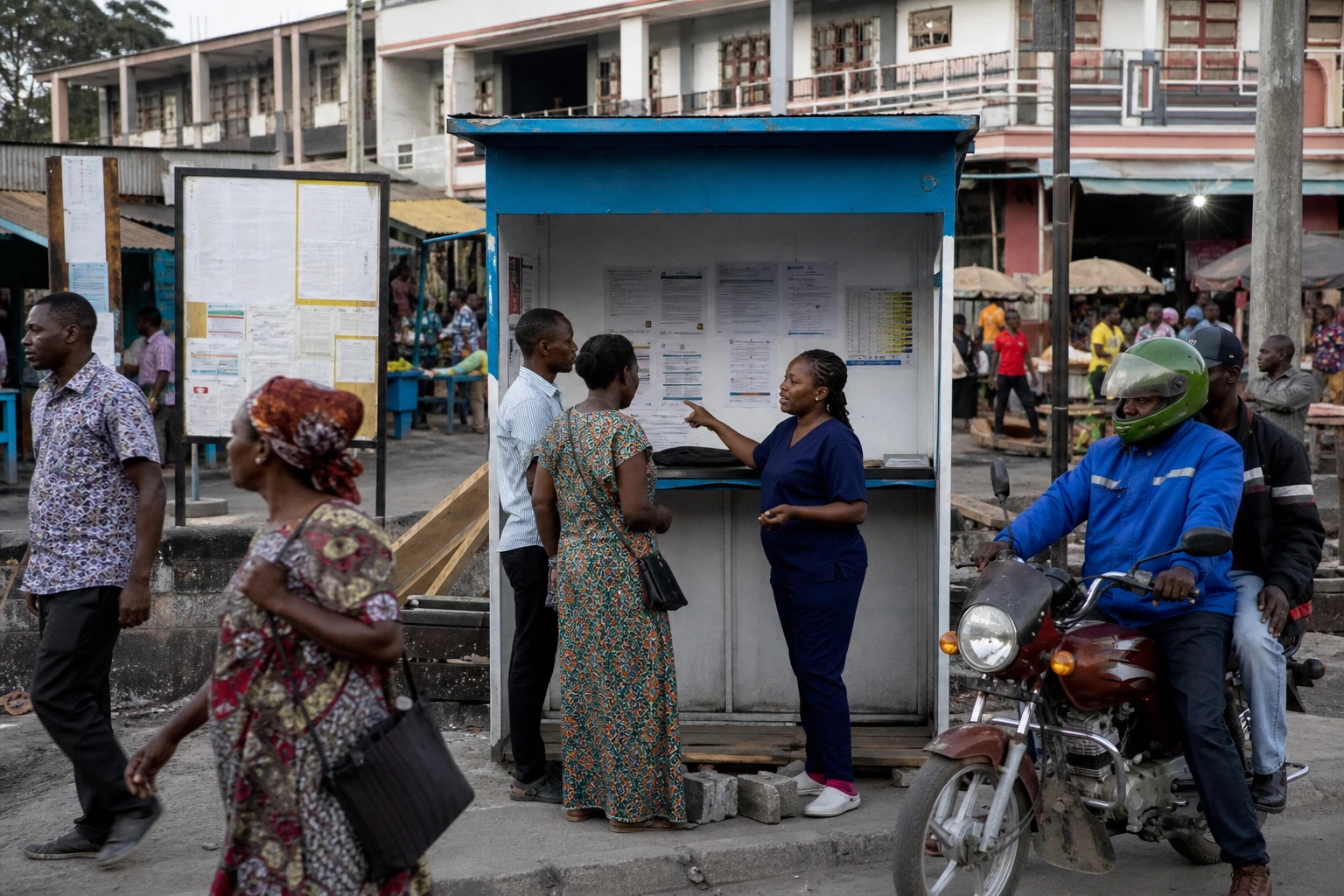
In North Kivu, the epidemic is not merely gaining ground. It is taking hold where the health system is already under strain.
In the Democratic Republic of the Congo, Ebola outbreaks are never quite the same. But they often expose the same weakness: the vulnerability of remote health zones, the rapid movement of patients and the difficulty of isolating cases early enough. In North Kivu, this equation has become even more challenging, with confirmed cases rising rapidly and treatment facilities at capacity.
North Kivu province, in the east of the country, remains both strategically important and fragile. It borders Uganda and Rwanda, at the heart of the Great Lakes region’s main human and commercial routes. In this kind of setting, an epidemic is not confined to a health map: it affects markets, daily travel, displaced families and supply chains.
A sharp rise in cases in North Kivu
As of 4 September 2026, North Kivu had recorded 969 confirmed cases and 638 cumulative deaths, according to consolidated response data. This puts the province’s case fatality rate at 65.8%, well above the national average, which stood at 48.1% on the same date. On that day, 31 new cases were recorded there in 24 hours, compared with 53 in Ituri and two in Haut-Uélé.
The increase is rapid. Between 30 August and 4 September, the number of confirmed cases in the province rose from 836 to 969, an increase of 133 in five days. Over the same period, the country recorded 422 additional cases, meaning that about one in three new cases came from North Kivu. This trend confirms that the province is no longer merely a transmission zone, but also an active centre of expansion.
North Kivu now has 16 affected health zones out of 34. Kayna was added to the count on 4 September, becoming the only newly affected zone in this five-day period. This expansion matters because a health zone is not simply an administrative unit: it is the level at which alerts, consultations, community surveillance and transfers to treatment centres are organised.
Why North Kivu matters so much to the response
Three zones account for a large share of the provincial burden: Katwa, Butembo and Beni. Together, they sum up some of the challenges facing the response. The case fatality rate remains very high, suggesting delays in detection, late treatment and an incomplete contact-tracing chain. In Beni, the rate exceeds 73%. In Butembo, it stands at 70.1%. In Katwa, it is 65%.
The problem is not only the number of cases. It is also the speed of the epidemic and the capacity to receive patients. North Kivu has 220 beds in its treatment centres, but occupancy exceeded 100% on the days studied. On 3 September, more than half of the province’s patients were being treated in health facilities not dedicated to Ebola. In other words, the response had to urgently expand its treatment sites, with the risk of making isolation and surveillance even more difficult.
This overcrowding sheds light on another aspect of the epidemic: the pressure on healthcare workers. When specialist centres overflow, general hospitals, clinics and peripheral facilities take in some of the patients. This increases the need for protective equipment, medical transport, rapid tests and contact tracing. It also heightens the exposure of local teams, who are already dealing with other public health emergencies.
What the figures say about the balance of health-system capacity
North Kivu has fewer cases than Ituri, but more deaths relative to its confirmed cases. This difference is not trivial. It points to later treatment, more complicated care pathways and, no doubt, greater virus transmission outside the surveillance system. In practice, the province pays a higher price for every delay in raising the alarm.
The situation also shows the limits of a response centred on urban areas. North Kivu’s major cities, notably Beni and Butembo, have more visible infrastructure and teams. But as soon as infection spreads to more dispersed areas, logistics become more difficult. Distances grow, travel becomes more costly, and community surveillance loses responsiveness. This is often where cases worsen before they are confirmed.
The Congolese government launched a revised 180-day multisectoral plan in Kinshasa on 4 September to strengthen the response. The initiative brings together the Ministry of Health, WHO, Africa CDC, the United Nations and several partners. It aims to better co-ordinate surveillance, treatment and the interruption of transmission. The decision to revise the plan confirms that the response is entering an adjustment phase, with needs greater than expected.
An alert for the DRC, but also for the region
This outbreak has implications beyond the country. North Kivu is in direct contact with several areas of movement in Central and East Africa. In a region where borders are porous, cross-border markets, family travel and movements linked to conflict make surveillance more complex. This is also why WHO, Africa CDC and the Congolese authorities are working in parallel with a regional co-ordination approach.
The country has already experienced 17 Ebola outbreaks since the virus was discovered in 1976, making the Democratic Republic of the Congo one of the African countries with the most experience in responding to the disease. But experience is not always enough when transmission accelerates and several provinces are affected at the same time. The challenge is no longer solely medical. It is also logistical, territorial and institutional.
For Kinshasa, the priority is clear: prevent North Kivu from becoming the foothold for a wider expansion. For local populations, the urgency is even more immediate: to access testing, care and isolation quickly, before the disease progresses to its most severe forms. This is where, once again, the difference is made between a contained response and an epidemic that drags on.



