
 Algeria
 Egypt
 Libya
 Morocco
 Sudan
 Tunisia
 Benin
 Burkina Faso
 Cabo Verde
 Côte d'Ivoire
 Ghana
 Guinea
 Guinea-Bissau
 Liberia
 Mali
 Mauritania
 Niger
 Nigeria
 Senegal
 Sierra Leone
 The Gambia
 Togo
 Cameroon
 Central African Republic
 Chad
 DR Congo
 Equatorial Guinea
 Gabon
 Republic of the Congo
 São Tomé and Príncipe
 Burundi
 Comoros
 Djibouti
 Eritrea
 Ethiopia
 Kenya
 Madagascar
 Malawi
 Mauritius
 Mozambique
 Rwanda
 Seychelles
 Somalia
 South Sudan
 Tanzania
 Uganda
 Angola
 Botswana
 Eswatini
 Lesotho
 Namibia
 Zambia
 Zimbabwe
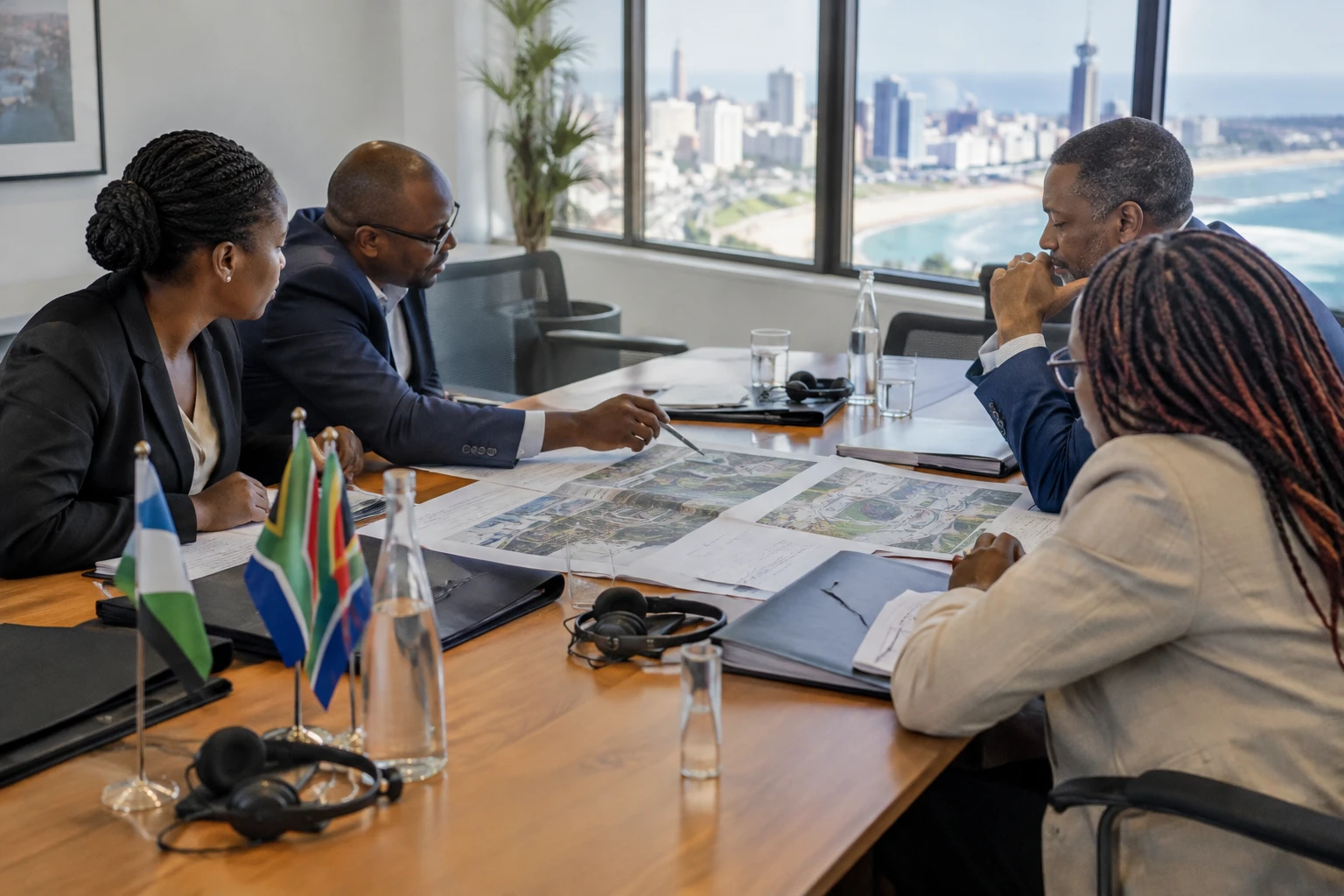
A stadium that has already been built is not enough to host the Olympic Games. Durban’s challenge is now to turn a continental ambition into a costed, sustainable and credible project for residents and sporting bodies alike.
A South African bid taking shape across several cities
The South African Olympic Committee has named Durban as the main city in its project for the 2036 or 2040 Olympic and Paralympic Games. The announcement was made on 29 October by Lwandile Simelane, acting president of the South African Sports Confederation and Olympic Committee, known by its English acronym SASCOC. Johannesburg and Cape Town had also been considered.
The proposed format would not be limited to Durban. Several cities could host events, following a multi-site approach. This option would distribute events and make use of existing facilities, but would require close co-ordination between municipalities, provinces and the national government.
The project is still at an exploratory stage. Durban’s designation as the national committee’s preferred city should not be confused with the award of the Games, or even with an officially selected bid by the International Olympic Committee (IOC).
The IOC currently lists seven countries in continuous dialogue for the 2036 edition: South Africa, Germany, Hungary, India, Qatar, the Republic of Korea and Türkiye. According to its updated timetable, an initial selection for strategic dialogue is expected in March 2027. The election of the host is targeted for mid-2029. The selection timetable published by the IOC therefore replaces provisional dates that were sometimes mentioned previously.
Infrastructure, but also lessons to learn
Durban, a major coastal city in KwaZulu-Natal province, already has facilities built for the 2010 FIFA World Cup. Moses Mabhida Stadium, constructed for the tournament, has a capacity of 56,000. It could be one of the main venues in the plan, although that alone does not make it possible to assess the work needed for all Olympic disciplines.
Durban was considered for the Olympic Games more than a decade ago, after the World Cup. The project did not go ahead, partly amid concerns about its cost. Durban later secured the right to host the 2022 Commonwealth Games, before losing it in 2017 because its financial guarantees were deemed insufficient. This precedent weighs on the current debate: the ability to present a realistic budget will be just as important as the availability of stadiums.
For now, South African authorities have not published an overall estimate of the cost of the Games. This is a major unknown. Hosting them requires much more than sports venues: transport, accommodation, security, health services, accessibility for people with disabilities and Paralympic operations. It also involves long-term expenditure, including the maintenance of facilities after the competition.
SASCOC presents Durban as the anchor for a national effort. Its announcement confirms the sports committee’s preference, but does not yet constitute a budget or a financial guarantee from the state. SASCOC’s statement highlights the experience gained from major events held in the country. The challenge will be to translate that experience into specific, verifiable commitments.
The benefits will depend on how costs and gains are shared
A multi-site bid can avoid concentrating all investment in a single city. It can also extend the benefits to other urban centres. But these gains are not automatic. Public spending, the choice of venues and transport priorities will determine who benefits from investment and who bears the costs.
In Durban, residents could benefit from improved infrastructure and opportunities for small businesses, particularly in services, catering and transport. But contracts must be accessible to them, and facilities must meet local needs after the Games. Temporary event-related jobs alone do not guarantee lasting economic activity.
Housing, traffic and access to services also merit a place in the assessment. In a bid of this scale, neighbourhoods close to venues, workers in the informal sector and less well-served areas may experience the changes differently. Consulting residents and publishing costs would help measure these effects, rather than reducing the debate to sporting prestige.
For Pretoria, the seat of government, the decision will involve balancing sporting ambition against the country’s budgetary constraints. The Commonwealth Games precedent is a reminder that announcing a major event does not replace funding guarantees. The respective responsibilities of the state, provinces, municipalities and private partners will also need to be clarified.
A matter for southern Africa and the African sporting movement
If successful, the bid would make South Africa the first African country to host the Summer Olympic Games. The continent has already hosted the FIFA World Cup, in 2010, but never the Olympic Games. The symbolic significance would therefore be considerable. It does not, however, remove the need to examine feasibility, public priorities and the concrete legacy for the population.
The bid also concerns southern Africa. South Africa is a member of the Southern African Development Community (SADC), a regional co-operation organisation. The bid could mobilise regional sporting networks, suppliers and visitors. But the authorities have not yet set out any cross-border co-operation or the distribution of events with neighbouring countries.
The next step will follow the IOC’s timetable: in March 2027, the body is due to determine which projects will proceed to strategic dialogue. The cities and countries concerned will then have to demonstrate the strength of their plans, including their financial guarantees. For Durban, the shift from announcement to a competitive bid will therefore depend on concrete answers: how much will the project cost, who will pay, which facilities will be reused and what benefits will remain after the Games?



