Algeria
 Egypt
 Libya
 Morocco
 Sudan
 Tunisia
 Benin
 Burkina Faso
 Cabo Verde
 Côte d'Ivoire
 Ghana
 Guinea
 Guinea-Bissau
 Liberia
 Mali
 Mauritania
 Niger
 Nigeria
 Senegal
 Sierra Leone
 The Gambia
 Togo
 Cameroon
 Central African Republic
 Chad
 Equatorial Guinea
 Gabon
 Republic of the Congo
 São Tomé and Príncipe
 Burundi
 Comoros
 Djibouti
 Eritrea
 Ethiopia
 Kenya
 Madagascar
 Malawi
 Mauritius
 Mozambique
 Rwanda
 Seychelles
 Somalia
 South Sudan
 Tanzania
 Uganda
 Angola
 Botswana
 Eswatini
 Lesotho
 Namibia
 South Africa
 Zambia
 Zimbabwe

Peace is first and foremost being decided on the ground, amid armed groups
In the east of the Democratic Republic of the Congo, peace does not depend solely on a text signed between capitals. It is being decided in the hills, along fighters’ return corridors, at cantonment centres and on front lines where the state is trying to regain control. This is where the FDLR issue remains central, because it affects local security, relations with Kigali and the credibility of the entire diplomatic process.
The issue is part of a broader regional framework. The EAC, SADC and the African Union have all been involved in efforts to stabilise eastern Congo, based on a simple principle: address armed threats, the withdrawal of foreign forces and verification guarantees at the same time. The joint EAC-SADC summit on 8 February 2025 called for the Luanda and Nairobi processes to be merged and reaffirmed the need to implement CONOPS, the operations plan that sets out the neutralisation of the FDLR and the disengagement of Rwandan forces.
Political commitments, but an incomplete mechanism
The core of the problem has been clear since October 2024. The framework adopted at that time stipulated that Kinshasa would neutralise the FDLR, while Kigali would disengage its forces and lift its so-called defensive measures. The approach was simultaneous: each side was to make progress in step with the other. UN documents have described this sequence as a harmonised plan, with a verification component and a technical coordination component.
In practice, however, implementation has proceeded in fits and starts. The joint meeting in September 2025 established an operational sequence, with implementation due to begin on 1 October 2025, according to several diplomatic monitoring sources and public reports. The parties concerned had agreed that the FDLR neutralisation phase should be accompanied by a gradual withdrawal of Rwandan deployments. The monitoring mechanisms, however, were still being developed.
The difficulty is as much political as military. Kigali rejects the idea of negotiated disarmament with the FDLR and maintains that they must be neutralised. Kinshasa, for its part, has presented a disarmament, demobilisation and reintegration plan, banking on defections, secure cantonment sites and the voluntary return of some fighters. The United Nations has, in turn, recalled that neutralising the group was part of the package of commitments linked to the 2025 peace agreement and its monitoring mechanisms.
This gap between principle and implementation is not new. The FDLR have been a sensitive issue for years because the group is linked to the history of the 1994 genocide in Rwanda, as well as to the low-intensity conflict that continues to fuel insecurity in eastern Congo. The UN Security Council describes them as a sanctioned armed group operating in eastern DRC, with leaders still active in its chain of command.
Why the FDLR issue remains such a stumbling block
The first obstacle is verification. The texts signed by the DRC and Rwanda provide for joint monitoring, but this still needs to be made fully operational. UN documents refer to a technical coordination framework, a verification mechanism and an implementation timetable that could still be improved. In other words, the parties have agreed on the objective, but still need to pin down the method, responsibilities and means of oversight.
The second obstacle is strategic. For Kinshasa, the challenge is to avoid appearing to negotiate with an armed group operating on its territory, while keeping open a way out for fighters willing to lay down their arms. For Kigali, the challenge is the reverse: to secure verifiable guarantees that a historic threat has been eliminated and prevent a partial disarmament from leaving its capacity to cause harm intact. The two capitals are therefore pursuing parallel interests, but these are not always perfectly aligned.
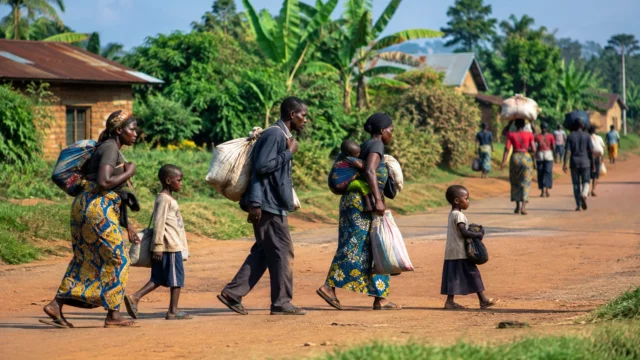
On the ground, this tension weighs first and foremost on the people of eastern Congo. Residents of North Kivu and South Kivu continue to face displacement, road closures, trade disruptions and security uncertainty. The EAC-SADC summit stressed the need to reopen the Goma-Sake-Bukavu and Goma-Rutshuru-Bunagana routes, as well as Goma airport, a sign that everyday economic activity depends directly on security. When logistical corridors remain closed, markets, transport, small businesses and humanitarian aid all slow down at the same time.
MONUSCO still plays a useful role in one specific area: supporting disarmament and voluntary repatriation. Between January and October 2025, its DDR-S section facilitated the return to Rwanda of 44 former fighters, mainly linked to the FDLR, as well as 54 dependants. This figure shows that a route out exists, but that it remains limited to cases handled through formal arrangements, far from a complete dismantling of the group.
What the next phase will reveal about the Great Lakes region
The next test is institutional. Those involved still need to set out a revised operational sequence and strengthen verification tools ahead of the next announced stage of talks. This is crucial, because the process will be credible only if each side can monitor the other without ambiguity, and if the commitments are clear to African mediators, international partners and the populations concerned.
The implications extend beyond the DRC-Rwanda border. In the Great Lakes region, every step forward on the FDLR also affects parallel negotiations over the M23, regional security cooperation and the African Union’s role in resolving crises. If neutralising the group hits another dead end, the risk is a return to a familiar cycle: mutual accusations, diplomatic slowdown and renewed use of security arguments to justify further military posturing. If, by contrast, the mechanism becomes more precise, it could set a useful precedent for other cross-border security issues on the continent.
The real question, then, is not simply whether an agreement exists. It is whether the parties will finally agree to turn a political commitment into a clear, verifiable and lasting procedure. In this region, that is often where peace processes are won or lost.