
 Algeria
 Egypt
 Libya
 Morocco
 Sudan
 Tunisia
 Benin
 Burkina Faso
 Cabo Verde
 Côte d'Ivoire
 Ghana
 Guinea
 Guinea-Bissau
 Liberia
 Mali
 Mauritania
 Niger
 Nigeria
 Senegal
 Sierra Leone
 The Gambia
 Togo
 Cameroon
 Central African Republic
 Chad
 Equatorial Guinea
 Gabon
 Republic of the Congo
 São Tomé and Príncipe
 Burundi
 Comoros
 Djibouti
 Eritrea
 Ethiopia
 Kenya
 Madagascar
 Malawi
 Mauritius
 Mozambique
 Rwanda
 Seychelles
 Somalia
 South Sudan
 Tanzania
 Uganda
 Angola
 Botswana
 Eswatini
 Lesotho
 Namibia
 South Africa
 Zambia
 Zimbabwe
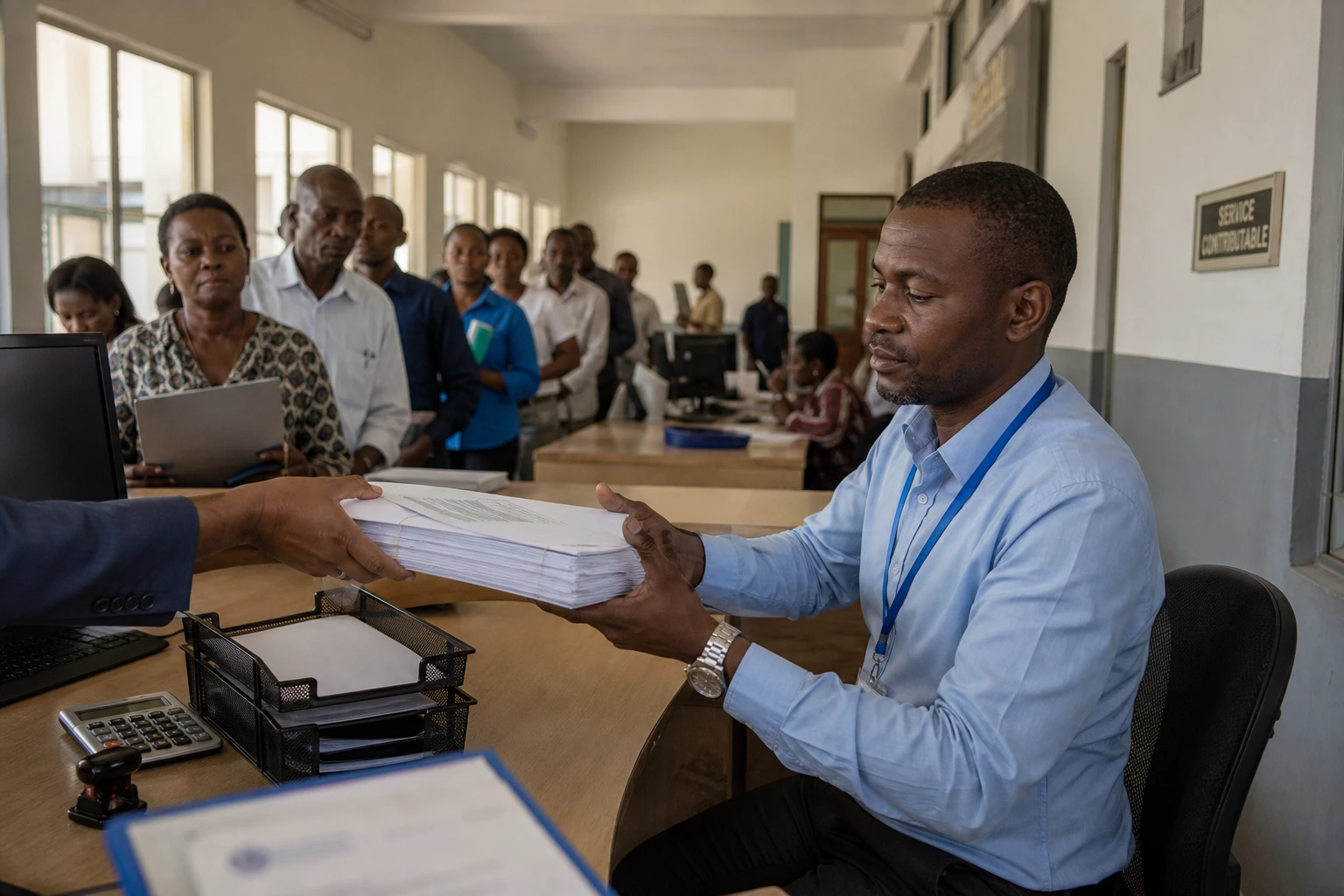
In Lubumbashi and Kolwezi, the question is no longer only how much copper and cobalt is extracted. It is now about the share that actually goes to the public budget, the provinces and communities near mining sites.
The Democratic Republic of the Congo is producing more, but this growth does not automatically guarantee a corresponding increase in revenue. That is at the heart of the debate over a possible change to the mining tax framework, eight years after the revised Mining Code came into force.
An expanding sector, but public returns remain under debate
Statistics from the National Institute of Statistics show that copper production reached 3.4 million tonnes in 2025. Cobalt production stood at about 201,000 tonnes that year. These volumes confirm DR Congo’s central role in the global supply of strategic minerals.
Yet higher production does not always translate into predictable public revenue. Mining revenues depend on international prices, costs declared by companies, exemption mechanisms and the administration’s ability to check the information submitted.
The International Monetary Fund has noted a significant improvement in domestic revenue mobilisation in the DRC since the adoption of the 2018 Mining Code. The tax burden, meaning the ratio of tax revenue to the wealth produced, rose sharply through 2022. This improvement remains exposed to fluctuations in copper and cobalt prices.
Data from the Extractive Industries Transparency Initiative show, in particular, a steep fall in the special tax on excess profits between 2022 and 2023. Its yield dropped from $365.32 million to $90.64 million. The levy targets exceptional profits made when mineral prices exceed certain economic assumptions.
The problem of tax complexity
In Lubumbashi, civil society organisations consider the system too difficult to apply. They cite nearly 60 taxes, duties, fees and royalties that may apply to mining operators. This accumulation complicates the work of companies, as well as that of the public services responsible for oversight.
Fabien Mayani, a programme officer at the Carter Center, is calling for a reduction in the number of tax instruments. The aim would not necessarily be to reduce the sector’s contribution, but to make the rules clearer and easier to verify.
This call echoes the findings of a study published in April 2025 by the Carter Center. The report recommends rationalising levies, clarifying the responsibilities of government departments and better measuring the revised Mining Code’s actual impact on public revenue.
For the state, a simpler tax system could make collection easier. For companies, it would reduce the risk of disputes and differing interpretations. For mining provinces, it would make it easier to track transfers intended to fund infrastructure and local services.
Sicomines and special tax regimes draw criticism
The debate also concerns preferential tax regimes. The case of Sicomines, a company established under cooperation between the DRC and China, is regularly cited by citizen oversight organisations.
In its report on tax expenditures, the Congolese Ministry of the Budget put the revenue shortfall associated with Sicomines at 838.15 billion Congolese francs for the financial year under review. This figure does not necessarily represent a constant annual loss of $1 billion. Rather, it illustrates the budgetary impact of the exemptions and benefits granted under this particular arrangement.
Civil society is calling for operators to be subject to comparable rules. It is concerned that a proliferation of specific contracts or agreements could create disparities between companies operating in the same sector.
This issue takes on a new dimension as Kinshasa holds talks with other foreign partners on strategic minerals, infrastructure and the security of supply chains. The challenge is to attract investment without weakening the common framework established by Congolese law.
The Chamber of Mines, for its part, is advocating a more gradual approach. It believes a comprehensive assessment of the implementation of the 2018 Mining Code should come before any further legislative changes. For operators, regulatory stability remains a key factor in decision-making, particularly for projects requiring heavy investment and spanning several decades.
Collection: the system’s weak link
The difficulty does not lie solely in the content of the laws. It also concerns their implementation. The special tax on excess profits depends, among other things, on companies’ updated feasibility studies. These documents are used to determine a project’s expected profitability and compare it with the results actually achieved.
Jean Keba, a member of the organisation Afrewatch, believes that the services responsible for collecting revenue do not always have the information needed to verify these calculations. Without reliable, up-to-date data, the administration may struggle to establish the amount actually due.
Afrewatch recommends, among other measures, modernising the tax system. Digitising tax returns, connecting revenue-collecting agencies and sharing access to production data could reduce discrepancies between extracted volumes, declared exports and taxes paid.
Transfer pricing oversight is another issue. It involves checking that transactions between a mining company and its subsidiaries or related partners do not artificially reduce taxable profits in the DRC. This oversight requires technical expertise, international data and cooperation between government departments.
Towards a tax system more closely linked to mineral prices
In Kolwezi, some are proposing that mining royalties should be adjusted in line with international prices. The principle is simple: when the price of a mineral rises sharply, the rate applied could increase so that the state and producing areas benefit more from the favourable market conditions.
Zambia is often cited as a regional example. Its system provides for different royalty rates depending on the price of copper. Such a formula can increase revenue when prices rise, but it must also avoid penalising projects when prices fall or production costs increase.
For the DRC, the challenge is therefore to strike a balance between three requirements: securing public revenue, maintaining the attractiveness of investment and ensuring more visible redistribution in mining areas.
An issue that extends beyond Katanga
Any reform of the mining framework will have effects far beyond Lubumbashi and Kolwezi. It concerns Kinshasa’s ability to fund public policy, as well as the ability of provinces and decentralised territorial entities to receive the shares due to them.
It also comes amid regional competition over copper, cobalt and export corridors. The DRC and Zambia are seeking to strengthen cooperation in the southern African Copperbelt, while the Lobito Corridor opens up a new route to the Atlantic for the region’s minerals.
At continental level, the debate is linked to the objectives of the African Continental Free Trade Area, which aims to develop more value addition on the continent. For the DRC, improving tax collection is a first step. The next will be to turn some of its mineral output into refined products, industrial components and skilled jobs.
The next test will be the method. A credible reform will need to be based on verifiable data, consultation with provinces, companies and civil society, and public monitoring of revenue and exemptions. In a country where mining output is reaching record levels, the central question is no longer simply how to produce more. It is who actually benefits from this wealth.



