Algeria
 Egypt
 Libya
 Morocco
 Sudan
 Tunisia
 Benin
 Burkina Faso
 Cabo Verde
 Côte d'Ivoire
 Ghana
 Guinea
 Guinea-Bissau
 Liberia
 Mali
 Mauritania
 Niger
 Nigeria
 Senegal
 Sierra Leone
 The Gambia
 Togo
 Cameroon
 Central African Republic
 Chad
 DR Congo
 Equatorial Guinea
 Gabon
 Republic of the Congo
 São Tomé and Príncipe
 Burundi
 Comoros
 Djibouti
 Eritrea
 Ethiopia
 Kenya
 Madagascar
 Malawi
 Mauritius
 Mozambique
 Rwanda
 Seychelles
 Somalia
 South Sudan
 Tanzania
 Angola
 Botswana
 Eswatini
 Lesotho
 Namibia
 South Africa
 Zambia
 Zimbabwe
Vaccination at a crossroads
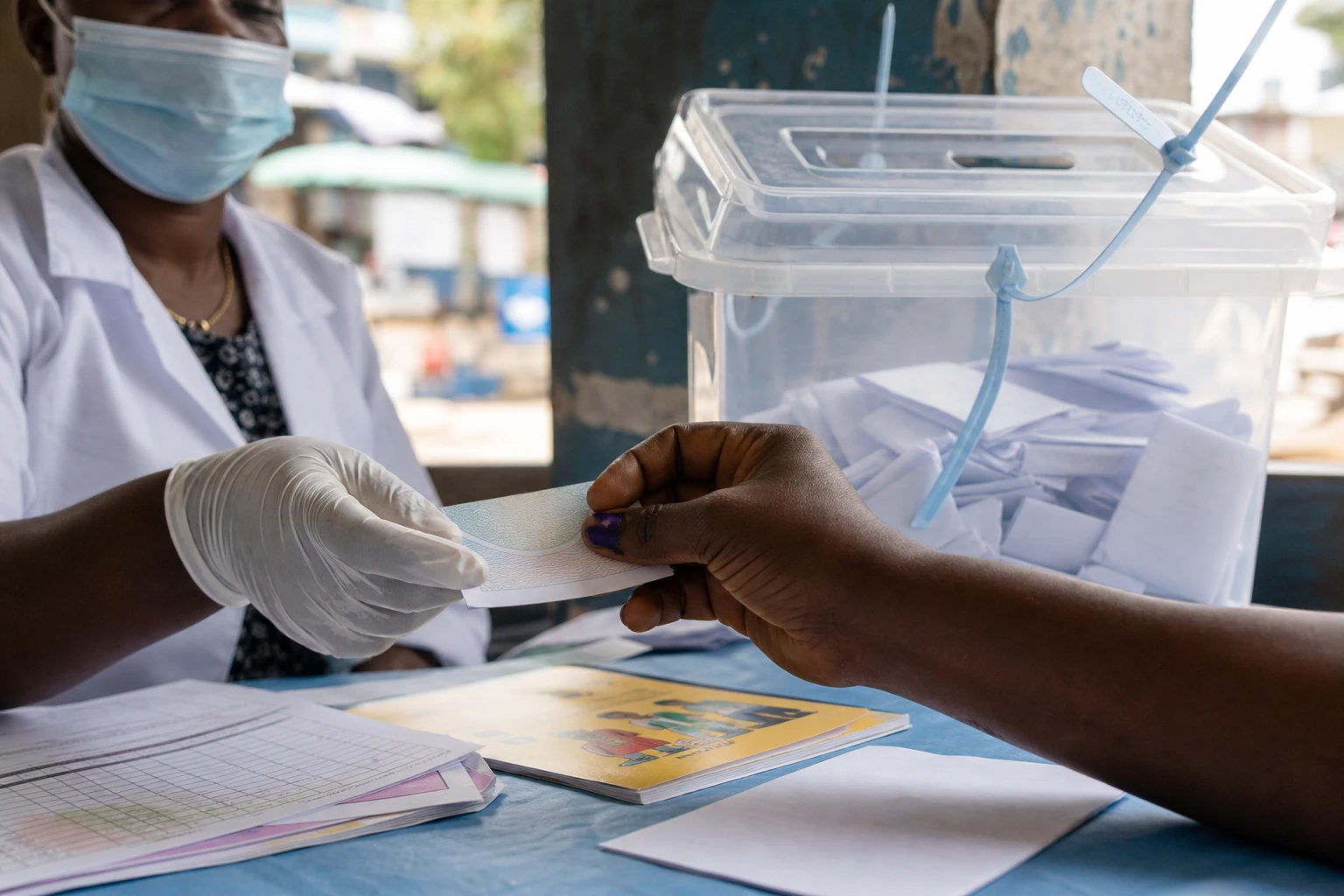
In Kisangani, the response to Ebola has stepped up. Vaccination has begun as the disease has already spread across several provinces of the Democratic Republic of the Congo, posing a particular risk to health workers, community health workers and frontline teams. In a country where river and road travel quickly link outbreak sites to major urban centres, every day counts.
Tshopo, Bas-Uélé, Haut-Uélé, Ituri, North Kivu and South Kivu are now affected by the outbreak, which continues to be driven largely along the country’s eastern axis. The Democratic Republic of the Congo belongs to the East African Community, where borders are porous and cross-border movement is part of daily life. In this context, an effective response depends not only on the capital, Kinshasa, but also on provinces, health zones and cross-border entry points.
What the authorities have launched in Kisangani
On 28 August 2026, the Congolese health minister launched a targeted Ebola vaccination campaign in Kisangani. Tshopo then had 17 confirmed cases, and the first doses were prioritised for health workers, community health workers and frontline staff at risk of exposure. This marks a further step in a response that has adapted since May to the spread of the outbreak into Tshopo and neighbouring provinces.
The campaign is backed by an allocation of 70,000 doses of Ervebo, an approved Ebola vaccine, announced by the international vaccine coordination mechanism. Of these, 20,000 doses are earmarked for a phase III clinical trial to better measure the vaccine’s effect against Bundibugyo virus, which is responsible for the current outbreak, while 50,000 doses are intended to protect health workers and frontline workers. The scientific stakes are high: early data suggest possible protection, but the vaccine’s effectiveness in humans against this strain remains to be documented.
This distinction matters. In responding to Ebola outbreaks, vaccination is not just about immediately protecting people at risk. It is also about generating evidence that will be useful in future crises on the continent. The DRC is one of the African countries that has most often had to test response tools that are still scarce in real-world conditions.
Cases rise sharply, but figures should be read with caution
The latest WHO data show an outbreak of unprecedented scale. As of 12 August 2026, the DRC had 4,665 confirmed cases and 2,184 deaths, with cases reported in six provinces and 54 health zones. Ituri still accounted for most infections, but Tshopo, Haut-Uélé and Bas-Uélé were already among the affected provinces.
These figures are far higher than those published at the start of the outbreak. They primarily reflect two developments: the spread of the virus, but also improvements in testing and reporting. In an outbreak that is so mobile, figures change quickly. They should therefore be read as surveillance snapshots, not as a fixed total.
Urban areas are paying a particular price. Kisangani, a major hub on the Congo River, is not just a point on the map. It is a logistical, commercial and human crossroads. When the virus reaches the city, the authorities must protect hospitals, markets, landing stages and families whose livelihoods depend on daily exchanges. The response is then as much an economic effort as a public health one.
Uganda has ended its outbreak, but regional vigilance remains essential
While the DRC steps up vaccination, Uganda announced on 27 August 2026 that its Bundibugyo outbreak had ended. The WHO and Africa CDC welcomed the decision after 42 days without a new confirmed case, following the discharge of the last patient on 16 July 2026. The 42-day period is twice Ebola’s maximum incubation period and is the international benchmark for declaring an outbreak over.
The contrast between the two countries is clear, but it is no reason to let up. The WHO says Uganda remains at risk of new imported cases because transmission is still active in the DRC. The outbreak also showed how porous the health border is: of the 20 confirmed cases recorded in Uganda, 15 were imported from the DRC, while five were contracted locally among contacts or health workers.
For Central Africa and the Great Lakes region, the lesson is clear. Outbreaks do not stop at administrative boundaries. They require compatible surveillance systems, laboratories able to scale up quickly and ongoing cross-border co-operation. This is also why the WHO and Africa CDC have stressed a community-centred approach rather than a response that is solely top-down.
What this sequence says about Africa’s response
The DRC and Uganda illustrate two complementary realities. On one hand, a country facing a major outbreak and combining vaccination, clinical trials and contact tracing. On the other, a neighbour that has managed to break the chains of transmission quickly enough to turn the page. Together, these two trajectories say something about the state of health capacity on the continent: it is improving, but remains under pressure from mobility, insecurity and delays in access to care.
The continental significance is real. The doses delivered to the DRC are not only being used to bring a local outbreak under control. They are also building an African operational memory of Ebola, a virus for which responses have often been improvised in an emergency and then refined through successive crises. The Kisangani campaign also shows that health preparedness is not a technical luxury. It is essential to stability in cities, trade and daily life throughout the sub-region.