
 Algeria
 Egypt
 Libya
 Morocco
 Sudan
 Tunisia
 Benin
 Burkina Faso
 Cabo Verde
 Côte d'Ivoire
 Ghana
 Guinea
 Guinea-Bissau
 Liberia
 Mali
 Mauritania
 Niger
 Nigeria
 Senegal
 Sierra Leone
 The Gambia
 Togo
 Cameroon
 Central African Republic
 Chad
 Equatorial Guinea
 Gabon
 Republic of the Congo
 São Tomé and Príncipe
 Burundi
 Comoros
 Djibouti
 Eritrea
 Ethiopia
 Kenya
 Madagascar
 Malawi
 Mauritius
 Mozambique
 Rwanda
 Seychelles
 Somalia
 South Sudan
 Tanzania
 Uganda
 Angola
 Botswana
 Eswatini
 Lesotho
 Namibia
 South Africa
 Zambia
 Zimbabwe
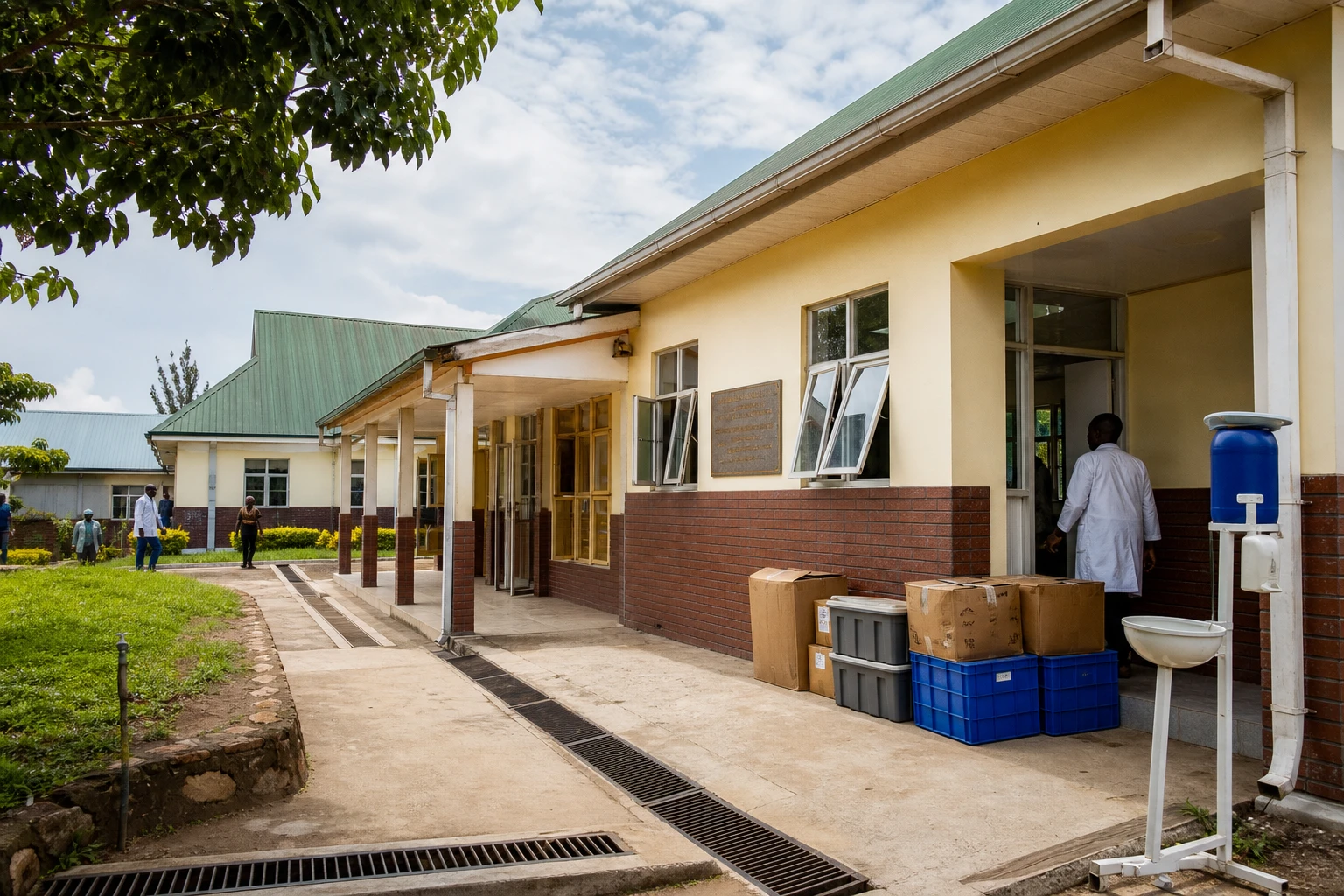
In the Democratic Republic of the Congo, the response to Ebola is now playing out beyond treatment centres. Population movements, trade and daily crossings between territories mean health teams must monitor roads, markets and borders with the same attention as care areas.
An epidemic that began in Ituri and spread across borders
The Congolese health ministry declared the outbreak on 15 May 2026, after confirming the Bundibugyo strain of Ebola virus in Ituri province in the country’s north-east. The first identified clusters were in the Mongbwalu and Rwampara health zones, around Bunia.
This is the 17th Ebola epidemic recorded in the Democratic Republic of the Congo since the virus was identified in 1976. The outbreak presents a particular challenge, however: there is not yet an approved vaccine or specific treatment for the Bundibugyo virus. The response therefore relies first on rapid detection, isolation, early care, contact tracing and the prevention of infection.
Ituri province remains the epicentre. However, the virus has spread to several provinces in the east and north-east. The latest epidemiological update from the World Health Organization, current to 7 September 2026, reported 6,757 confirmed cases and 3,267 deaths in the Democratic Republic of the Congo. These figures correspond to a crude case fatality rate of 48.3%.
A Congolese tally cited on 24 September reported 7,541 people infected and 3,639 deaths. The difference between the two sets of figures is explained by their update dates and the continuing investigations. Tally figures should therefore always be accompanied by their date and source.
Surveillance puts borders at the centre
With support from the International Organization for Migration, the authorities are stepping up screening at official and informal points of entry. Teams screen travellers, look for symptoms consistent with the disease and refer suspected cases to health facilities.
These operations do not in themselves constitute a diagnosis. Their main purpose is to identify a person showing warning signs quickly, collect their contact details and limit their movements for as long as medical checks require.
The priority is particularly high in areas linking Ituri, North Kivu, Haut-Uélé, South Kivu, Tshopo and Bas-Uélé. These provinces do not form a uniform whole. Some areas are urban and highly connected. Others are rural, difficult to access and reliant on tracks, boats or minor trade routes.
Surveillance also covers the borders with Uganda and South Sudan. The WHO reported cross-border spread to Uganda at the start of the epidemic. Kampala subsequently declared the end of its outbreak linked to this epidemic on 28 July 2026, but geographical proximity makes it essential to maintain alert systems and information-sharing mechanisms.
A response challenged by insecurity and mistrust
In the east of the Democratic Republic of the Congo, the fight against Ebola depends on more than medical resources. Insecurity slows teams’ movements, complicates contact tracing and can interrupt activities in the areas most exposed to the disease.
Internal displacement also plays an important role. Ituri is home to communities displaced by violence, while trade, agriculture and mining generate more contact between territories. A strategy limited to official border crossings would therefore miss some of the actual movements.
Public trust is just as important. Teams must explain the symptoms, how the disease spreads and why a transfer to a treatment centre may be necessary. They must also involve families in safe and dignified burials. Without local dialogue, refusals of care, sudden departures and the concealment of contacts can prolong chains of transmission.
This echoes lessons from the previous major Ebola epidemic, which affected North Kivu and Ituri between 2018 and 2020. At the time, attacks on response teams and tensions with some communities severely disrupted operations. The capacity developed then — laboratories, surveillance, response teams and local co-ordination — is being used again today, but in a still unstable health and security context.
Funding becomes an operational issue
Needs go far beyond the purchase of medical equipment. Funding is required for treatment centres, laboratories, ambulances, surveillance teams, air transport and the protection of personnel. Supplies of water and personal protective equipment must also be maintained, alongside information activities in communities.
United Nations Secretary-General António Guterres has called for an additional $1.1bn to complete funding for the international response plan. According to the UN, the plan, valued at $2.13bn, was only 48% funded at the end of August.
The United States announced an additional contribution of $267m on 23 September. Washington estimates that its direct health and humanitarian assistance has thus reached $887m since the start of the crisis. The announcement is a significant contribution, but it does not resolve questions over the actual disbursement of funds, their timing and how they are allocated among the provinces.
For residents of Bunia, Mongbwalu and more remote territories, the issue is immediate. A financial pledge has an impact only when it enables a laboratory to operate, a patient to be transported, a team to be paid or surveillance to be maintained on the ground.
A test of regional health co-operation
The epidemic is testing co-operation between the Democratic Republic of the Congo, Uganda and South Sudan. It also involves continental mechanisms. The African Union and the Africa Centres for Disease Control and Prevention, Africa CDC, are helping to co-ordinate the response and prepare neighbouring countries.
The next goal is to reduce transmission in areas where cases continue to rise, while preventing new clusters from emerging. This requires stronger community-based care, more reliable contact tracing and continued surveillance at crossing points without blocking essential trade.
The situation is also a reminder of a reality that is often overlooked: epidemics do not stop at administrative boundaries. In Central Africa, health security therefore depends as much on the quality of care as on the rapid flow of data, community trust and the ability of states to act together.



