
 Algeria
 Egypt
 Libya
 Morocco
 Sudan
 Tunisia
 Benin
 Burkina Faso
 Cabo Verde
 Côte d'Ivoire
 Ghana
 Guinea
 Guinea-Bissau
 Liberia
 Mali
 Mauritania
 Niger
 Nigeria
 Senegal
 Sierra Leone
 The Gambia
 Togo
 Cameroon
 Central African Republic
 Chad
 Equatorial Guinea
 Gabon
 Republic of the Congo
 São Tomé and Príncipe
 Burundi
 Comoros
 Djibouti
 Eritrea
 Ethiopia
 Kenya
 Madagascar
 Malawi
 Mauritius
 Mozambique
 Rwanda
 Seychelles
 Somalia
 South Sudan
 Tanzania
 Uganda
 Angola
 Botswana
 Eswatini
 Lesotho
 Namibia
 South Africa
 Zambia
 Zimbabwe
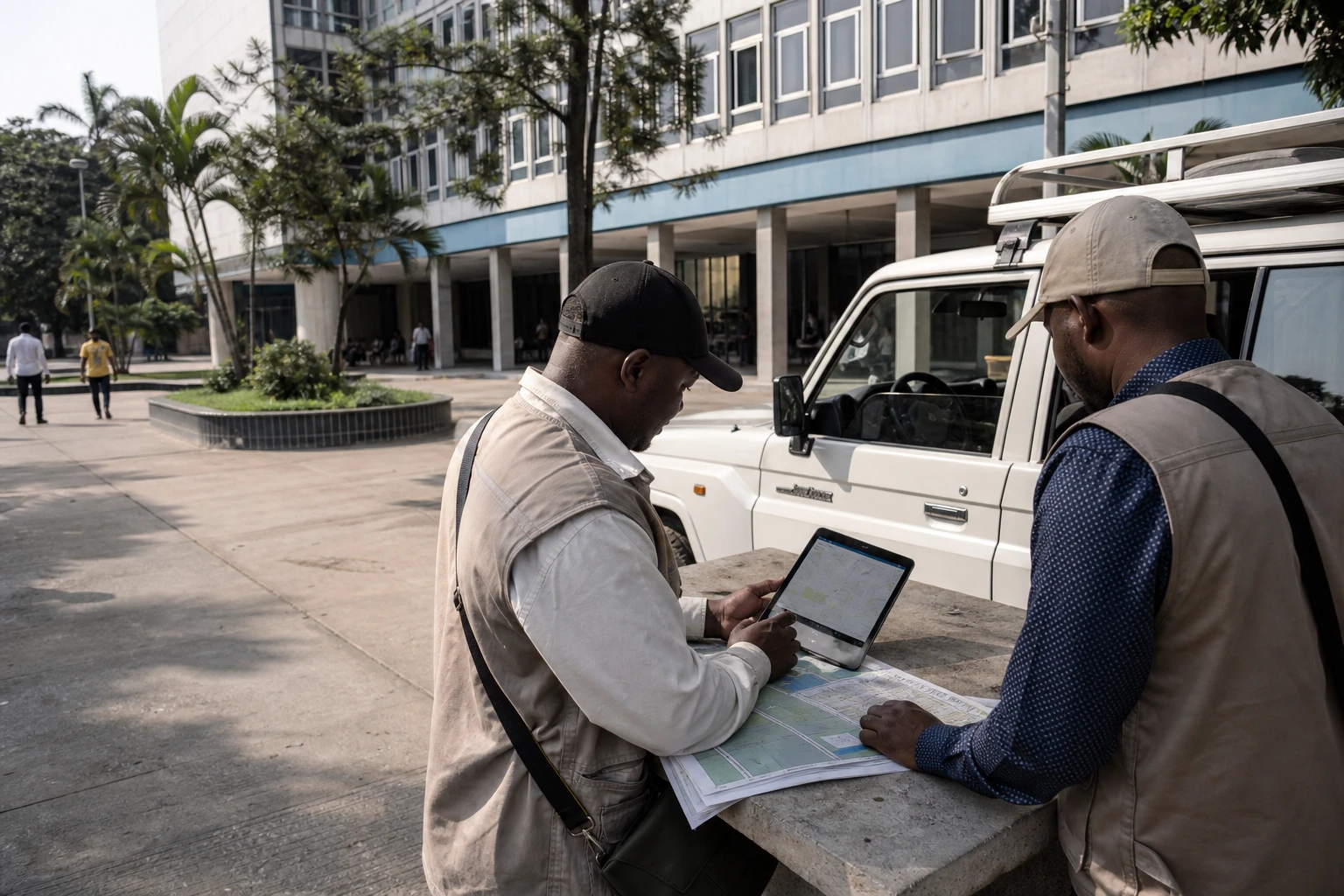
In Kinshasa, the general population census is entering a visible new phase: agents tasked with mapping neighbourhoods, villages and buildings will begin work on Tuesday 29 September 2026. For the Democratic Republic of the Congo, the stakes go beyond simply counting people. The aim is to replace outdated estimates with data that can be used to plan public services.
An operation prepared over several years
The second General Population and Housing Census, or RGPH2, comes forty-two years after the first national census, conducted in 1984. Since then, the Congolese population has grown considerably, while administrations have often had to rely on demographic projections rather than a recent count.
The Congolese authorities began preparations through the National Institute of Statistics and the Central Census Bureau. The process also involves several technical partners, including the United Nations Population Fund, the World Bank, UNICEF, UNDP and the African Development Bank.
A round table held in Kinshasa on 23 March 2026 announced contributions of more than $200 million. The process had initially been budgeted at about $192 million. The African Development Bank, for its part, announced a contribution of $80 million.
This financial mobilisation addresses a central challenge: a national census must cover an immense territory marked by differences in accessibility, uneven infrastructure and an unstable security situation in several provinces.
Mapping before the count
The phase starting on 29 September does not yet involve definitively counting every resident. Mapping teams must first identify residential areas, places of activity and key buildings, including schools, health centres, shops and administrative facilities.
This stage will divide the territory into enumeration areas. Each will contain a defined number of households to make it easier for census agents to carry out the main data collection. Teams are due to start in Kinshasa before gradually extending their operations to the other provinces.
The Central Census Bureau plans to collect data digitally. Applications installed on tablets are intended to record geographic information, households and infrastructure. Tests have already been carried out in several neighbourhoods of Kinshasa, as well as in Masi-Manimba, in Kwilu province.
The official website of the RGPH2 of the Democratic Republic of the Congo describes census mapping as a stage intended to delineate enumeration areas and update documents dating back to 1984. The old maps are no longer sufficiently suited to modern data collection.
Data expected to improve governance
The mapping is expected to take about three months. It will already provide useful information on the distribution of homes and activities. Above all, it will prepare for the count planned for 2027, during which agents will collect individual data on residents.
The timetable announced by the authorities provides for a counting operation lasting about two weeks in July 2027. More than 100,000 people could be mobilised to cover the country’s territories, cities and rural areas.
The census is intended to establish residents’ age, sex, activity and location. It should also improve understanding of households, housing and public facilities. This information is essential for planning the capacity of schools, health centres, water networks, roads and social protection programmes.
In Kinshasa, the stakes are particularly high. The capital is experiencing rapid urban growth and high population density in several communes. Yet its exact population remains subject to varying estimates. A more robust statistical baseline would help distribute investment more effectively between the capital, other cities and rural areas.
A test for the state and public trust
The operation’s success will depend as much on public trust as on the methodology. Local authorities, neighbourhood leaders, security services and community representatives have been briefed on their role in the process, according to Radio Okapi.
This coordination will need to prevent several problems: duplicate entries, overlooked areas, population movements and location errors. It will also need to reassure households about how the information collected will be used. A credible census requires clear rules on confidentiality and data protection.
Security will also affect the timetable. Organisers say they intend to cover areas affected by armed violence, particularly parts of North Kivu and South Kivu. In these territories, however, agents’ access will depend on how the situation develops and on local arrangements to ensure their safety.
Displaced people present another challenge. Some families are living far from their places of origin, in temporary sites, with relatives or in urban centres. Including them will require a specific approach to ensure they are not left out of the results or counted more than once.
National data in a region on the move
For the Democratic Republic of the Congo, RGPH2 comes at a time when planning needs are considerable. The country must respond to urban growth, demand for jobs, the expansion of social services and displacement linked to crises in the east.
The census will also have regional significance. The DRC is a member of the Southern African Development Community, SADC, which works on issues including economic cooperation and regional security. It also maintains close ties with the East African Community, which it joined in 2022. Updated demographic data can inform policies on mobility, trade and planning in these neighbouring regions.
At African Union level, the operation will underscore a shared requirement: public policies cannot be based indefinitely on estimates that diverge too far from reality. The next milestone will be the completion of census mapping, followed by preparations for the count announced for July 2027. That is when the statistical promise will have to be turned into verifiable results.



