Algeria
 Egypt
 Libya
 Morocco
 Sudan
 Tunisia
 Benin
 Burkina Faso
 Cabo Verde
 Côte d'Ivoire
 Ghana
 Guinea
 Guinea-Bissau
 Liberia
 Mali
 Mauritania
 Niger
 Nigeria
 Senegal
 Sierra Leone
 The Gambia
 Togo
 Cameroon
 Central African Republic
 Chad
 Equatorial Guinea
 Gabon
 Republic of the Congo
 São Tomé and Príncipe
 Burundi
 Comoros
 Djibouti
 Eritrea
 Ethiopia
 Kenya
 Madagascar
 Malawi
 Mauritius
 Mozambique
 Rwanda
 Seychelles
 Somalia
 South Sudan
 Tanzania
 Uganda
 Angola
 Botswana
 Eswatini
 Lesotho
 Namibia
 South Africa
 Zambia
 Zimbabwe
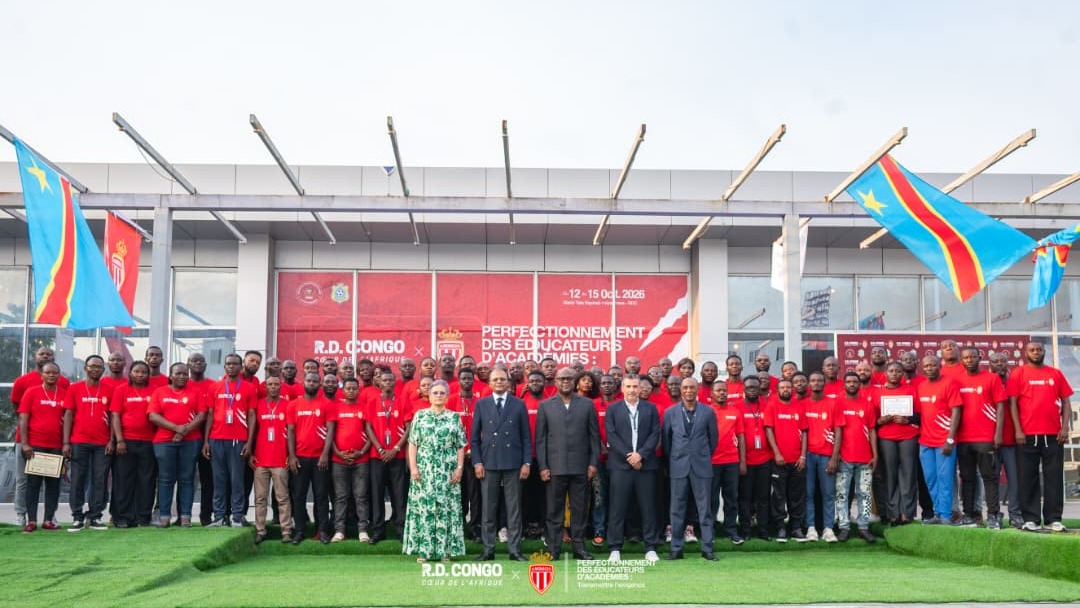
“You must never leave the premises before the children.” Chila Luambo Makiadi coaches at The Goat Academy in Kinshasa. Of the three-day training course at Tata Raphaël Stadium, he first remembers this safety rule, Radio Okapi reports. The detail may seem modest. Yet it marks the first practical step in the partnership between the Democratic Republic of the Congo and AS Monaco — a long-awaited step after 16 months of debate over its cost.
An agreement long judged by its price tag
Signed in June 2025 and running until 2028, the “R.D. Congo, Heart of Africa” agreement has two strands. The first is about visibility. Under the terms announced when it was signed, the slogan appears on the sleeve of the first team’s shirt. It also features on the shirts of the youth teams. The second strand provides for the transfer of expertise in training young footballers.
On the Congolese side, the ministry had entrusted negotiations to French businessman Aurélien Logeais, according to Foot Mercato. The outlet describes him as an unpaid intermediary. Sports and Leisure Minister Didier Budimbu said his role had been limited to negotiating on behalf of the DRC.
The agreement costs €4.8 million over three seasons. The sum is modest compared with the contracts signed that same year with FC Barcelona and AC Milan, which the press estimates at more than €40 million each. Yet the deal as a whole drew fierce criticism in Kinshasa. Some members of civil society saw it as unjustifiable spending in the midst of war in the country’s east.
The case then took a legal turn. Two Congolese nationals living in France filed a complaint in September 2025 alleging corruption, money laundering and misappropriation of public funds. France’s National Financial Prosecutor’s Office referred the case to Monaco. In July 2026, Monaco’s public prosecutor’s office closed it without further action, ruling that the alleged offences were “insufficiently substantiated”. The Congolese government had consistently rejected the allegations.
Three days on the pitch at Tata Raphaël Stadium
The session took place from 13 to 15 October at the Kinshasa stadium. The Monaco delegation was led by Sébastien Muet, the club’s academy director. It worked with Médard Lusadisu, technical director of the Congolese Football Association (FECOFA).
The programme alternated between theory and practice. On the second day, the coaches covered physical preparation, injury prevention and video analysis. They then moved on to pitch exercises. The number of participants varies between Congolese media: around 70, according to the Congolese Press Agency, and more than 100, according to Radio Okapi.
On Thursday 15 October, Félix Tshisekedi presided over the closing ceremony and presented the coaches with their certificates of participation. The head of state’s presence gives the programme considerable political weight. It also confirms that the agreement has backing at the highest level of government.
Training the trainers: a long-term bet
Targeting academy coaches is no accident. They work with children long before they reach professional clubs’ training centres. Training a coach can therefore potentially affect dozens of young players.
The national technical director sees the course as an opportunity to refresh coaches’ skills. “This training provides a framework that allows our coaches to update their skills,” he said, according to Radio Okapi. Some participants are more cautious. Sadra Makondele, coach of the under-20 Leopards women’s team, said that “three days were not enough to take everything in”.
Didier Budimbu, for his part, sees the session as part of a broader strategy. He defends the agreement on the grounds of “the need to develop technical skills”, rather than visibility alone. According to Congolese outlet Cumulard, the minister announced talent trials in several provinces by the end of the year. Those selected would then go to Monaco for an immersion programme. At the end of October 2025, the government had already raised the creation of a national academy with the club.
What to watch for between now and 2028
The DRC is not the first African country to invest in partnerships with major European clubs. Rwanda did so before it, with Arsenal, PSG and Bayern Munich, to promote tourism. In February 2025, Kinshasa had in fact asked the three clubs to end their contracts with “Visit Rwanda”. The Congolese government accuses neighbouring Rwanda of fuelling the war in the country’s east. Critics therefore pointed to the contradiction: the DRC, too, is now promoting itself on European shirts.
The Monaco agreement, however, stands out for its training component, which is meant to leave a lasting mark on the country. It is on this basis that it will be judged. Will the announced talent trials take place before the end of the year? How many young Congolese will actually go to Monaco for an immersion programme? Will the coaches trained at Tata Raphaël receive follow-up support beyond a certificate of participation?
The contract runs until 2028. Until then, one question remains: will the DRC’s investment in Monaco’s shop window benefit football played in Kinshasa, Lubumbashi or Kisangani? The first session offers an initial answer. More will be needed before a verdict can be reached.