Algeria
 Egypt
 Libya
 Morocco
 Sudan
 Tunisia
 Benin
 Burkina Faso
 Cabo Verde
 Côte d'Ivoire
 Ghana
 Guinea
 Guinea-Bissau
 Liberia
 Mali
 Mauritania
 Niger
 Nigeria
 Senegal
 Sierra Leone
 The Gambia
 Togo
 Cameroon
 Central African Republic
 Chad
 DR Congo
 Equatorial Guinea
 Gabon
 Republic of the Congo
 São Tomé and Príncipe
 Burundi
 Comoros
 Djibouti
 Eritrea
 Ethiopia
 Kenya
 Madagascar
 Malawi
 Mauritius
 Mozambique
 Rwanda
 Seychelles
 Somalia
 South Sudan
 Tanzania
 Uganda
 Angola
 Botswana
 Eswatini
 Lesotho
 Namibia
 Zambia
 Zimbabwe
Courage in the face of apartheid and South Africa
When José Eduardo dos Santos became president of Angola in 1979, southern Africa was still deeply shaped by the power of South Africa’s apartheid regime. Pretoria occupied Namibia, intervened militarily beyond its borders and sought to prevent liberation movements from establishing themselves permanently in neighbouring countries.
Angola then made a decisive choice: not to look away. Luanda welcomed and supported ANC fighters, as well as those of Namibia’s SWAPO, and placed its own sovereignty within a much broader vision of African emancipation. Nelson Mandela himself would say years later: “Angola’s solidarity with South Africans who were fighting for their liberation was of heroic proportions.” Addressing Angola’s National Assembly in April 1998, he also recalled that Angolans had defended the freedom of South Africans before they had definitively secured their own.
This solidarity was not merely diplomatic. It came at a considerable human, military and economic cost. Under José Eduardo dos Santos, Angola nevertheless accepted that cost because the Angolan president believed that lasting stability in his country also depended on the end of the regional order imposed by apartheid.
Cuito Cuanavale, the moment history turned
It was at Cuito Cuanavale, between 1987 and 1988, that this strategy took on its full significance. In south-eastern Angola, Angolan and Cuban forces fought UNITA, which was backed by the South African army. Military assessments of the precise outcome of the battle remain disputed, but its political importance is far less contested: it marked a major turning point in the regional war and hastened the start of negotiations that would permanently alter the balance of power in southern Africa.
Nelson Mandela himself would give Cuito Cuanavale considerable historical significance, calling it “a turning point for the liberation of our continent and my people”.
A few months later, in December 1988, Angola, Cuba and South Africa signed a tripartite agreement in New York. It provided for the withdrawal of foreign forces and paved the way for Namibia’s independence under the auspices of the United Nations. Pretoria now had to accept a new regional balance.
The sequence was striking: Cuito Cuanavale in 1988, the New York Accords that same year, Namibian independence, and then, on 11 February 1990, Nelson Mandela’s release. None of these events can be attributed to a single actor, but José Eduardo dos Santos’s Angola was undoubtedly one of the places where the balance of power that made this transformation possible was forged.
Mandela had not forgotten Luanda
Perhaps this is what gives the story such force today: Mandela himself made a point of publicly acknowledging what Angola had represented in the struggle against apartheid.
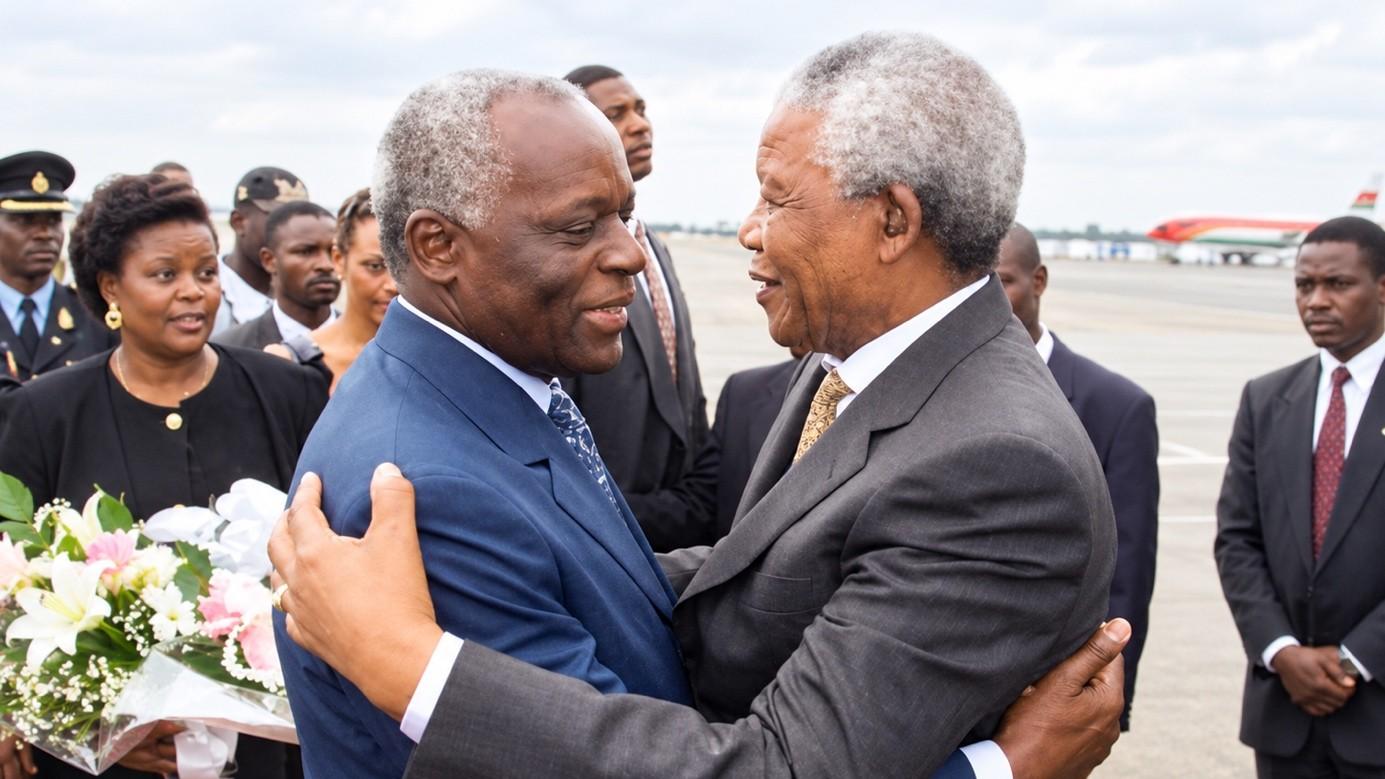
When he visited Luanda in 1998, by then president of a democratic South Africa, his words were particularly powerful. In front of José Eduardo dos Santos, he recalled that Angola had embraced the principle that freedom in southern Africa was indivisible.
The connection between the two men therefore went beyond simple diplomacy between heads of state. It reflected two paths that crossed at a decisive moment in African history: that of a man imprisoned for twenty-seven years for refusing to accept apartheid, and that of a president who chose, from Luanda, to support those fighting that system.
An African legacy
Heads of state are too often judged solely by their national borders. Yet José Eduardo dos Santos’s legacy extends far beyond Angola. His actions also belong to the history of independent Namibia, the retreat of apartheid’s military power and, more broadly, the political liberation of southern Africa.
It would be excessive to say that one man alone freed Nelson Mandela. But it would be just as wrong to forget that José Eduardo dos Santos’s Angola helped directly to create the strategic and political conditions in which South Africa’s regime was ultimately forced to give ground.
And when Mandela, free and then president, chose to visit Luanda to pay tribute to this solidarity, he was not speaking only on behalf of South Africa. He was recalling a deeper truth: Angola had its place in the story of his own freedom. And so did José Eduardo dos Santos, right at the forefront.