Algeria
 Libya
 Morocco
 Sudan
 Tunisia
 Benin
 Burkina Faso
 Cabo Verde
 Côte d'Ivoire
 Ghana
 Guinea
 Guinea-Bissau
 Liberia
 Mali
 Mauritania
 Niger
 Nigeria
 Senegal
 Sierra Leone
 The Gambia
 Togo
 Cameroon
 Central African Republic
 Chad
 DR Congo
 Equatorial Guinea
 Gabon
 Republic of the Congo
 São Tomé and Príncipe
 Burundi
 Comoros
 Djibouti
 Eritrea
 Ethiopia
 Kenya
 Madagascar
 Malawi
 Mauritius
 Mozambique
 Rwanda
 Seychelles
 Somalia
 South Sudan
 Tanzania
 Uganda
 Angola
 Botswana
 Eswatini
 Lesotho
 Namibia
 South Africa
 Zambia
 Zimbabwe
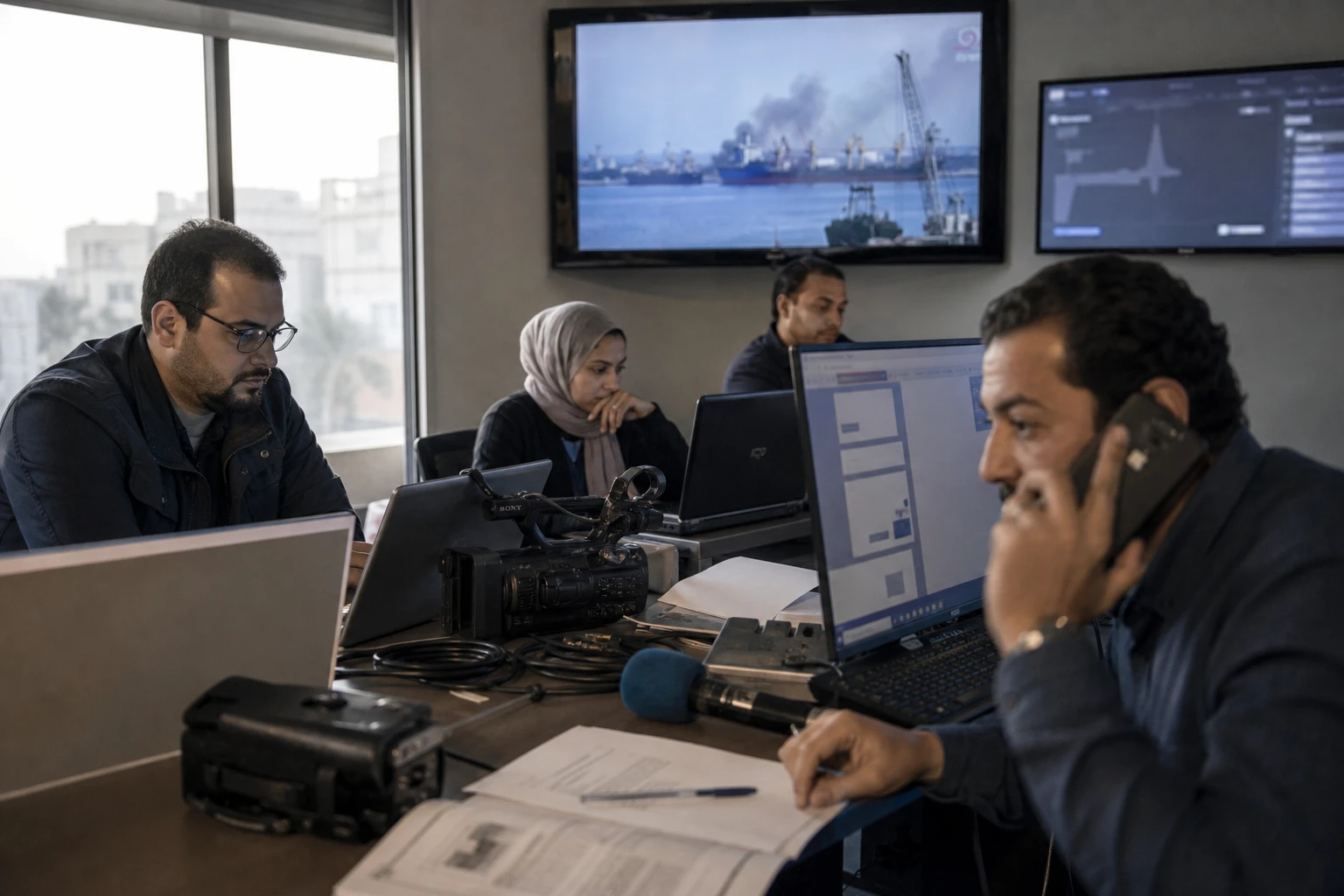
An Egyptian port at the heart of a crisis that extends beyond the Middle East
In Damietta, on Egypt’s Mediterranean coast, a maritime incident has served as a reminder of a point that is often overlooked: ports are not just places of trade; they are also points of strategic vulnerability. When a gas terminal is hit, the impact goes beyond the vessel struck. It affects maritime security, energy flows and the credibility of a country seeking to remain a regional hub.
The Damietta site occupies a sensitive position in northern Egypt, not far from the entrance to the Suez Canal. The port is among the country’s major maritime infrastructure and serves freight and logistics as well as liquefied natural gas activities, a sector Cairo has presented in recent years as an economic and diplomatic asset.
What is known about the incident, and what remains to be established
Egyptian authorities have opened an investigation after a fire was caused by what was described as a drone attack on two vessels carrying natural gas in the port of Damietta. Rescue teams quickly brought the flames under control. No injuries were reported. According to the first information made public, the drone debris was recovered to establish its origin.
The government has not identified a perpetrator at this stage. Egyptian Prime Minister Mostafa Madbouly said that no group had claimed responsibility for the operation and that the results of the investigation had to be awaited before any conclusions were drawn. This caution is important: in a regional environment saturated with conflicting messages, an attack cannot be attributed on the basis of speculation.
However, information corroborated by maritime and press sources converges on one point: a drone did hit a gas-related facility, before the fire spread to a second vessel moored nearby. Available sources identify one of the vessels as the Energos Winter, a floating storage and regasification unit, and the other as the GasLog Salem. The first is linked to a US company, the second to a Greek company.
The Egyptian government also said that initial investigations had concluded that a drone was used, without going further on its origin or possible perpetrators. At the same time, regional actors cited in international coverage have denied any involvement. At this stage, the only firmly established fact is this: a drone triggered a fire in a sensitive industrial and energy zone, alongside a major shipping route.
Why Damietta matters so much to Egypt’s economy
Damietta is not an ordinary transit point. It is a logistics hub serving Egyptian foreign trade, as well as a component of the national gas system. Public data from authorities and operators show that the port and its LNG terminal are designed as infrastructure for outward projection, with export and transit capacity to Mediterranean and European markets.
This dimension is decisive. Egypt was long seen as a gas exporter, before having to contend with stronger domestic demand and pressure on national production. The country nevertheless remains a key player in the Eastern Mediterranean gas chain. The US Energy Information Administration notes that Egypt still has liquefied natural gas export capacity, and that Damietta is part of this infrastructure.
For the Egyptian state, the challenge is therefore not limited to repairing material damage. It must also reassure shipowners, insurers, gas buyers and foreign partners. A single incident can be enough to drive up risk premiums, delay port calls or temporarily shift flows to other Mediterranean ports. In an economy where foreign currency and energy imports carry considerable weight, the indirect impact matters almost as much as the fire itself.
An Egyptian warning in an already tense maritime space
The Damietta incident comes as the region’s shipping routes are already facing multiple pressures. Attacks and incidents in the Red Sea, off the coast of Yemen, have disrupted trade routes and forced some operators to reconsider their routes. At the same time, exchanges of strikes between the United States and Iran, as well as tensions between Iran and its regional adversaries, have sustained a climate of uncertainty across the entire arc from the Red Sea to the Eastern Mediterranean.
For Egypt, a pivotal African country between the Mediterranean, the Red Sea and the Arab world, this affair has implications that go beyond the strictly national sphere. Cairo has often played the role of mediator in regional crises. It is also seeking to protect its ports, foreign-currency revenues and status as a logistics link between Africa, Europe and Asia. An attack on a gas terminal therefore touches on sovereignty, economic security and the stability of trade alike.
This case also highlights a broader trend for North Africa and, more widely, the continent: port infrastructure is becoming a strategic asset of the highest order. It concentrates trade, energy, supply chains and military interests. For the African Union and the regional organisations concerned, this reinforces an already familiar priority: securing maritime corridors without turning African coastlines into mere extensions of external rivalries.