Algeria
 Egypt
 Libya
 Morocco
 Sudan
 Tunisia
 Benin
 Burkina Faso
 Cabo Verde
 Côte d'Ivoire
 Ghana
 Guinea
 Guinea-Bissau
 Liberia
 Mali
 Mauritania
 Niger
 Nigeria
 Sierra Leone
 The Gambia
 Togo
 Cameroon
 Central African Republic
 Chad
 DR Congo
 Equatorial Guinea
 Gabon
 Republic of the Congo
 São Tomé and Príncipe
 Burundi
 Comoros
 Djibouti
 Eritrea
 Ethiopia
 Kenya
 Madagascar
 Malawi
 Mauritius
 Mozambique
 Rwanda
 Seychelles
 Somalia
 South Sudan
 Tanzania
 Uganda
 Angola
 Botswana
 Eswatini
 Lesotho
 Namibia
 South Africa
 Zambia
 Zimbabwe
In Dakar, the trafficking network shifts and adapts
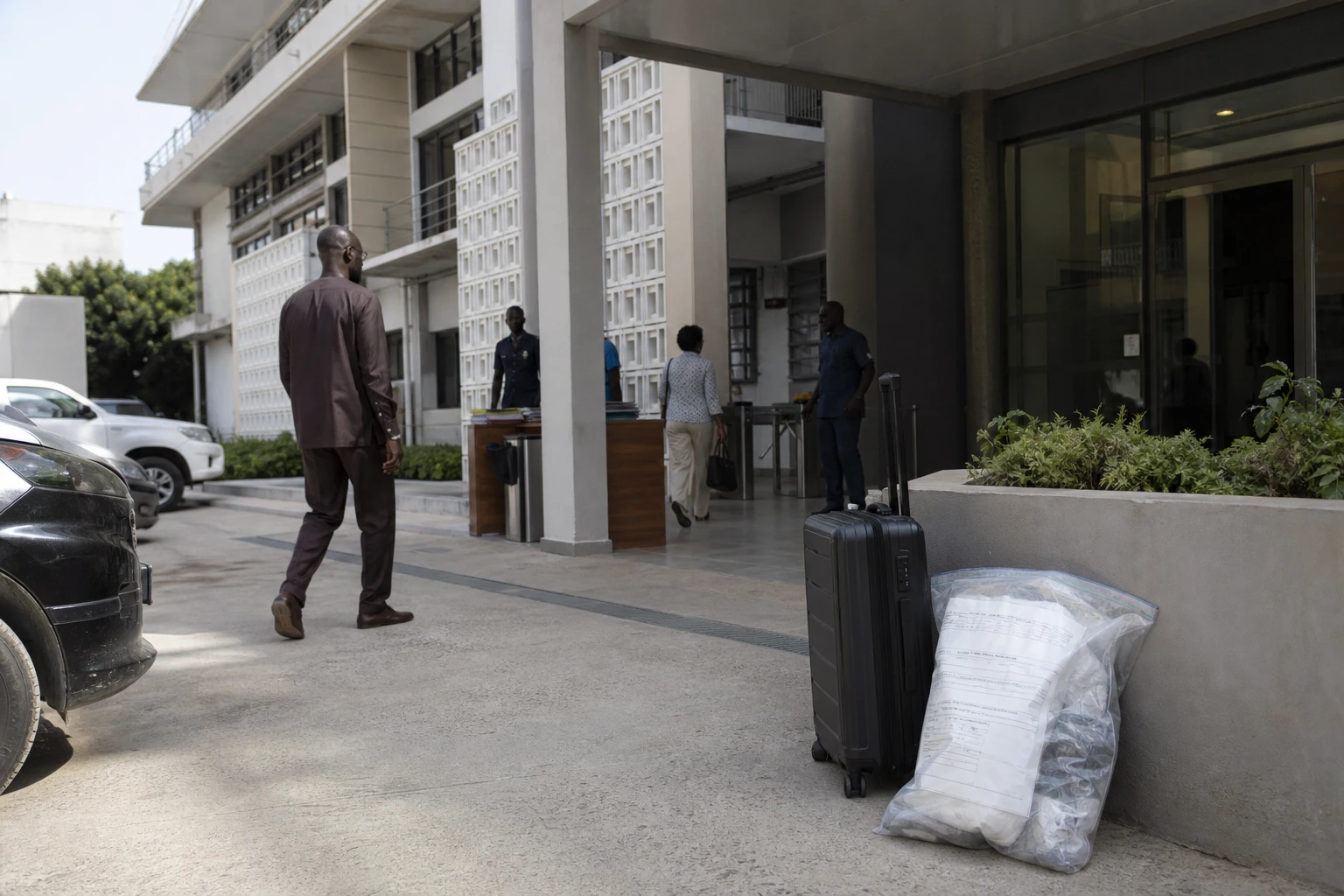
In Dakar, drug trafficking is no longer limited to visible consignments and high-profile arrests. It is adapting, fragmenting and seeking more discreet routes, even in urban neighbourhoods heavily exposed to the flow of people and deliveries. The recent seizure of cocaine concealed in a suitcase with a false bottom illustrates this evolution.
Senegal lies at the crossroads of several criminal routes linking South America, West Africa and Europe. Regional organisations such as ECOWAS have monitored this phenomenon for years; it affects public health, security and illicit finance alike. The issue therefore goes beyond the arrest of a few suspects: it concerns states’ ability to control highly mobile networks.
Operation conducted from start to finish by the anti-narcotics brigade
During the night of 8 to 9 August 2026, Dakar’s Regional Narcotics Brigade, a unit attached to OCRTIS, arrested three people in a case involving international drug trafficking. The operation led to the seizure of 1.070 kilograms of cocaine, eight grams of hashish, CFAF 4,010,000 in cash, a Chevrolet vehicle and several items linked to packaging, including precision scales, cling film and scissors.
The case began with intelligence indicating that a suspicious package was hidden in the false bottom of a suitcase. The bag, entrusted to a transit agent on behalf of a client awaiting travel, led investigators to a shop in Sicap Foire, where an inspection uncovered two carefully concealed sachets. Tests confirmed that they contained cocaine.
Police then mounted a surveillance operation to trace the intended recipients. The suspected sender was first told that a flight had supposedly been cancelled, then asked to collect the suitcase himself. According to the investigation, he then requested that a delivery worker take the bag to a meeting point in the Almadies district. It was during this journey that the police operation enabled officers to locate a first suspect and arrest him after a chase.
A search of the first detainee’s home led to the arrest of a second person present there. Investigators seized his mobile phone and several items relevant to the proceedings. At the end of the operation, three people were placed in police custody. They face charges of criminal conspiracy, possession and international trafficking of narcotics, drug export, aiding and abetting, and money laundering.
What the case reveals for Senegalese people and the region
The case first confirms a very concrete reality for Senegalese people: drug networks attach themselves to the ordinary movement of goods, luggage and delivery services. They use busy locations such as Sicap Foire and the Almadies because these areas offer movement, intermediaries and useful points of contact to evade surveillance. The capital, Dakar, therefore remains a central hub for both licit and illicit flows.
From a security perspective, the case also highlights the growing number of seizures in the country. In 2026, Senegalese forces have already announced several crackdowns, including cases involving cocaine, hashish and networks active around Dakar, Ouest Foire, the Almadies and other urban transit areas. This recurrence suggests not so much isolated incidents as sustained pressure on investigative services.
The regional context reinforces this assessment. ECOWAS and UNODC have for years described West Africa as a transit zone, but also as an area where consumption and repackaging are increasing. Available reports highlight how cocaine trafficking generates criminal revenues, risks of corruption and money-laundering channels that affect property, transport and informal trade.
In Senegal, the issue extends beyond the police. It affects ports, roads, peri-urban areas and airports. It also involves customs, magistrates, intelligence services and the authorities of the Ministry of the Interior. The country is also strengthening its maritime resources and its inspection capacity at the Port of Dakar, a sign that the fight is taking place at sea as well as in neighbourhoods where packages change hands.
Beyond the case, a test for the public response
The seizure is part of a broader trend marked by the increasing professionalisation of criminal networks. Traffickers divide consignments, use transit intermediaries and rely on vehicles, phones and delivery routes to bypass traditional checks. Security forces, in turn, must combine intelligence, physical surveillance and judicial coordination.
The Senegalese case is also of interest to West Africa as a whole. In a region with numerous land borders and where trade is essential, every seizure raises a broader question: how can economic routes be protected without restricting legitimate movement? This is the balance ECOWAS states are seeking as cocaine trafficking becomes more sophisticated and resilient.
For Dakar, the immediate challenge is to consolidate operational results. For residents of the neighbourhoods concerned, the priority is to prevent areas of everyday movement from becoming permanent trafficking corridors. At continental level, the case is a reminder of an obvious truth: the fight against drugs cannot be won through seizures alone, but depends on institutions’ ability to track networks that are constantly reorganising.