Algeria
 Egypt
 Libya
 Morocco
 Sudan
 Tunisia
 Benin
 Burkina Faso
 Cabo Verde
 Côte d'Ivoire
 Ghana
 Guinea-Bissau
 Liberia
 Mali
 Mauritania
 Niger
 Nigeria
 Senegal
 Sierra Leone
 The Gambia
 Togo
 Cameroon
 Central African Republic
 Chad
 DR Congo
 Equatorial Guinea
 Gabon
 Republic of the Congo
 São Tomé and Príncipe
 Burundi
 Comoros
 Djibouti
 Eritrea
 Ethiopia
 Kenya
 Madagascar
 Malawi
 Mauritius
 Mozambique
 Rwanda
 Seychelles
 Somalia
 South Sudan
 Tanzania
 Uganda
 Angola
 Botswana
 Eswatini
 Lesotho
 Namibia
 South Africa
 Zambia
 Zimbabwe
When a road changes more than a journey
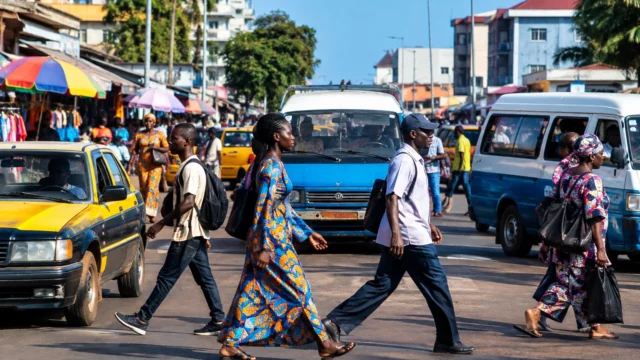
In Dabola, in central Guinea, a road is never just a strip of asphalt. It determines time spent on the track, the price of a sack of rice, access to the market and, sometimes, a locality’s real place on the national economic map. It is against this backdrop that two roads are to be paved, linking Cissela to Banko, N’Dèma and then Saraya.
The project touches on a sensitive issue for the country: movement is often faster in speeches than on the ground. Guinea’s railway, inherited from the colonial era, does not yet fully serve as an internal network. Roads therefore remain the most tangible means of connecting prefectures, supporting trade and opening up agricultural areas.
Dabola, a useful but still vulnerable crossroads
Dabola occupies a strategic position between several areas of settlement and trade. The prefecture is in the Faranah region, in the centre of the country, on routes that matter for traffic towards Kankan, Conakry and inland markets. In this part of Guinea, roads matter as much as administration. When they deteriorate, food crops, passenger transport and small businesses are among the first to slow down.
The project is also part of a broader political sequence. Since 2021, the transitional authorities have made infrastructure one of the visible markers of their action. The Simandou 2040 programme, now presented as the national framework for long-term development, places roads, transport and connectivity at the heart of the third pillar of public policy. The message is clear: mineral wealth must not circulate alone; it must bring the regions along with it.
This approach also addresses a longstanding structural weakness. A World Bank document on Guinea states that in 2021 only 30% of paved national roads were in good condition, while about 75% of unpaved national roads were deteriorated. The problem is therefore not just new construction. It also lies in the maintenance of existing infrastructure, which is often postponed.
Funding, then the test of construction
On 10 September 2026, the ECOWAS Bank for Investment and Development signed three loan agreements with the Guinean state totalling €269.5 million. One of the loans, worth €143.05 million, is earmarked for the construction and paving of the 84-kilometre Cissela-Banko-N’Dèma and Banko-Saraya road. The regional bank describes the operation as a high-impact investment to improve connectivity and trade in Upper Guinea.
The timetable and execution will nevertheless be decisive. In countries where road networks suffer from chronic under-maintenance, a new road can quickly lose its value if drainage structures, verges and maintenance do not keep pace. During the rainy season, it is often the weak points along the route, rather than the asphalt itself, that determine the investment’s actual lifespan.
For residents of Dabola, Banko and N’Dèma, the stakes are immediate. A passable road lowers transport costs, makes school and medical journeys safer, and facilitates the sale of agricultural produce. For traders, it can expand the area they serve. For transport operators, it reduces vehicle wear. For the administration, it brings the state closer to rural areas, which matters in a country where distance is often measured in hours lost rather than kilometres.
Simandou 2040, a national showcase and political test
The link with Simandou 2040 is direct. Guinea’s authorities have made the mining mega-project and its logistics infrastructure a driver of transformation. In this vision, infrastructure must serve both the mining economy and everyday life. Roads are therefore more than a supporting measure. They are central to the promise of modernisation.
The approach is consistent with other recent projects announced in the country. In April 2025, for example, the presidency highlighted the signing of a contract to build the Faranah-Dabola road, more than 100 kilometres long and still unpaved. The sequence of these projects shows that the centre of the country has again become a priority for infrastructure investment.
But this priority will be judged by how the roads perform. If the Dabola routes are delivered on time, properly maintained and integrated into a coherent network, they could reduce high logistics costs and strengthen domestic integration. If they are delayed or deteriorate quickly, they will join the long list of projects that improve the government’s image more than Guineans’ mobility.
Across West Africa, the issue goes beyond Guinea alone. ECOWAS has for years promoted regional connectivity because an efficient road corridor affects trade, prices and the flow of markets. Guinea therefore faces a twofold challenge: connecting localities to one another, then incorporating these roads into a regional economy in which Conakry, Kankan, Bamako and the border corridors remain closely linked. The real significance of these 84 kilometres will be determined there.
The Dabola project will thus say something beyond what its route covers. It will show whether Guinea can finally turn its infrastructure announcements into lasting services for its regions, businesses and households. In a vast, mineral-rich and diverse country, it is often the road that reveals how credible the national project is.