Algeria
 Egypt
 Libya
 Morocco
 Sudan
 Tunisia
 Benin
 Burkina Faso
 Cabo Verde
 Côte d'Ivoire
 Ghana
 Guinea
 Guinea-Bissau
 Liberia
 Mali
 Mauritania
 Niger
 Nigeria
 Senegal
 Sierra Leone
 The Gambia
 Togo
 Cameroon
 Central African Republic
 Chad
 DR Congo
 Equatorial Guinea
 Gabon
 Republic of the Congo
 São Tomé and Príncipe
 Burundi
 Comoros
 Djibouti
 Eritrea
 Ethiopia
 Kenya
 Madagascar
 Malawi
 Mauritius
 Mozambique
 Rwanda
 Seychelles
 Somalia
 South Sudan
 Tanzania
 Uganda
 Angola
 Botswana
 Eswatini
 Lesotho
 Namibia
 South Africa
 Zambia
 Zimbabwe
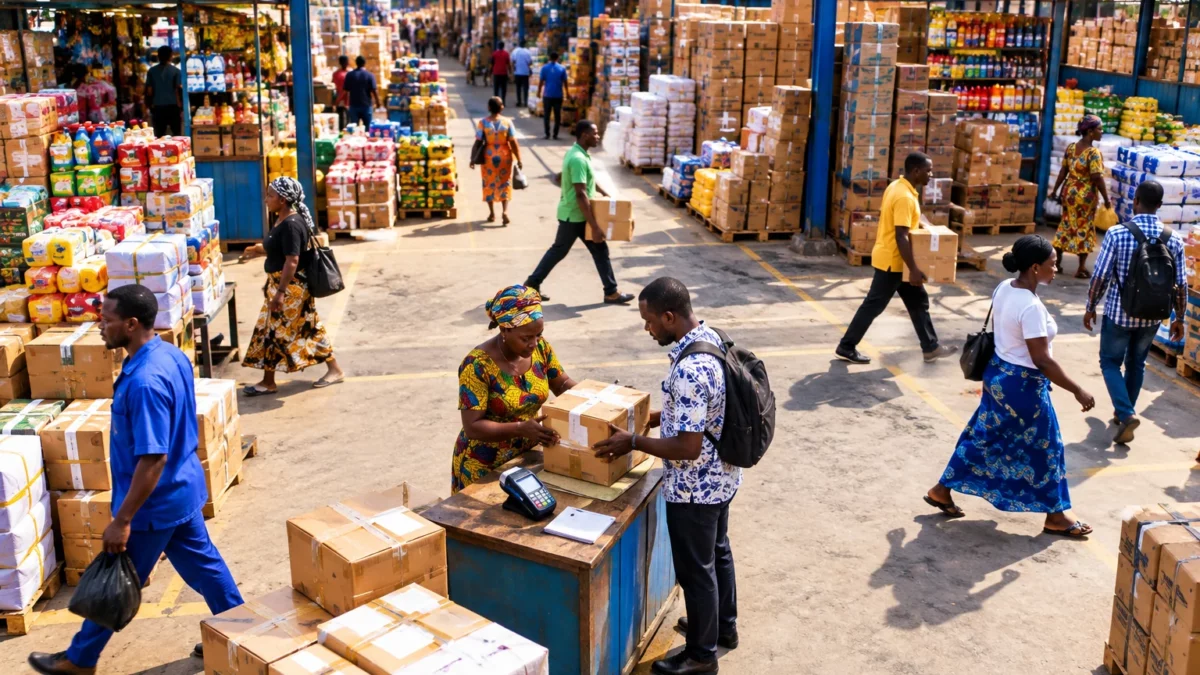
A company in Ghana selling to Nigeria may find a buyer before finding a simple, affordable way to get paid. This financial friction is a reminder that trade integration is not just about borders: it also depends on banks, currencies and payment rules.
Trade is growing, but the figures need careful handling
Available statistics confirm that trade between African countries remains limited, but they do not all support the figure of $214 billion or the tripling since 2020 cited in the original material. Afreximbank estimates intra-African trade at $206.6 billion in 2024, up 5.4% year on year. Its share of the continent’s total trade rose from 14.7% in 2023 to 15.3% in 2024.
The United Nations Economic Commission for Africa (ECA), using a different data series, put trade in goods between African countries at $185.7 billion in 2023, or 14.6% of African trade. The differences between estimates are a reminder that statistical methods and coverage vary. It would therefore be imprudent to present a tripling since 2020 as an established fact without specifying the data series used.
The broad trend remains one of significant, but minority, regional trade. The African Continental Free Trade Area (AfCFTA), an African Union agreement intended to facilitate trade among its members, aims to reduce tariff and regulatory barriers. Its implementation, however, depends on very practical arrangements: transport, customs, financing and payments.
Cross-border payments remain costly
Businesses trading across borders often have to contend with different currencies, complex banking channels and compliance checks. Where there is no direct market between two currencies, a bank may convert a payment into an intermediary currency, often the dollar, and then convert it again into the recipient’s currency. These steps can add fees and delays.
This challenge particularly affects small and medium-sized enterprises. A large company can negotiate banking rates or deploy a finance team. For a small exporter, foreign-exchange fees and a delayed payment can absorb a significant share of the margin or prevent it from accepting an order.
Commercial banks and development finance institutions already contribute to trade finance. They can also share some of the risk, for example through guarantees that reassure banks when they finance a buyer or seller in another country. Local-currency payment facilities can help businesses spread out or defer settlement. But they are no substitute for reliable verification procedures or cooperation between national authorities.
Regional solutions exist, but face practical limits
The Pan-African Payment and Settlement System (PAPSS), developed by Afreximbank with the AfCFTA Secretariat, aims to enable cross-border payments in local currencies. According to the system, transfers can pass through connected banks without requiring businesses to invoice systematically in a hard currency.
This infrastructure addresses a real difficulty, but its usefulness depends on adoption. Businesses can use it only through participating banks. Banks, central banks and payment networks therefore need to connect, and users need to know the actual terms, fees and processing times.
The issues differ by region. In West Africa, members of the West African Economic and Monetary Union share the CFA franc, while Nigeria and Ghana use the naira and cedi. In Central Africa, several states also share a currency, but trade with neighbouring countries outside the zone involves other channels. A continental solution must therefore link existing systems without assuming that needs are identical everywhere.
Continental figures conceal regional realities
The recovery recorded in 2024 did not benefit all subregions equally. Afreximbank attributes 42.1% of intra-African trade flows that year to Southern Africa. West Africa accounted for 23.3%, East Africa 14.5%, North Africa 12.6% and Central Africa 7.5%. South Africa remains the leading national player in this trade, with $42.2 billion in trade with its African partners, according to the same institution.
These differences reflect, among other things, the size of economies, the proximity of infrastructure and the composition of trade. Better payments can help a trader in Lagos, a company in Dakar or an importer in Douala, but they are not enough to reduce transport costs or border delays. The gains will also depend on states’ ability to apply common rules and better connect regional markets.
To track progress, it will therefore be necessary to look beyond the total value of trade. The share of payments settled in local currencies, the number of banks connected to regional systems, the fees borne by SMEs and the regularity of trade flows will provide a more concrete measure of integration. The AfCFTA provides a continental framework; its impact will be determined in the trade corridors and financial systems that connect countries day to day.
The data used here come from Afreximbank, with its estimates of intra-African trade in 2024, the ECA’s 2025 Economic Report on implementation of the AfCFTA and information from PAPSS on payments in local currencies.