Algeria
 Egypt
 Libya
 Morocco
 Sudan
 Tunisia
 Benin
 Burkina Faso
 Cabo Verde
 Ghana
 Guinea
 Guinea-Bissau
 Liberia
 Mali
 Mauritania
 Niger
 Nigeria
 Senegal
 Sierra Leone
 The Gambia
 Togo
 Cameroon
 Central African Republic
 Chad
 DR Congo
 Equatorial Guinea
 Gabon
 Republic of the Congo
 São Tomé and Príncipe
 Burundi
 Comoros
 Djibouti
 Eritrea
 Ethiopia
 Kenya
 Madagascar
 Malawi
 Mauritius
 Mozambique
 Rwanda
 Seychelles
 Somalia
 South Sudan
 Tanzania
 Uganda
 Angola
 Botswana
 Eswatini
 Lesotho
 Namibia
 South Africa
 Zambia
 Zimbabwe
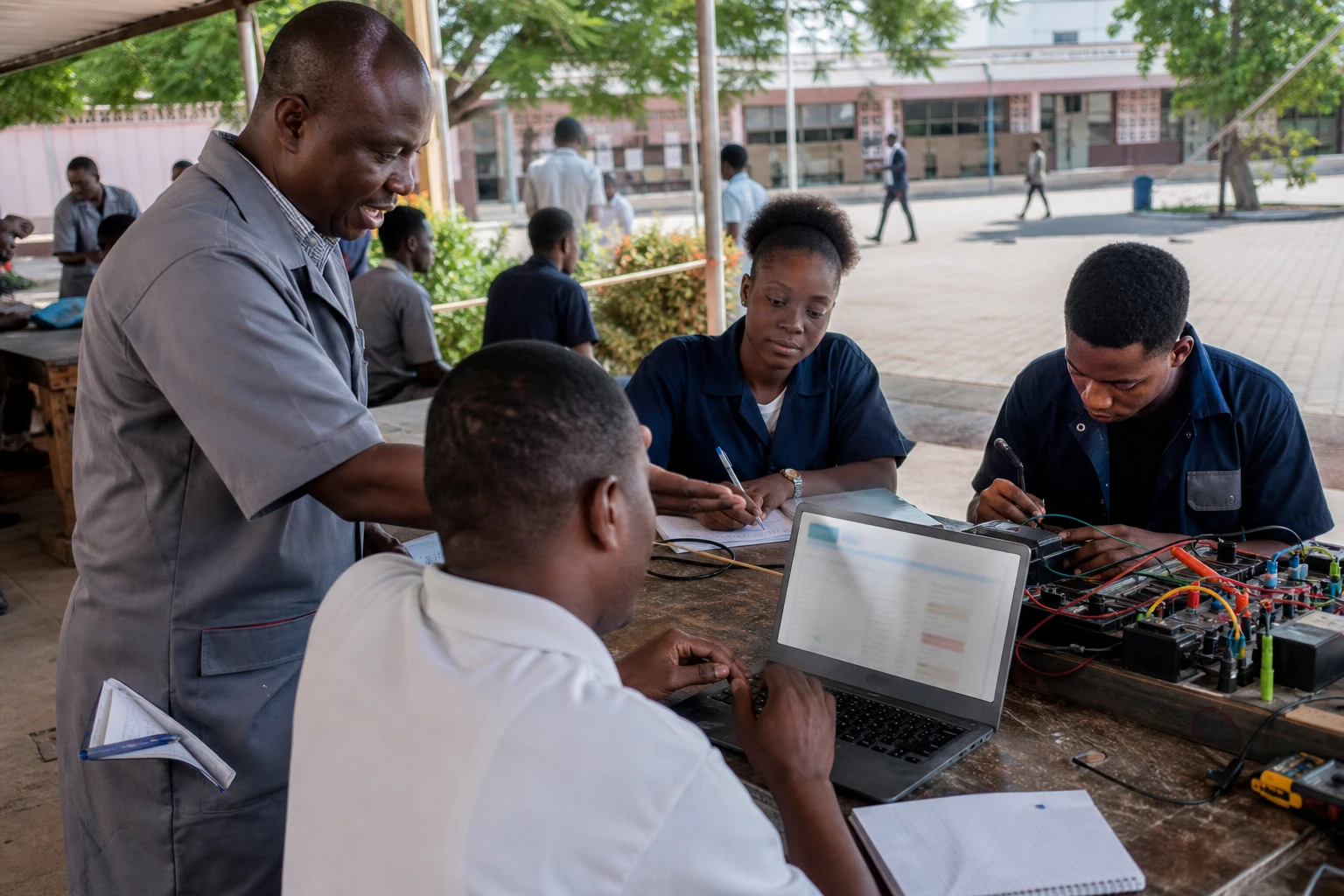
In Abidjan, the question is no longer simply whether artificial intelligence will enter classrooms. It is already being put to those who train technicians, skilled workers and the future managers of the Ivorian economy: how can these tools be used without losing sight of the quality of learning, ethics and realities on the ground ?
First, train those who pass on skills
Côte d’Ivoire launched a programme in Abidjan on 17 September 2026 to strengthen the capabilities of 3 000 teachers, pedagogical supervisors and heads of technical education and vocational training institutions. The initiative receives technical support from UNESCO, the United Nations organisation responsible, among other things, for education, science and culture.
The first phase will cover 1 000 teachers in the Abidjan area. It is due to run from 1 October to 30 December 2026, combining online courses with in-person sessions. Nearly 2 000 people had already registered at the time of the launch, according to Ivorian authorities.
The content goes beyond a general introduction to digital tools. It covers the fundamentals of artificial intelligence, its uses in teaching, course design, learner assessment, technical disciplines and practical work. Ethics, data protection and security are also on the syllabus.
Jean-Louis Moulot, the minister delegate in charge of technical education, describes this first phase as a pilot. It is intended to measure results, adjust the approach and prepare for a possible expansion of the initiative on a larger scale. The Ivorian government sets out details of the training launch.
A reform linked to the needs of the Ivorian economy
The initiative comes amid a reorganisation of technical education in Côte d’Ivoire. The government wants to increase the share of learners in this stream, estimated at around 6 % today, to 10 % in 2030 and then 15 % in 2035. The plan also provides for the construction of 100 new institutions and the renovation of 55 existing facilities.
These objectives form part of the 2026-2030 National Development Plan. For Côte d’Ivoire, the challenge is to respond more effectively to the needs of sectors such as industry, agro-industry, mining, energy, digital technology, hospitality and maintenance. Technical education must therefore cease to be seen as a secondary route. It is becoming an instrument of industrial policy and employment.
The reform does not, however, rely solely on equipment or the opening of new institutions. It also requires curricula, assessment methods and relations between schools and businesses to be reviewed. In April 2026, the Ivorian state and several companies signed a pact focused on aligning training with employment. The principle is to involve the private sector more closely in defining skills, hosting trainees, work-study programmes and graduate employment. The Ivorian Press Agency looks back at the pact between the state and businesses.
AI as a tool, not an automatic solution
In the classroom, artificial intelligence can help a teacher prepare a lesson, produce exercises tailored to several levels or identify certain difficulties. It can also support the simulation of technical procedures and speed up the creation of teaching materials.
But these uses replace neither the trainer’s expertise nor workshop practice. In vocational education, a skill is also demonstrated through an action, a measurement, work on a machine or the ability to follow a safety instruction. A digital tool can support this learning. It cannot take the place of human guidance.
Teacher training will therefore have to address very practical questions. Which tools are available in institutions outside Abidjan ? Do teachers have a stable internet connection and sufficient equipment ? How can the answers generated by an application be checked ? How can learners be prevented from delegating their work entirely to software ? The protection of personal data must also remain a priority.
The answers to these questions will determine the programme’s real reach. One-off training will not be enough unless it is accompanied by follow-up, resources tailored to technical disciplines and regular exchanges between teachers. It will also have to take account of the differences between better-connected urban institutions and those in other regions of Côte d’Ivoire.
Data to bring education closer to the labour market
The artificial intelligence pilot is being added to other management tools. On 23 June 2026, Côte d’Ivoire launched its Labour Market Information System, or SIMT. The platform brings together data on employment, qualifications and skills in order to narrow the gap between the training on offer and businesses’ needs.
The SIMT can help identify occupations that are recruiting, skills that are lacking and courses that need to evolve. It thus provides a more precise basis for revising curricula. The Ivorian Prime Minister’s Office outlines the aims of the information system.
For young people, the expected impact is direct. Training better aligned with businesses’ needs can make it easier to secure a first job. However, the benefits will not be the same for everyone. Graduates in major urban centres could make use of equipment and partnerships more quickly. Learners in secondary cities and rural areas will need comparable investment if they are not to be left out of this transformation.
An issue extending beyond Côte d’Ivoire’s borders
Côte d’Ivoire’s approach is part of a broader debate in West Africa. In ECOWAS member states, the Economic Community of West African States, training systems must support economies facing the digital transition, industrial transformation and rapid growth in the working-age population.
The question, then, is not simply whether to introduce artificial intelligence into curricula. It is also about the ability of states to train teachers, produce content suited to local contexts and build links between institutions and productive sectors. Côte d’Ivoire’s experience will be watched across the region.
The next stage will be decisive. It will show whether training the 1 000 teachers in Abidjan genuinely improves practices in classrooms and workshops. The effects on learners, access to equipment and employment will then need to be measured. Only under these conditions can artificial intelligence become a lasting lever for technical education in Côte d’Ivoire, rather than a mere announcement.