Algeria
 Egypt
 Libya
 Morocco
 Sudan
 Tunisia
 Benin
 Burkina Faso
 Cabo Verde
 Ghana
 Guinea
 Guinea-Bissau
 Liberia
 Mali
 Mauritania
 Niger
 Nigeria
 Senegal
 Sierra Leone
 The Gambia
 Togo
 Cameroon
 Central African Republic
 Chad
 DR Congo
 Equatorial Guinea
 Gabon
 Republic of the Congo
 São Tomé and Príncipe
 Burundi
 Comoros
 Djibouti
 Eritrea
 Ethiopia
 Kenya
 Madagascar
 Malawi
 Mauritius
 Mozambique
 Rwanda
 Seychelles
 Somalia
 South Sudan
 Tanzania
 Uganda
 Angola
 Botswana
 Eswatini
 Lesotho
 Namibia
 South Africa
 Zambia
 Zimbabwe
Producing more rice in Côte d’Ivoire depends on more than the land available. It also requires control of water, financing for equipment, and the organisation of storage, processing and market access. The Ivorian government is now seeking to attract Italian partners in several of these areas.
Projects to finance, from irrigation to processing
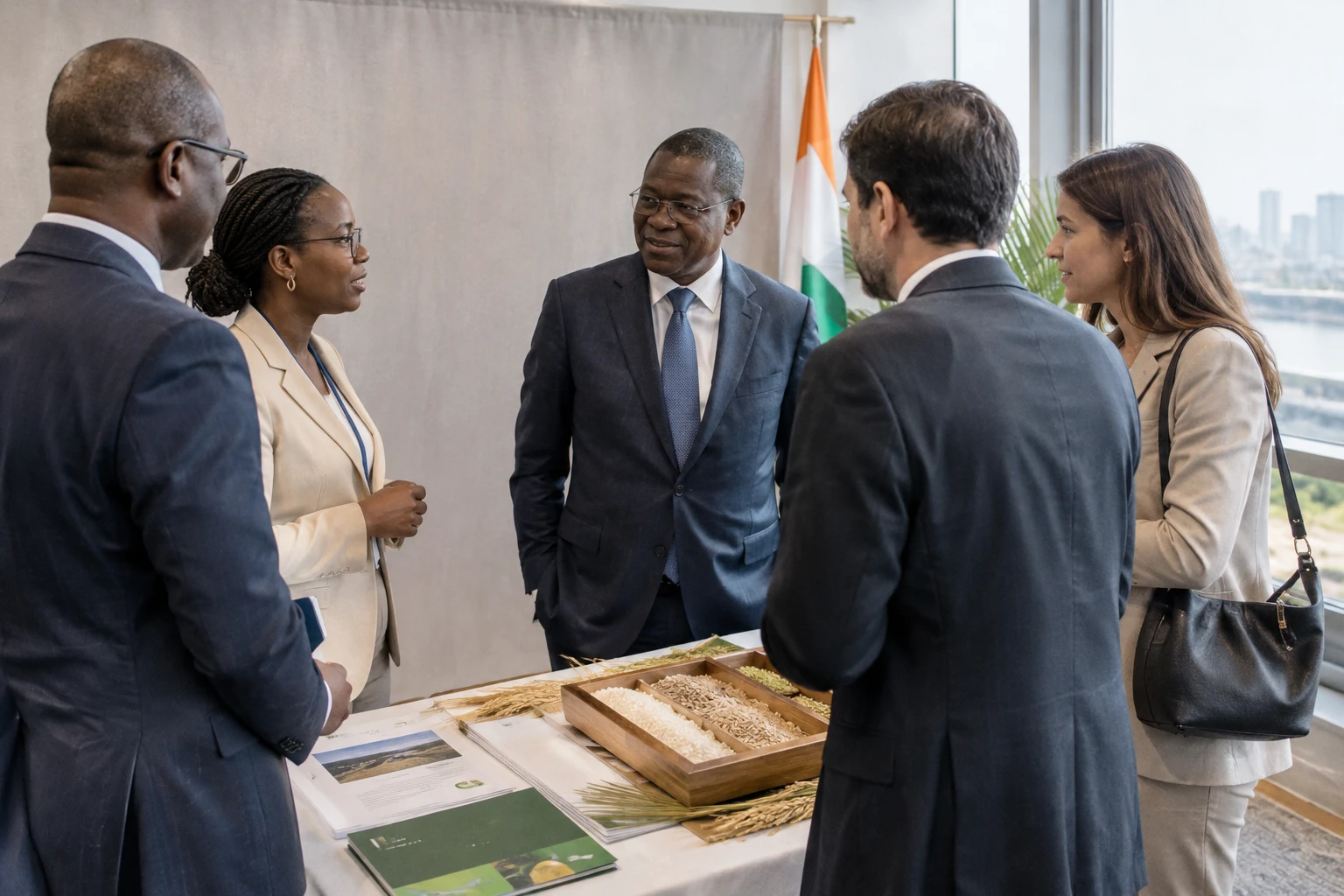
On 14 October 2026 in Abidjan, Minister Delegate for Food Crop Production Bernard Kini-Komoé presented agricultural projects to Italian companies. According to the Ivorian Press Agency, the portfolio comprises 30 food-crop projects, 13 of them focused on rice. The meeting was part of an effort to mobilise financing and technology for local production.
Estimates for the rice portfolio put projected investment at 731.6 billion CFA francs, or around $1.25 billion. This figure represents anticipated needs, not financing already committed. One flagship project envisages developing 35,000 hectares of irrigated land at Kossou and Buyo, at an estimated cost of 355 billion CFA francs, according to reports of the meeting.
Other proposals include mechanisation, seed production, the rehabilitation of rice-growing areas, storage and the modernisation of processing facilities. The value of these investments will depend on whether they are delivered, as well as on how well they match producers’ needs and local conditions.
A matter of production, but also of purchasing power
Côte d’Ivoire remains a major regional market for imported rice. In 2024, its imports reached about 1.6 million tonnes, according to data from the US Department of Agriculture, cited by French authorities in their overview of agricultural trade. The Food and Agriculture Organization of the United Nations (FAO) estimated national production at 1.55 million tonnes at the time, and demand at between 2.5 million and 2.8 million tonnes.
The figures do not always align exactly: they can vary according to the marketing year used and whether they refer to paddy or milled rice. The USDA report for the 2025-2026 season, meanwhile, forecasts milled rice production of 1.6 million tonnes, imports of 1.6 million tonnes and consumption of 2.95 million tonnes. These estimates underline the scale of the gap to be closed, but do not amount to a definitive season-end balance.
Dependence on external purchases exposes the Ivorian market to fluctuations in global prices, transport costs and supply availability. Rice is a staple food for households, so higher import costs can feed through to retail prices. For producers, greater market access alone does not guarantee higher incomes. Quality, production costs, collection and competition from imported rice also matter.
Investment cannot replace organisation of the sector
The Italian expertise discussed at the meeting includes mechanisation and agro-industrial equipment. But buying machinery or building infrastructure is not enough to increase supply sustainably. Farmers also need training, equipment maintenance and access to suitable seeds.
Irrigation can reduce dependence on rainfall and enable more regular production. However, it requires sustainable water management, clear access rules and an allocation system that takes family farms into account. The major developments at Kossou and Buyo will therefore need to be assessed not only in terms of their production capacity, but also for their impact on the communities and land concerned.
Côte d’Ivoire has already launched other initiatives to strengthen the rice value chain. The government says a project funded by the Islamic Development Bank will support hydro-agricultural sites, seeds, processing and marketing. In 2025, the FAO also announced Japanese support for the digitalisation of the sector. These programmes show that Italian capital would form part of a broader effort rather than an isolated initiative.
A national strategy with West African implications
Rice development is among Côte d’Ivoire’s agricultural priorities for 2026-2030. The issue extends beyond national borders, however. Côte d’Ivoire is a member of ECOWAS, the Economic Community of West African States, which supports regional co-operation on agriculture and food security. An increase in Ivorian production could alter trade with neighbouring countries, but the impact will depend on the volumes actually available, prices and trade rules.
For now, the meeting with Italian companies marks an exploratory stage, not the implementation of the announced projects. The next milestones will be the signing of specific agreements, the effective mobilisation of financing and the start of construction. It will also be important to monitor the role reserved for Ivorian producers in managing the projects and sharing the benefits.
Sources consulted: Ivorian Press Agency on the projects presented, Le Méridien on the investment portfolio, USDA report on grains and rice, FAO in Côte d’Ivoire on the rice sector, Ivorian government on financing for the rice value chain, overview of Côte d’Ivoire’s agricultural trade.