Algeria
 Egypt
 Libya
 Morocco
 Sudan
 Tunisia
 Benin
 Burkina Faso
 Cabo Verde
 Ghana
 Guinea
 Guinea-Bissau
 Liberia
 Mali
 Mauritania
 Niger
 Nigeria
 Senegal
 Sierra Leone
 The Gambia
 Togo
 Cameroon
 Central African Republic
 Chad
 DR Congo
 Equatorial Guinea
 Gabon
 Republic of the Congo
 São Tomé and Príncipe
 Burundi
 Comoros
 Djibouti
 Eritrea
 Ethiopia
 Kenya
 Madagascar
 Malawi
 Mauritius
 Mozambique
 Rwanda
 Seychelles
 Somalia
 South Sudan
 Tanzania
 Uganda
 Angola
 Botswana
 Eswatini
 Lesotho
 Namibia
 South Africa
 Zambia
 Zimbabwe
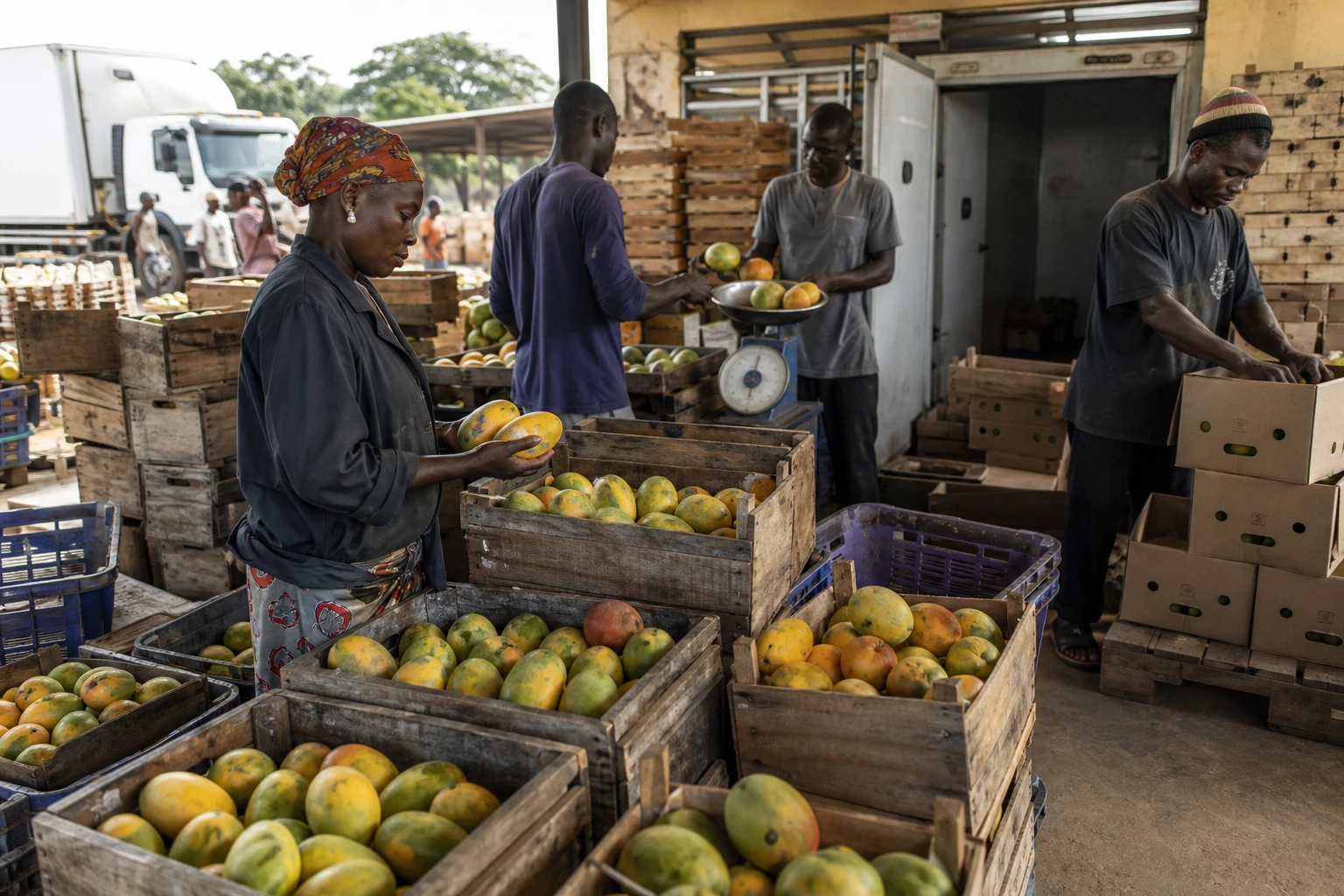
In northern Côte d’Ivoire, mangoes are not short of markets. What they lack, above all, is time, storage and processing capacity. Each season, a large share of the fruit ripens within a few weeks, while markets, cold-storage facilities and industrial plants do not always keep pace. The Ivorian government now wants to address this value chain through an expanded institutional framework.
Mango sector now overseen by the CCAK
Meeting on Wednesday 23 September 2026, the Council of Ministers adopted an ordinance extending to the mango sector the rules already applied to cotton and cashew. The text assigns the Council for Cotton, Cashew and Shea — the CCAK — responsibilities for regulation, monitoring and development in the sector.
The framework is based on Law No. 2013-656 of 13 September 2013. This law governs the marketing of cotton and cashew, two major sectors of Côte d’Ivoire’s rural economy. Its extension to mangoes aims to avoid fragmented management of the various links in the chain: production, collection, marketing, export and processing.
The government has also adopted a draft law to ratify the ordinance. The organisation’s Board of Directors will therefore have to take on this new responsibility and include representatives of the mango sector. The reform does not create a separate body. Instead, it expands the responsibilities of a council already present in several of the country’s agricultural regions.
This development follows several exchanges between the authorities and industry professionals. On 9 July 2026, Ivorian Agriculture Minister Bruno Nabagné Koné met Vincent Omer-Decugis, president of the Ivorian Import and Marketing Company. Discussions focused on protecting orchards, maintaining exports and the threat posed by fruit flies.
The following day, the minister also held talks with the mango industry association. The authorities and operators announced that they were preparing an action plan. Its detailed provisions have not been made public. The challenge, however, is clear: to safeguard access to overseas markets while reducing losses in production areas.
Exports rise, but value remains too low
Côte d’Ivoire has strengthened its presence in the fresh mango market over the past decade. According to data available from Ivorian economic services and customs, export volumes rose from about 27,600 tonnes in 2015 to 64,100 tonnes in 2024.
Revenue increased over the same period, reaching about CFA francs 8.9bn in 2015, compared with CFA francs 26bn in 2024. These figures confirm the growing importance of mangoes among Côte d’Ivoire’s agricultural exports.
The growth remains fragile, however. Shipments have fluctuated from one season to another, depending on weather conditions, fruit quality and the phytosanitary requirements of importing markets. To export, operators must in particular comply with registration formalities and obtain a phytosanitary certificate, in accordance with rules set out by the Ivorian Customs.
Above all, exports account for only part of national production. The Ministry of Agriculture estimates the 2024 harvest at about 198,700 tonnes. With 64,100 tonnes shipped abroad, exports amounted to nearly a third of production. The remainder must be sold on the domestic market, moved through informal channels or processed.
This gap between production and exports offers significant room for growth. It also highlights the limits of a model focused on fresh fruit. When the harvest comes in at the same time across the northern production areas, growers have little leeway to wait for better prices or direct fruit to other markets.
Processing is the next major challenge
Post-harvest losses are one of the sector’s main weaknesses. Data cited by agricultural support programmes and Côte d’Ivoire Export put them at as much as 40 per cent of production in some years. This figure should be treated as an estimate, since calculation methods may vary between areas and seasons.
The problem affects more than producers. It also touches collectors, traders, transporters and consumers. Fruit unsuitable for export may nevertheless be fit for making juice, purées, jams, dried mangoes or ingredients for the food industry.
Local processing could therefore extend the product’s shelf life. It could also create jobs in rural areas and improve the income of some producers. But this would require investment in storage, sorting, packaging, energy, food safety and logistics.
An initial proposal was put forward in December 2024. The Agricultural Value Chain Development Support Programme was then seeking CFA francs 14bn from private investors to finance an agro-industrial plant dedicated to mango processing in the north of the country. At the time, the authorities estimated that less than 2 per cent of Côte d’Ivoire’s harvest was processed locally.
The challenge now is to move from announcements to practical capacity. An industrial plant will not be enough if small-scale producers cannot supply regular volumes, if roads slow collection or if quality standards remain difficult to meet. Co-ordination between producer organisations, companies and public authorities will be crucial.
A national and regional issue
The reform is part of the effort to organise Côte d’Ivoire’s agricultural sectors. It builds on policies pursued in cotton, cashew and shea, while addressing a challenge specific to mangoes: a seasonal, perishable harvest that is highly exposed to the requirements of international markets.
Across the Economic Community of West African States, the issue extends beyond Côte d’Ivoire. Production areas, trade routes and consumer markets link several West African countries. Better storage can therefore support regional trade, not just exports to Europe or the Middle East.
For Ivorian producers, the first measure of success will be tangible: will the new framework reduce losses and make incomes more predictable? For businesses, access to finance and the availability of infrastructure will need to be assessed. For consumers, the challenge will also be to make more locally processed products available in the markets of Abidjan, Bouaké and northern cities.
The next step will be the practical implementation of the ordinance. The CCAK’s responsibilities, the role of the industry association, monitoring mechanisms and funding for health and industrial initiatives will need to be clarified. Ivorian mangoes already have a market and an export track record. Their real turning point will now depend on the sector’s ability to retain more value in Côte d’Ivoire.