Algeria
 Egypt
 Libya
 Morocco
 Sudan
 Tunisia
 Benin
 Burkina Faso
 Cabo Verde
 Ghana
 Guinea
 Guinea-Bissau
 Liberia
 Mali
 Mauritania
 Niger
 Nigeria
 Senegal
 Sierra Leone
 The Gambia
 Togo
 Cameroon
 Central African Republic
 Chad
 DR Congo
 Equatorial Guinea
 Gabon
 Republic of the Congo
 São Tomé and Príncipe
 Burundi
 Comoros
 Djibouti
 Eritrea
 Ethiopia
 Kenya
 Madagascar
 Malawi
 Mauritius
 Mozambique
 Rwanda
 Seychelles
 Somalia
 South Sudan
 Tanzania
 Uganda
 Angola
 Botswana
 Eswatini
 Lesotho
 Namibia
 South Africa
 Zambia
 Zimbabwe
A signal from lithium, but not yet a mine
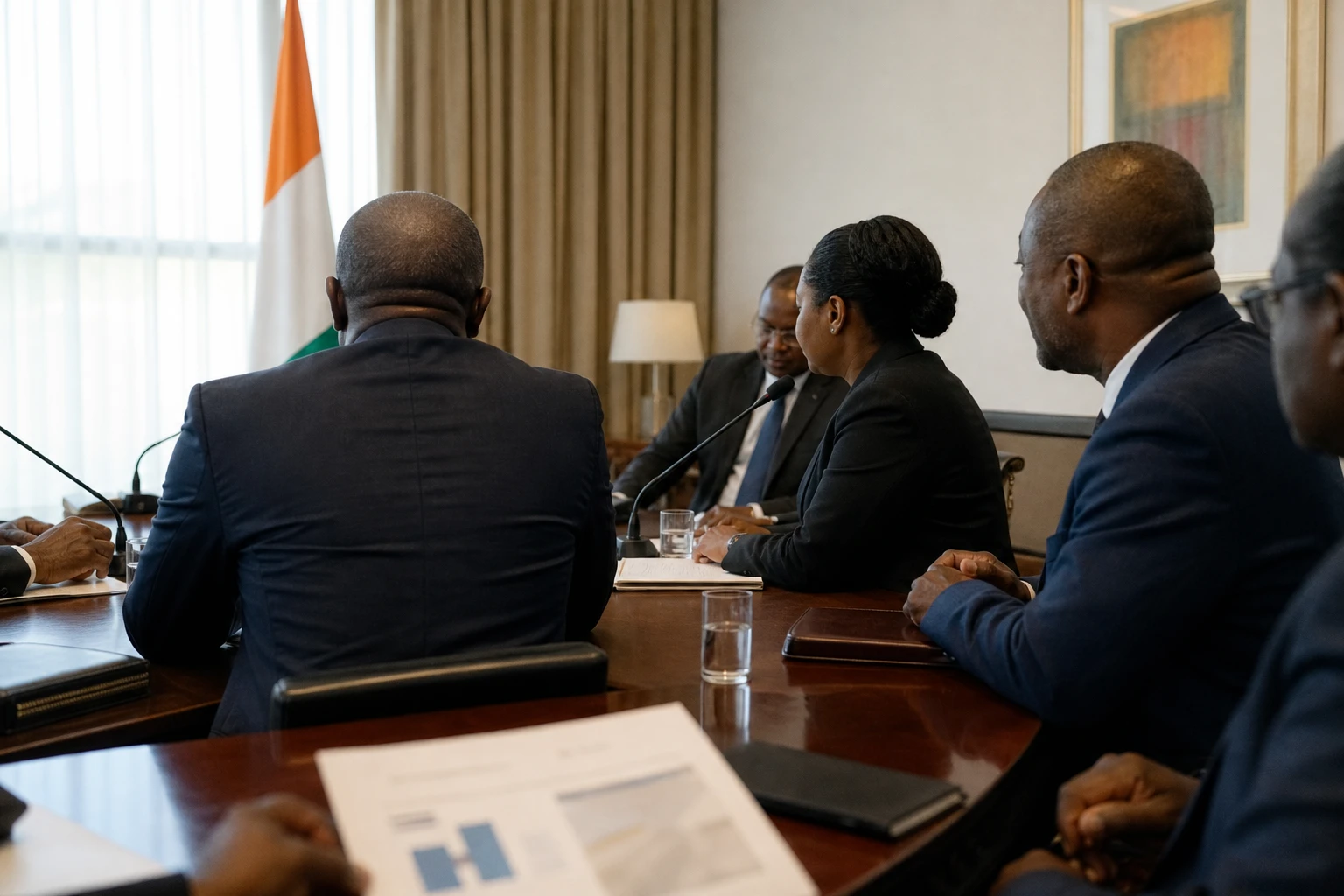
In Yamoussoukro, Côte d’Ivoire’s mining strategy now also hinges on transition metals such as lithium. The metal is of interest to groups seeking to secure battery supplies, but the challenge for a country is not simply to attract capital: it must also turn permits, drilling and geological promise into measured resources, and then into a credible industrial project. In Côte d’Ivoire, that step still lies ahead for the lithium sector.
The regional context matters greatly. Competition between mining jurisdictions in West Africa has intensified, while ECOWAS remains a space for the movement of capital, suppliers and skills. Abidjan is highlighting a regulatory framework considered clearer than those in several neighbouring countries, and the government further strengthened its message in 2025 and 2026 on digitising the mining cadastre, local content and an integrated policy for mineral resources and energy.
What the announced Firering–Australasian Metals deal says
On 7 September 2026, Firering Strategic Minerals confirmed that it had granted Australasian Metals an exclusive 90-day option over its major interests in the Atex and Alliance projects in Côte d’Ivoire. The agreement provides for an initial payment of 100,000 Australian dollars to conduct due diligence, followed by up to a further 1.4 million Australian dollars if the option is exercised. The arrangement gives Australasian Metals the opportunity to acquire up to 75% of Atex and 51% of Alliance, subject to technical validation and the required approvals.
Geologically, Atex is not starting from scratch. Firering says the project lies in the Baoulé-Mossi domain of the West African Craton, a mineralised belt that has already yielded lithium discoveries in Mali, notably at Bougouni and Goulamina. The company also says its previous drilling delivered significant intersections, including 67.97 metres at 1.23% lithium oxide and 20.77 metres at 1.65%. These results remain exploration data, not a declared mineral resource.
Alliance, meanwhile, is at an earlier stage. The asset is described as an exploration permit application, underlining a simple reality of the sector: investors’ interest often focuses first on promising ground, well before its economic value has been proved. In practice, the final decision will depend on technical checks, sample quality, metallurgical tests and Côte d’Ivoire’s administrative framework.
Why Côte d’Ivoire remains attractive despite market volatility
Interest in Ivorian lithium is not explained by geology alone. It is also supported by the country’s mining environment. The Ivorian government points to the ongoing reform of the mining code, the digitisation of the cadastre and a local-content policy designed to anchor more value in the national economy. These institutional signals weigh in exploration decisions, especially when capital moves quickly from one country to another.
External assessments share this diagnosis. According to the Fraser Institute’s 2025 ranking, published in February 2026, Côte d’Ivoire has once again become the most attractive jurisdiction in West Africa for mining investment and ranks fifth in Africa, with a score of 60.92 out of 100. This performance guarantees neither discovery nor production, but confirms a climate perceived as more predictable than in other mining areas of the sub-region.
The global market is also helping. The International Energy Agency notes that lithium prices more than doubled between early 2025 and early 2026, before remaining well below their 2022 peak. In other words, the previous downturn curbed exploration budgets, but the recent rebound is giving several African projects breathing space. For an exploration company, such a recovery shifts the balance of power between buyers and sellers of assets.
What this means for the Ivorian economy
For Côte d’Ivoire, the lithium project is part of a broader trajectory. The country remains primarily a major gold producer, but the authorities want to broaden the mining portfolio to include bauxite, nickel, manganese, colombo-tantalite and now lithium. This diversification could reduce dependence on a single metal. It could also attract new subcontractors, engineers, logistics firms and financiers to the mining areas in the north and centre of the country.
But the social stakes should not be reduced to stock-market announcements alone. Until there is a mine, direct benefits remain limited to geological work, drilling and service contracts. If a project reaches the feasibility and then construction stages, the issues become roads, water, electricity, local procurement and tax revenue distribution. That is where the difference is made between a mere exploration frontier and a sector that leaves a lasting mark on Côte d’Ivoire’s economy.
The timetable is therefore crucial. Firering’s 90-day option opens a due diligence phase, not a final decision. Approvals and further studies will follow, and only if the results are positive will the question of funding the work arise. For Abidjan, the stakes go beyond Atex and Alliance: the challenge is to prove that Côte d’Ivoire can convert its reputation for mining attractiveness into real projects, without losing sight of the requirements of economic sovereignty and local content.
A development to watch across West Africa
At ECOWAS and African Union level, this project reflects a broader trend: West Africa is no longer attracting attention solely for gold, but also for minerals linked to the energy transition. Lithium is becoming a field of competition between jurisdictions, alongside copper, cobalt and graphite. In this race, countries offering a stable framework, credible geological data and an efficient administration retain an advantage.
Côte d’Ivoire is therefore entering a testing phase. If Australasian Metals confirms its interest, the project will say something broader than the fate of a single project in the north of the country: it will show whether the Ivorian environment can turn renewed international confidence into future production, while retaining public control over the rules of the game. That is the real measure of the transition from mining potential to a national transformation strategy.