
 Algeria
 Egypt
 Libya
 Morocco
 Sudan
 Tunisia
 Benin
 Burkina Faso
 Cabo Verde
 Ghana
 Guinea
 Guinea-Bissau
 Liberia
 Mali
 Mauritania
 Niger
 Nigeria
 Senegal
 Sierra Leone
 The Gambia
 Togo
 Cameroon
 Central African Republic
 Chad
 DR Congo
 Equatorial Guinea
 Gabon
 Republic of the Congo
 São Tomé and Príncipe
 Burundi
 Comoros
 Djibouti
 Eritrea
 Ethiopia
 Kenya
 Madagascar
 Malawi
 Mauritius
 Mozambique
 Rwanda
 Seychelles
 Somalia
 South Sudan
 Tanzania
 Uganda
 Angola
 Botswana
 Eswatini
 Lesotho
 Namibia
 South Africa
 Zambia
 Zimbabwe
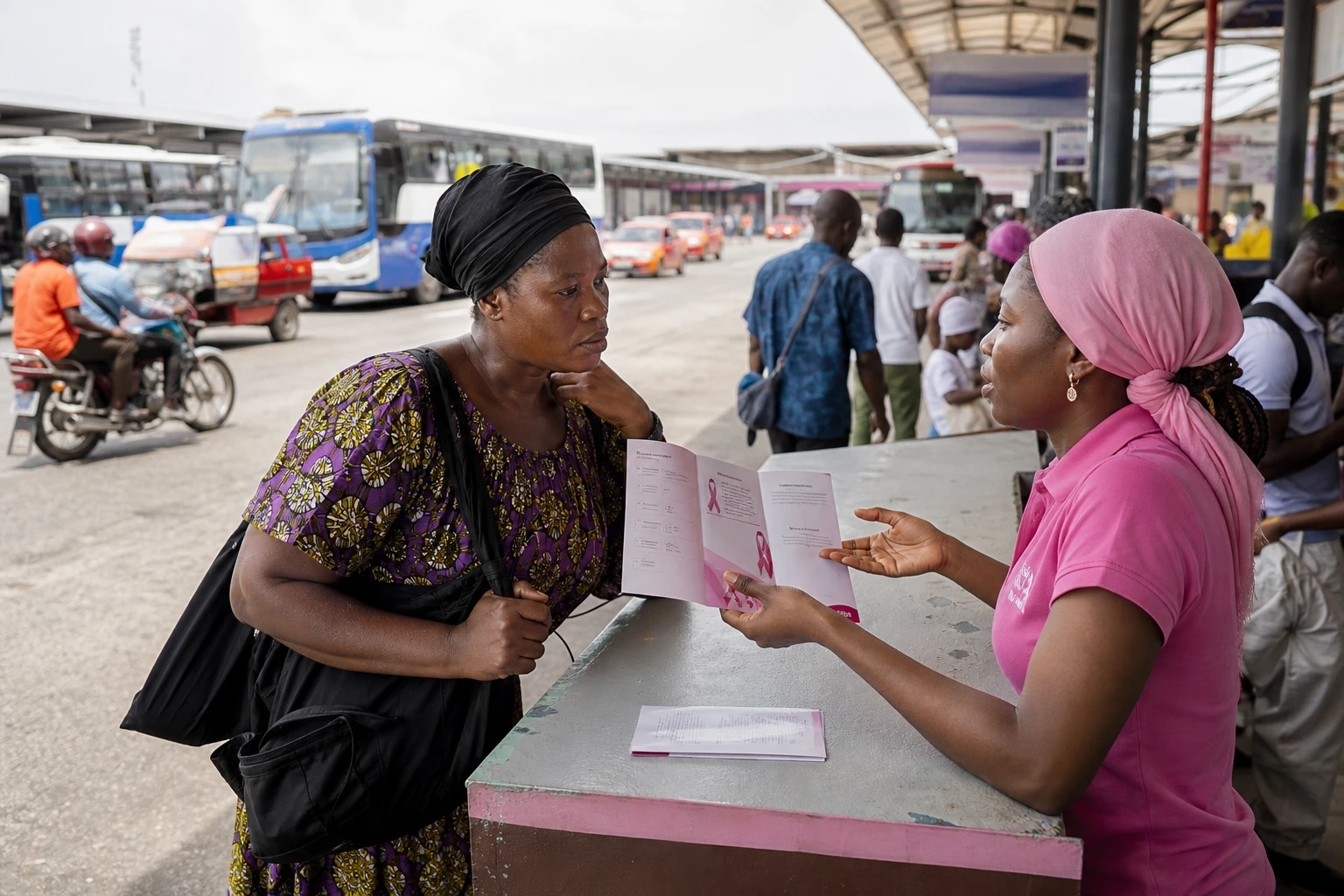
In Côte d’Ivoire, the fight against breast cancer does not take place only in hospital wards. It also hinges on the time taken to seek a consultation, the cost of tests and families’ ability to support a patient. In Abidjan and in cities across the country, early screening therefore remains a public health priority, as well as an issue of access to care.
A common cancer, often detected late
Breast cancer is the most common cancer among women in Côte d’Ivoire. GLOBOCAN 2022 data cited by the Ivorian Ministry of Health report 3,869 new cases and 2,092 deaths. These figures describe a widespread disease, but they do not capture individual experiences or the progress being made in the health system.
Late diagnosis remains one of the main obstacles. When the disease is detected at an advanced stage, treatment becomes more intensive and the chances of recovery fall. The ministry also highlights the impact of socio-economic barriers and a lack of awareness of warning signs.
This reality primarily affects women who live far from specialist centres. It also affects those who have to stop working, pay for travel or rely on relatives to attend several treatment sessions. In the informal economy, a day spent in hospital can also mean a day without income.
Côte d’Ivoire has nevertheless expanded its oncology services in recent years. The country has breast health centres at the Treichville University Hospital, the Cocody University Hospital and the Bouaké University Hospital. A mammography unit installed at the National Institute of Public Health in Adjamé has also expanded public screening and diagnostic capacity.
Screening must bring care closer to women
Screening does not mean waiting for severe pain to appear. A lump, a change in the shape of the breast, nipple retraction, unusual discharge or a change in the skin should prompt a consultation without delay. These signs do not automatically mean cancer is present, but they require medical advice.
Health professionals also encourage women to know their own bodies. Looking in a mirror and regular self-examination can help identify an abnormality. These actions, however, do not replace a clinical examination or tests prescribed by a health professional.
Campaigns organised by community groups in Abobo have illustrated this approach. During an awareness event held at a town hall, more than 300 women received free screening. Around 20 were referred to a health centre for further tests, according to information provided during the initiative.
This kind of action helps overcome one initial hurdle: entering a health facility. The next challenge is to ensure continuity of care. A one-off campaign will have only a limited impact if a patient who is referred cannot quickly obtain an ultrasound, mammogram, biopsy or appropriate treatment.
Cost remains a major ordeal
For many families, illness quickly transforms the household budget. One Ivorian patient says she was first given a prescription costing 333,000 CFA francs before beginning eight sessions of chemotherapy. She also describes injections for which each box cost 90,000 CFA francs, with several boxes needed after some sessions.
Her account highlights the gap between the growing availability of equipment and households’ actual ability to finance the entire course of care. Costs go beyond medicines. They include tests, transport, food, supportive care and, in some cases, lost income.
Universal health coverage can reduce some healthcare expenses, but it does not automatically resolve the question of the most expensive cancer treatments. Chemotherapy in particular remains a source of strain for patients and their relatives. Financial protection is therefore just as important as opening a new centre.
Ivorian authorities say they invest several hundred million CFA francs each year in breast cancer care. The ministry has set a target of treating 2,295 patients annually. These efforts are strengthening services nationwide, but they must still be matched by more equal access between Abidjan, other major cities and rural areas.
After diagnosis, preserving life and dignity
Breast cancer care can include surgery, chemotherapy, radiotherapy, hormone therapy or other treatments, depending on the type and stage of the disease. In some cases, removal of the breast becomes necessary. The operation can save a life, but it also affects body image and how a woman relates to the way others see her.
Sabine’s account is a reminder of this dimension. After discovering a lump beneath her breast, the mother was confronted with the fear of dying and anxiety for her children. She eventually underwent a mastectomy. Her story shows how psychological and social support must complement medical care.
Former patients speaking out can also help challenge the immediate association between cancer and a death sentence. In Côte d’Ivoire, as elsewhere, providing information is not just about giving instructions. It also means making treatment options visible, as well as the women who continue their lives after the disease.
A national and West African challenge
The fight against breast cancer is part of the broader development of Côte d’Ivoire’s health system. The country is seeking to upgrade its equipment, expand public oncology services and improve early detection. A public mobile mammography truck, announced in March 2026, is expected to help bring diagnosis closer to health districts.
This development also concerns the Economic Community of West African States (ECOWAS), which brings countries in the region together around shared policies and cooperation. The challenges are similar: specialists concentrated in capitals, high treatment costs, dependence on certain equipment and the need for more regular data.
For Ivorian women, the next step will be to turn Pink October campaigns into lasting care pathways. This means accessible appointments, available tests, funded treatment and follow-up after care. Prevention messages will only have their full meaning when a woman who discovers an abnormality knows where to go, how much it will cost and how soon she can receive care.
Data from the Ivorian Ministry of Health on breast cancer help measure the scale of the challenge. The expansion of public screening centres shows that a response is beginning to take shape. The task now is to make it accessible to all women, whatever their place of residence or income level.



