Algeria
 Egypt
 Libya
 Morocco
 Sudan
 Tunisia
 Benin
 Burkina Faso
 Cabo Verde
 Ghana
 Guinea
 Guinea-Bissau
 Liberia
 Mali
 Mauritania
 Niger
 Nigeria
 Senegal
 Sierra Leone
 The Gambia
 Togo
 Cameroon
 Central African Republic
 Chad
 DR Congo
 Equatorial Guinea
 Gabon
 Republic of the Congo
 São Tomé and Príncipe
 Burundi
 Comoros
 Djibouti
 Eritrea
 Ethiopia
 Kenya
 Madagascar
 Malawi
 Mauritius
 Mozambique
 Rwanda
 Seychelles
 Somalia
 South Sudan
 Tanzania
 Uganda
 Angola
 Botswana
 Eswatini
 Lesotho
 Namibia
 South Africa
 Zambia
 Zimbabwe
A diplomatic visit that goes beyond protocol
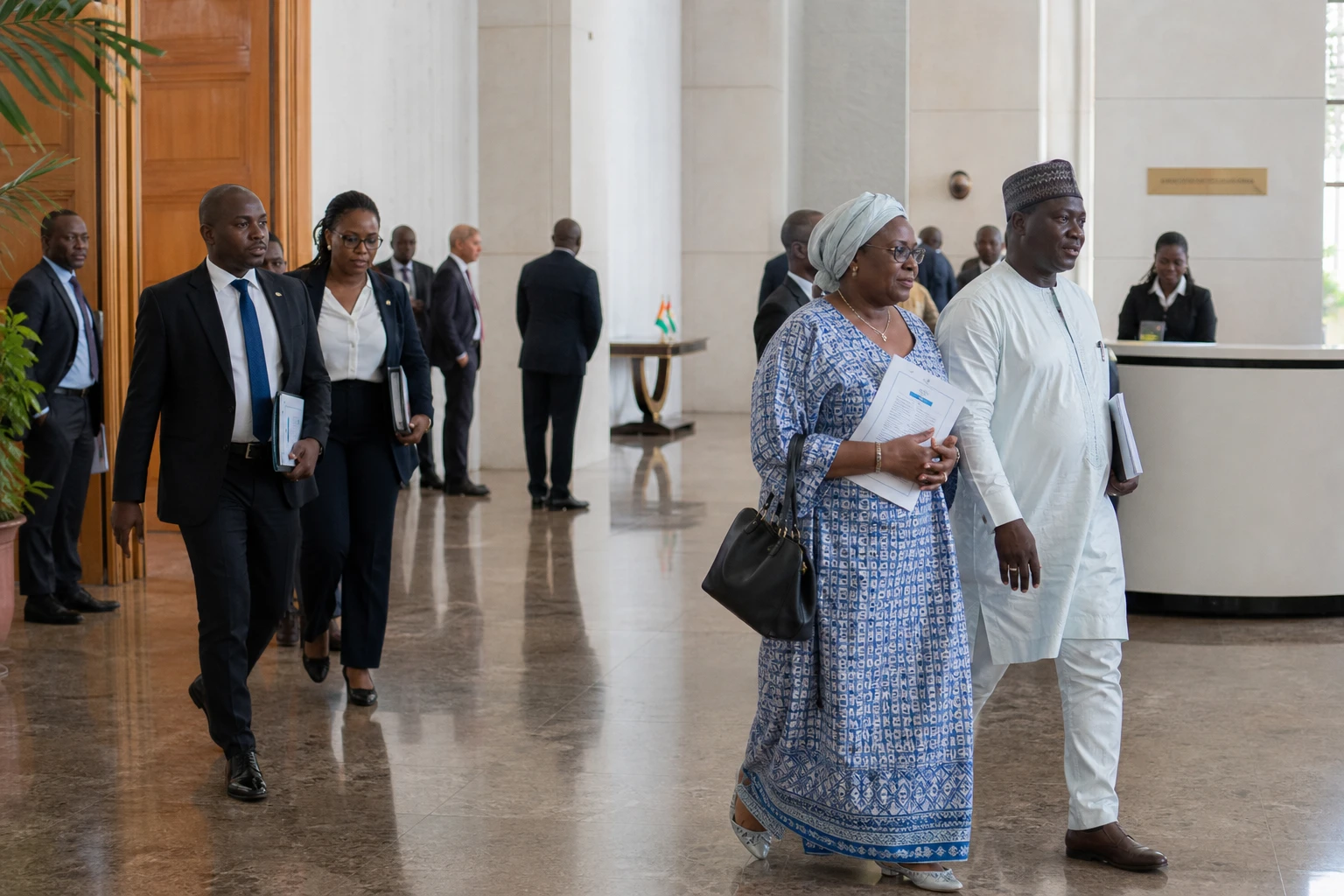
In Abidjan, an official visit is not just about multiplying handshakes. It often says something broader: the place a country wants to take in its neighbourhood, and how it intends to secure its trade routes, borders and alliances. It was in this spirit that Guinean President Mamadi Doumbouya made an official visit to Côte d’Ivoire from 11 to 13 September 2026, including a key meeting with Alassane Ouattara at the presidential palace.
For both Côte d’Ivoire and Guinea, this meeting is rooted in a very concrete geography. The two countries are neighbours, connected by longstanding human flows, trade and shared security interests in West Africa. In the region, ECOWAS remains the main framework for political cooperation and free movement, although its balance has been weakened in recent years.
What the two presidents discussed
The talks covered several issues at once: economic cooperation, trade relations, security and training. According to reports published in Abidjan and Conakry, the two heads of state also stressed the need to give fresh impetus to the bilateral partnership. The Guinean president, for his part, praised Côte d’Ivoire’s support during the political process that led to his election, while Abidjan highlighted the strength of the ties between the two capitals.
The visit did not take place in isolation. It came soon after the official resumption of government activities in Côte d’Ivoire, where the Council of Ministers meeting on 9 September 2026 put public action back on course under the 2026-2030 National Development Plan. In this context, talks with Conakry have an immediate economic dimension: ports, logistics corridors, trade in goods, the movement of people and the security of cross-border routes.
At the end of the meeting, Abidjan also announced that Côte d’Ivoire had been invited to Guinea’s national day celebrations. The diplomatic gesture may seem symbolic. In reality, it demonstrates a desire to maintain a regular political channel between the two states, at a time when West Africa is still seeking its bearings amid regional integration, political transitions and shifting alliances.
A strategic neighbourhood, not just cordial relations
The relationship between Côte d’Ivoire and Guinea goes beyond mere courtesy. The two countries have complementary economies. Côte d’Ivoire has a larger port, industrial and financial infrastructure. Guinea, meanwhile, is pursuing a transformation agenda centred on Simandou, the vast mining and rail project set to reshape its economic outlets. The World Bank describes the corridor as a cornerstone of Guinea’s transformation strategy, extending beyond the mining sector alone.
For the Ivorian authorities, this relationship also has regional value. Abidjan wants to consolidate its role as a West African economic hub, while the African Development Bank projects regional growth of 4.6% in 2026 for West Africa. In its country report, the institution highlights priorities directly relevant to Côte d’Ivoire: formalising the economy, property and mining taxation, financial reform and mobilising investment. Talks with Guinea are therefore part of a regional competitiveness strategy, not just neighbourly diplomacy.
Security cooperation is also central. In a West African region crossed by trafficking networks, border tensions and risks of destabilisation, states are seeking to coordinate their systems more closely. ECOWAS remains the institutional platform for this coordination, even though several recent political crises have weakened its ability to drive it forward. For Abidjan and Conakry, discussing security therefore means discussing trade routes, border controls and domestic stability.
What the visit says about Guinea today
Mamadi Doumbouya’s visit comes at a time when Guinea is seeking to signal a return to institutional normality. The Guinean presidency says Doumbouya was elected on 28 December 2025 and sworn in on 17 January 2026. Since then, Conakry has stepped up signals of diplomatic and economic normalisation, with the head of state more visibly present on the regional stage.
This approach also has a domestic dimension. For the Guinean government, making more visits and gestures towards neighbouring countries helps show that the country is not confined to a political transition or a purely domestic agenda. For the population, the stakes are more tangible: jobs, food prices, travel to neighbouring countries, security in border areas and market opportunities for informal operators as well as established businesses.
The timing is all the more sensitive because Guinea is also advancing economic transformation projects presented as foundational. In 2026, the Guinean government, with support from international partners, launched the AgriConnect compact to link food security and employment with the Simandou corridor. This shows that Conakry now wants to talk about agriculture, infrastructure and industrialisation, not just mining. In this context, ties with Côte d’Ivoire could provide a bridge to wider markets and more practical forms of integration.
A West African, and even continental, significance
Finally, the visit has significance beyond the bilateral relationship. It is a reminder that in West Africa, countries that sustain growth most effectively are often those that manage to combine neighbourly diplomacy, institutional stability and open markets. Côte d’Ivoire and Guinea share this challenge: turning historic ties into economic levers in a regional environment where the AfCFTA, ECOWAS and WAEMU remain frameworks that are still unevenly used.
The immediate follow-up also warrants attention. The question is not simply whether the two presidents get along. It is whether announcements will translate into specific mechanisms: customs facilitation, cross-border cooperation, business mobility, security monitoring and technical meetings between government departments. This is where, far more than in the ceremony itself, the real significance of Mamadi Doumbouya’s visit to Yamoussoukro, Côte d’Ivoire’s political capital, and Abidjan, the country’s diplomatic and economic centre, will be measured.