Algeria
 Egypt
 Libya
 Morocco
 Sudan
 Tunisia
 Benin
 Burkina Faso
 Cabo Verde
 Côte d'Ivoire
 Ghana
 Guinea-Bissau
 Liberia
 Mali
 Mauritania
 Niger
 Nigeria
 Senegal
 Sierra Leone
 The Gambia
 Togo
 Cameroon
 Central African Republic
 Chad
 DR Congo
 Equatorial Guinea
 Gabon
 Republic of the Congo
 São Tomé and Príncipe
 Burundi
 Comoros
 Djibouti
 Eritrea
 Ethiopia
 Kenya
 Madagascar
 Malawi
 Mauritius
 Mozambique
 Rwanda
 Seychelles
 Somalia
 South Sudan
 Tanzania
 Uganda
 Angola
 Botswana
 Eswatini
 Lesotho
 Namibia
 South Africa
 Zambia
 Zimbabwe
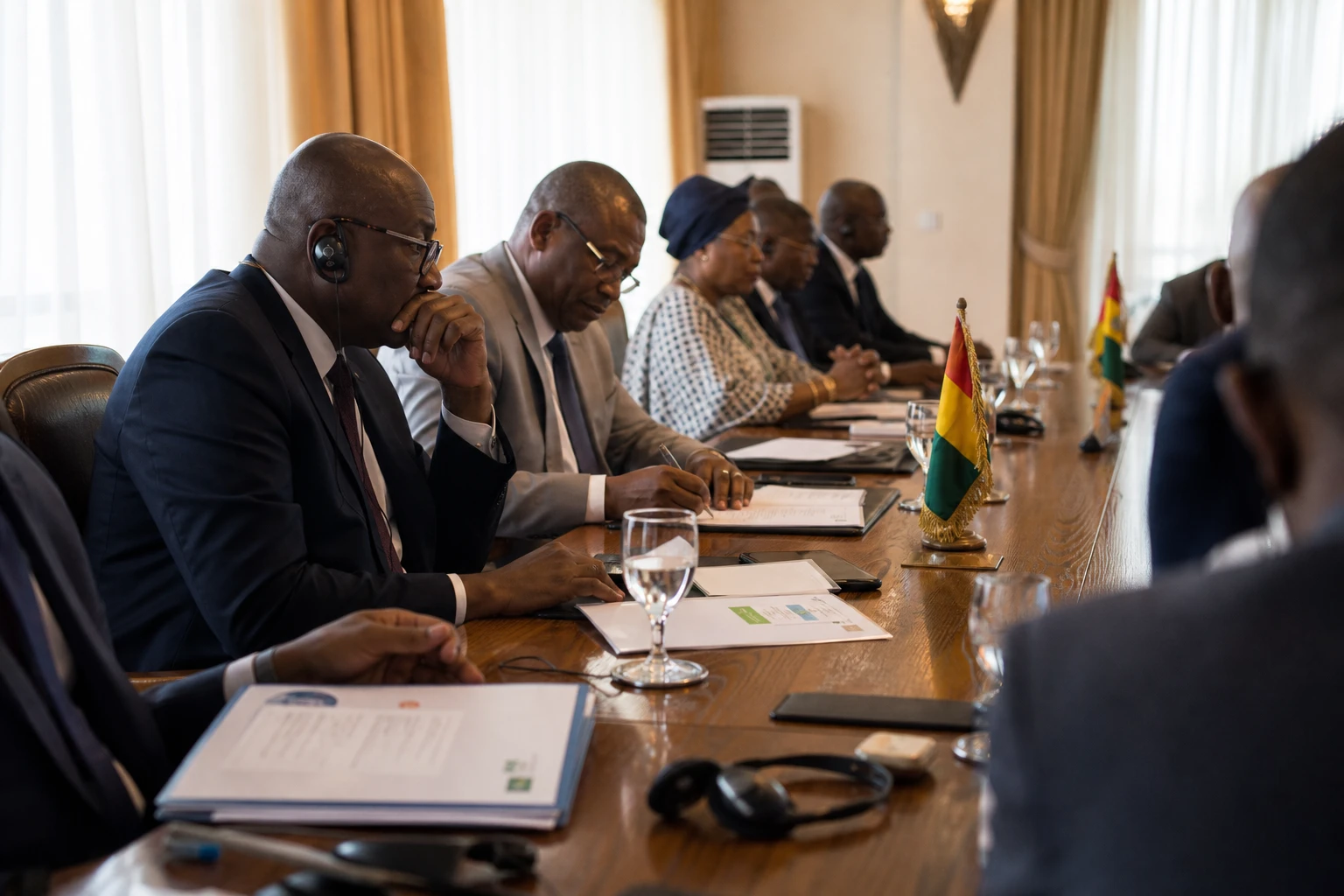
In Conakry, the danger lies not only in the rain. It also lurks on the city’s margins, where homes encroach on unstable ground and waste has been piling up for years.
In the Gbessia municipality, the Dar-es-Salam rubbish dump was the scene of another deadly collapse during the night of Saturday 22 to Sunday 23 August 2026. The disaster struck a working-class neighbourhood in Conakry, the Guinean capital, while several families were still sleeping near the site. A provisional toll released by the authorities reported at least 30 dead and 22 injured, six of them seriously. Other figures published later put the death toll at 31. This variation is a reminder of the need for caution in the first hours after a disaster.
The scene says much about the urban pressure bearing down on Conakry. The capital concentrates administrative activity, a significant share of the informal economy and densely populated areas often exposed to climate hazards. At national level, Guinea is only just emerging from a political period marked by a gradual return to constitutional order and elections held on 31 May 2026, while ECOWAS, the Economic Community of West African States, continues to closely monitor the institutional stability of its member states.
The Dar-es-Salam disaster happened at dawn, after heavy rain
According to the provisional toll reported by the African Press Agency, the landslide occurred at about 2am after sustained rainfall over the Guinean capital. Rescue workers were deployed to search for anyone who might be trapped, recover bodies and take the injured to health facilities, including Donka University Hospital. This sequence confirms that the emergency was not only a matter of fatalities; it was also medical, logistical and social.
On the ground, people rallied to help immediately. Displaced families were taken to a school in Conakry that had been converted into temporary accommodation. Other local press reports confirmed the emergency relocation to Dixinn Centre 1 school, where public services and humanitarian teams took in several hundred people. The detail matters: in an urban disaster, a school can sometimes become the first refuge, before lasting solutions are found.
The civil protection service and the National Agency for the Management of Emergencies and Humanitarian Disasters coordinated the reception of those displaced, while local authorities began identifying households still at risk. This marks a shift in the response. The focus is no longer solely on immediate rescue, but also on moving people out of high-risk areas and securing a site whose dangers have long been tolerated.
A known site, a known risk, a still-fragile response
Dar-es-Salam is no anonymous place. The rubbish dump has long been one of Conakry’s sanitation blackspots. Guinean media reported, even before the disaster, preparations for a future landfill elsewhere in the metropolitan area, a sign that the issue is longstanding and that permanently closing the site remains a stated goal, but one that has yet to be achieved. The latest collapse therefore raises a simple question: how long can a city live with infrastructure that is at once a rubbish dump, a residential area and a constant threat?
For residents, the shock is twofold. First comes the loss of loved ones. Then there is the loss of a home, a business or a daily route. In these neighbourhoods, the survival economy often depends on being close to markets, roads and construction sites. When a site becomes dangerous, forced relocation further destabilises households that are already precarious, without guaranteeing stable housing or a swift return to work.
The disaster also echoes a recent precedent. In August 2025, a landslide in Manéah, about 50 kilometres from Conakry, had already killed at least 11 people according to Africanews, followed by a toll of 15 dead, 12 injured and 10 missing, according to an official figure reported by the APA. There, too, the rainy season exposed the vulnerability of inhabited areas and the difficulty of preventing people from settling in high-risk locations. The repeated pattern shows that this is not an isolated disaster; it is part of a chain of urban and environmental risks.
What the disaster reveals about Guinea and the region
For Guinea, the issue goes beyond the death toll. It touches on urban governance, land-use planning and waste management in a capital growing faster than its infrastructure. It also affects the credibility of public action, as every crisis of this kind revives the same expectation: permanently relocate people at risk, close dangerous sites, fund sanitation and control unregulated settlement. In Conakry, the response cannot be humanitarian alone; it must also be political and technical.
Across West Africa, the warning is just as clear. The sub-region’s major cities are facing rising water levels, heavier rainfall and pressure on land. Urban disasters first hit working-class neighbourhoods, then the entire local economic chain. Guinea, as an ECOWAS member, is therefore confronting a problem shared by several regional capitals: how to protect large populations without turning high-risk areas into places of residence for lack of an alternative.
The next steps will play out on two fronts. The first is immediate: treat, rehouse, compensate and secure. The second is structural: end Dar-es-Salam’s status as a recurring threat and speed up the sanitation solutions announced months ago. As long as this second front remains open, each rainy season could reopen the same wound at the heart of Conakry.