
 Algeria
 Egypt
 Libya
 Morocco
 Sudan
 Tunisia
 Benin
 Burkina Faso
 Cabo Verde
 Côte d'Ivoire
 Ghana
 Guinea
 Guinea-Bissau
 Liberia
 Mali
 Mauritania
 Niger
 Nigeria
 Senegal
 Sierra Leone
 The Gambia
 Togo
 Cameroon
 Central African Republic
 Chad
 DR Congo
 Equatorial Guinea
 Gabon
 Republic of the Congo
 São Tomé and Príncipe
 Burundi
 Comoros
 Djibouti
 Eritrea
 Ethiopia
 Kenya
 Madagascar
 Malawi
 Mauritius
 Mozambique
 Rwanda
 Seychelles
 Somalia
 South Sudan
 Tanzania
 Uganda
 Angola
 Botswana
 Eswatini
 Lesotho
 Namibia
 Zambia
 Zimbabwe
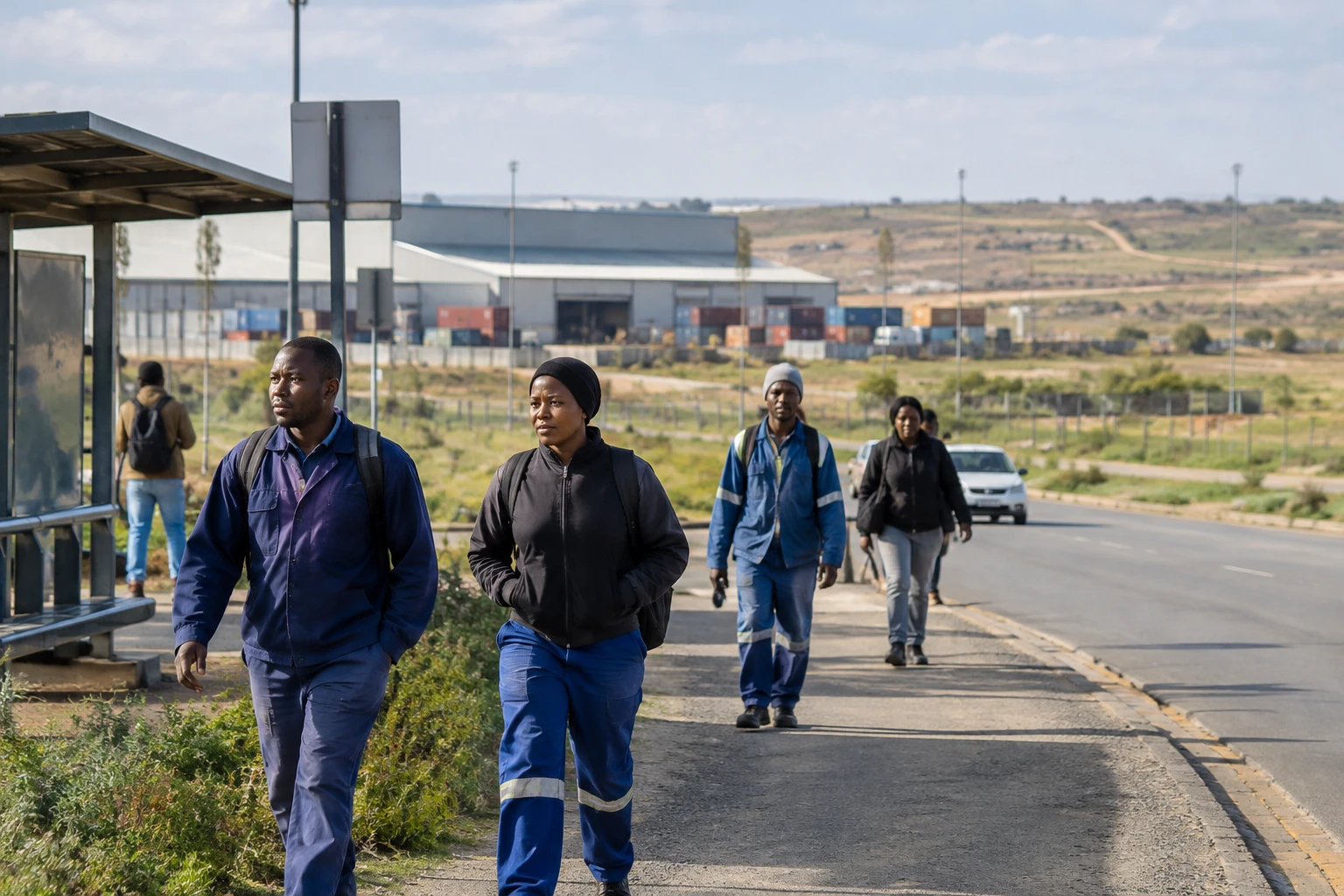
Can an industrial zone turn a port and serviced land into lasting jobs, factories and local added value? At Coega, in Eastern Cape province, activity is real. But the still-vacant spaces are a reminder that infrastructure alone does not guarantee industrialisation.
A site designed around the port and production
Located near Gqeberha, formerly known as Port Elizabeth, Coega is South Africa’s largest special economic zone (SEZ). The scheme brings businesses together within an area equipped with infrastructure and incentives intended to support investment. Coega covers about 9,003 hectares and adjoins the deep-water Port of Ngqura, an asset for export-oriented activities.
The sectors represented range from automotive and agro-processing to metals, logistics and energy. South African companies there, for example, package fruit for overseas markets. International manufacturers, including Chinese automakers BAIC and FAW, have also established operations there. The site’s appeal lies as much in its port access as in the industrial infrastructure developed on site.
The port nevertheless has room to grow. According to data reported by its managing authority, the container terminal could handle up to two million TEUs, the equivalent of a standard 20-foot container. Its capacity in use was put at 1.2 million TEUs. This gap underlines that proximity to a port is not enough: activity volumes, efficient logistics links and regular customers are also needed.
Jobs and revenue, but uneven results
Statistics South Africa’s published data offer a concrete measure of activity. In 2024, Coega had 46 businesses and 9,842 people in employment, up from 43 businesses and 8,585 jobs a year earlier. Of these workers, 6,594 were directly employed by businesses located in the zone. Manufacturing accounted for 59.4% of jobs.
Total revenue for Coega businesses reached 25 billion rand in 2024, up 32.2% from 2023. Investment in new assets also increased. But these indicators alone do not show how many jobs or investments would not have existed without the zone’s special status. This is precisely one of the challenges in assessing the effectiveness of public aid.
The national record of SEZs should therefore be viewed with nuance. In July 2026, the South African government released findings from a World Bank study covering the country’s 12 zones. Trade, Industry and Competition Minister Parks Tau said the operational zones had generated 14.8 billion rand in revenue and created more than 30,000 jobs. He also acknowledged that the study proposed ways to improve performance, particularly in the weaker zones.
These official results point to measurable economic activity and jobs. However, they do not establish that tax benefits and infrastructure spending deliver an equivalent return everywhere. The government is considering a five-year intervention framework for struggling zones, as well as more structured agreements with municipalities on service provision.
The decisive test: attracting activity that would not have happened elsewhere
For Anthony Black, an economist at the University of Cape Town, infrastructure and support costs can be high, while incentives are not always enough to attract new investment. A company may choose an SEZ because of access to a port, energy or roads; it may also set up there even though it would have invested elsewhere in the country. This distinction matters for public finances: a subsidy is genuinely effective only if it triggers additional activity or creates stronger local benefits.
The benefits are also unevenly distributed. Exporting businesses and workers directly recruited benefit from activity at the site. Small businesses in the region may benefit if they supply goods, services or skills to tenants. But empty land, delayed projects and indirect jobs that are harder to measure are reminders that the benefits do not automatically spread to neighbouring areas and local businesses.
South African rules provide, among other things, for a 15% corporate income tax rate in an SEZ for certain eligible businesses, compared with the general rate of 27%, as well as customs- and employment-related schemes. These benefits are subject to conditions. Their usefulness also depends on less visible factors: reliable municipal services, the availability of water and electricity, freight transport and the ability to train a suitably skilled workforce.
An issue that extends beyond South Africa’s borders
Coega forms part of the industrial strategy of the Southern African Development Community (SADC), the regional organisation bringing together Southern African states. It aims to develop value chains in agro-processing, mineral beneficiation and pharmaceuticals. For industrial zones to serve this ambition, they must facilitate trade and partnerships with neighbouring countries, rather than simply shipping raw materials or assembled products to distant markets.
The next decisions will therefore focus on the quality of investments, their ability to create stable jobs and their links with local and regional suppliers. The announced review of South Africa’s programme, and the measures being considered for underperforming zones, will provide a concrete test. In Coega, as elsewhere in the country, the challenge is not merely to fill the land: it is to establish whether public funds contribute to sustainable production that is better connected to the surrounding economy.
For the data and policies discussed, see South African statistics on Coega’s activity in 2024, information released by the South African government on the SEZ study, the official overview of the zones and their incentives and SADC’s regional value-chain priorities.



