Algeria
 Egypt
 Libya
 Sudan
 Tunisia
 Benin
 Burkina Faso
 Cabo Verde
 Côte d'Ivoire
 Ghana
 Guinea
 Guinea-Bissau
 Liberia
 Mali
 Mauritania
 Niger
 Nigeria
 Senegal
 Sierra Leone
 The Gambia
 Togo
 Cameroon
 Central African Republic
 Chad
 DR Congo
 Equatorial Guinea
 Gabon
 Republic of the Congo
 São Tomé and Príncipe
 Burundi
 Comoros
 Djibouti
 Eritrea
 Ethiopia
 Kenya
 Madagascar
 Malawi
 Mauritius
 Mozambique
 Rwanda
 Seychelles
 Somalia
 South Sudan
 Tanzania
 Uganda
 Angola
 Botswana
 Eswatini
 Lesotho
 Namibia
 South Africa
 Zambia
 Zimbabwe
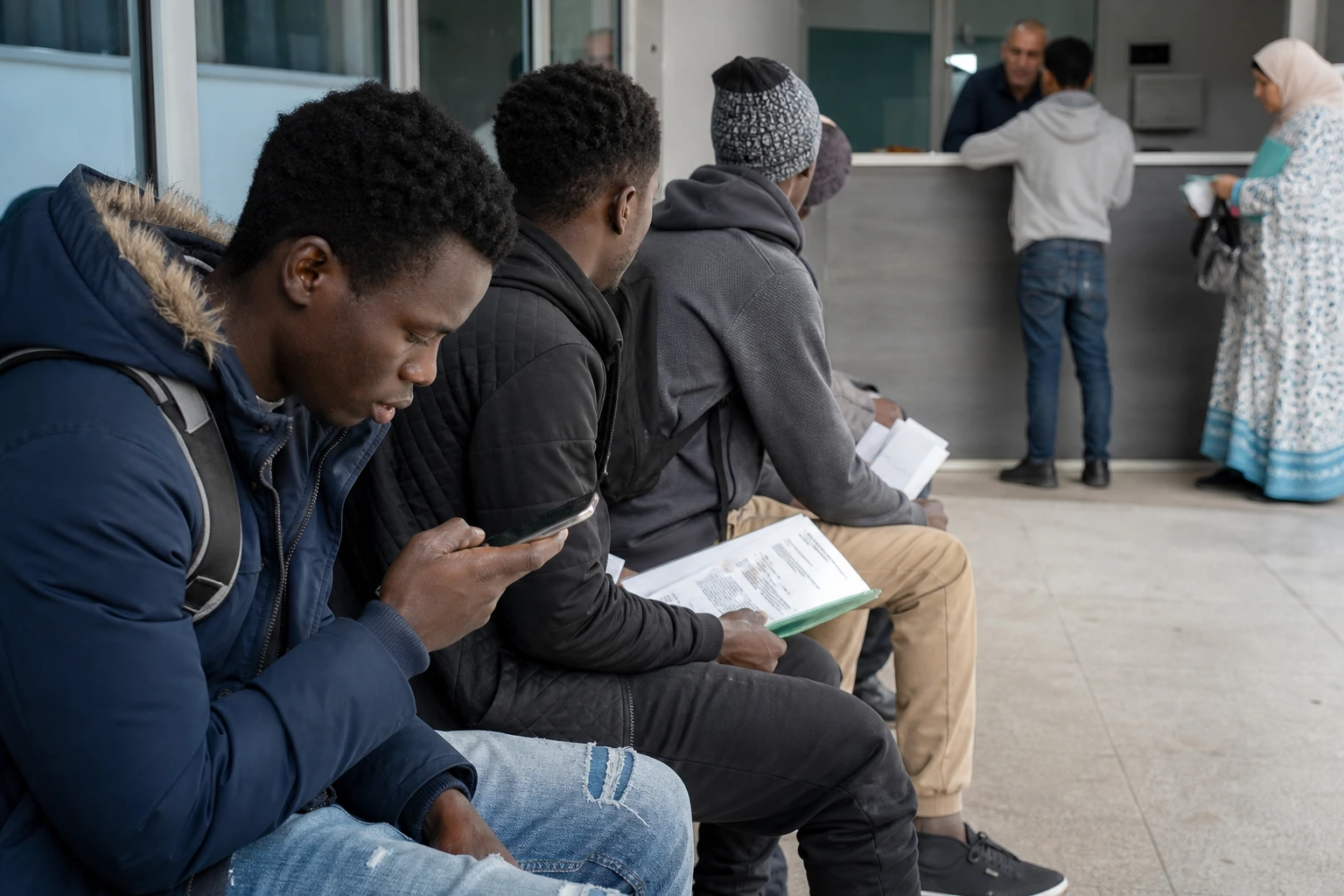
In Ceuta, a beach has become a waiting area for young people seeking protection
On the sand at Trampolín, in Ceuta, dozens of young people from sub-Saharan Africa remain in view, just metres from a city where every movement is now seen through the lens of the border. They have neither fully entered nor really left. They are waiting for a place, a case file, an answer. In this Spanish enclave bordering Morocco, the question is no longer only one of control. It is also about reception, the right to asylum and the ability of institutions to manage pressure that returns in waves.
Ceuta and Melilla, together with sea routes to the Iberian Peninsula, form one of the sensitive points on the so-called Western Mediterranean route, which crosses Morocco before reaching Spain. The border at Ceuta remains distinctive. On one side, it is a European crossing point. On the other, it is intertwined with geography, daily movement and diplomatic relations with Rabat. In this context, Morocco plays a central role, as a country of transit, a passageway and a security partner of Madrid and the European Union.
More arrivals, a rising number of minors and a strained system
On 5 August, the situation at Trampolín attracted international attention, with dozens of young people from sub-Saharan Africa gathered near the beach in the hope of obtaining asylum in Spain. This came after several days of intense migration pressure around Ceuta. On 1 August, the Spanish authorities even deployed a floating barrier in the border area, as Madrid seeks to limit crossings by swimming while complying with recent case law.
The decision to strengthen the border comes as the autonomous city is already under pressure on another front: unaccompanied minors. On 25 February 2026, the Spanish government said that 1,019 unaccompanied foreign minors from Ceuta, the Canary Islands and Melilla had already been transferred to other regions. Then, in July 2026, the government earmarked €5.5 million for Ceuta from a national allocation of €35 million intended to care for these minors. A few days later, the city prepared two large facilities to reorganise accommodation for more than 1,000 young people.
This dual movement says much about the scale of the issue. On one hand, the land and sea borders remain active. On the other, accommodation and social support capacity has been exceeded. The local administration is working with limited resources, while the Spanish state is trying to spread the burden across the rest of the country. Meanwhile, the right to asylum remains available at the borders of Ceuta and Melilla, according to information provided by UNHCR in Spain.
Why this crisis also concerns Morocco
Ceuta is not a distant issue for Morocco. The city is linked to movement patterns in the north of the country, smuggling networks, political relations with Spain and cooperation with the European Union. Madrid also notes that Moroccan citizens can enter Ceuta and Melilla without a visa, provided they do not spend the night on Spanish territory. This feature makes the border highly permeable in everyday practice, while also rendering it politically explosive whenever a surge in migration occurs.
The Moroccan reading of this kind of crisis often differs from the highly security-focused approach taken by European capitals. In Rabat, the stated priority is generally to manage flows, combat trafficking networks and preserve stable dialogue with Madrid. But on the ground, the reality is more complex. The young people seen in Ceuta often come from countries in West or Central Africa. Morocco is therefore not their point of origin, but a transit point. This is a reminder of a truth that is often overlooked: African mobility is primarily regional before it is international.
The issue also reveals the limits of a response focused solely on closure. Spain has strengthened its resources in Ceuta and Melilla. The European Union, for its part, supports the management of the Western route through FRONTEX operations and cooperation programmes with neighbouring countries. But the pressure does not disappear. It shifts. It changes form. And it often returns to the most vulnerable point: young people with no support network, caught between controls, rumours of asylum and the exhaustion of the journey.
An issue that extends beyond Ceuta
The stakes go far beyond the city. In Ceuta, migration has become intertwined with an administration’s ability to keep going over the long term. In Spain, it is also fuelling debate over how minors should be distributed among regions. At European level, it is testing the balance between border security and protection obligations. And for North Africa, it is a reminder that no Mediterranean border is merely local: it is always connected to longer journeys, from the Sahel to the Moroccan coast and then towards Europe.
What is unfolding at Trampolín is therefore not an isolated episode. It is a signal. The coming days will show whether the pressure eases, whether further transfers of minors are set in motion and whether control measures are enough to prevent another overcrowding crisis. For Rabat and Madrid alike, the question remains the same: how to manage a border where labour migration, asylum claims, domestic security and humanitarian responsibility intersect, without turning every summer into a political crisis.