Algeria
 Egypt
 Libya
 Sudan
 Tunisia
 Benin
 Burkina Faso
 Cabo Verde
 Côte d'Ivoire
 Ghana
 Guinea
 Guinea-Bissau
 Liberia
 Mali
 Mauritania
 Niger
 Nigeria
 Senegal
 Sierra Leone
 The Gambia
 Togo
 Cameroon
 Central African Republic
 Chad
 DR Congo
 Equatorial Guinea
 Gabon
 Republic of the Congo
 São Tomé and Príncipe
 Burundi
 Comoros
 Djibouti
 Eritrea
 Ethiopia
 Kenya
 Madagascar
 Malawi
 Mauritius
 Mozambique
 Rwanda
 Seychelles
 Somalia
 South Sudan
 Tanzania
 Uganda
 Angola
 Botswana
 Eswatini
 Lesotho
 Namibia
 South Africa
 Zambia
 Zimbabwe
When the border opens, illusions fall as quickly as bodies
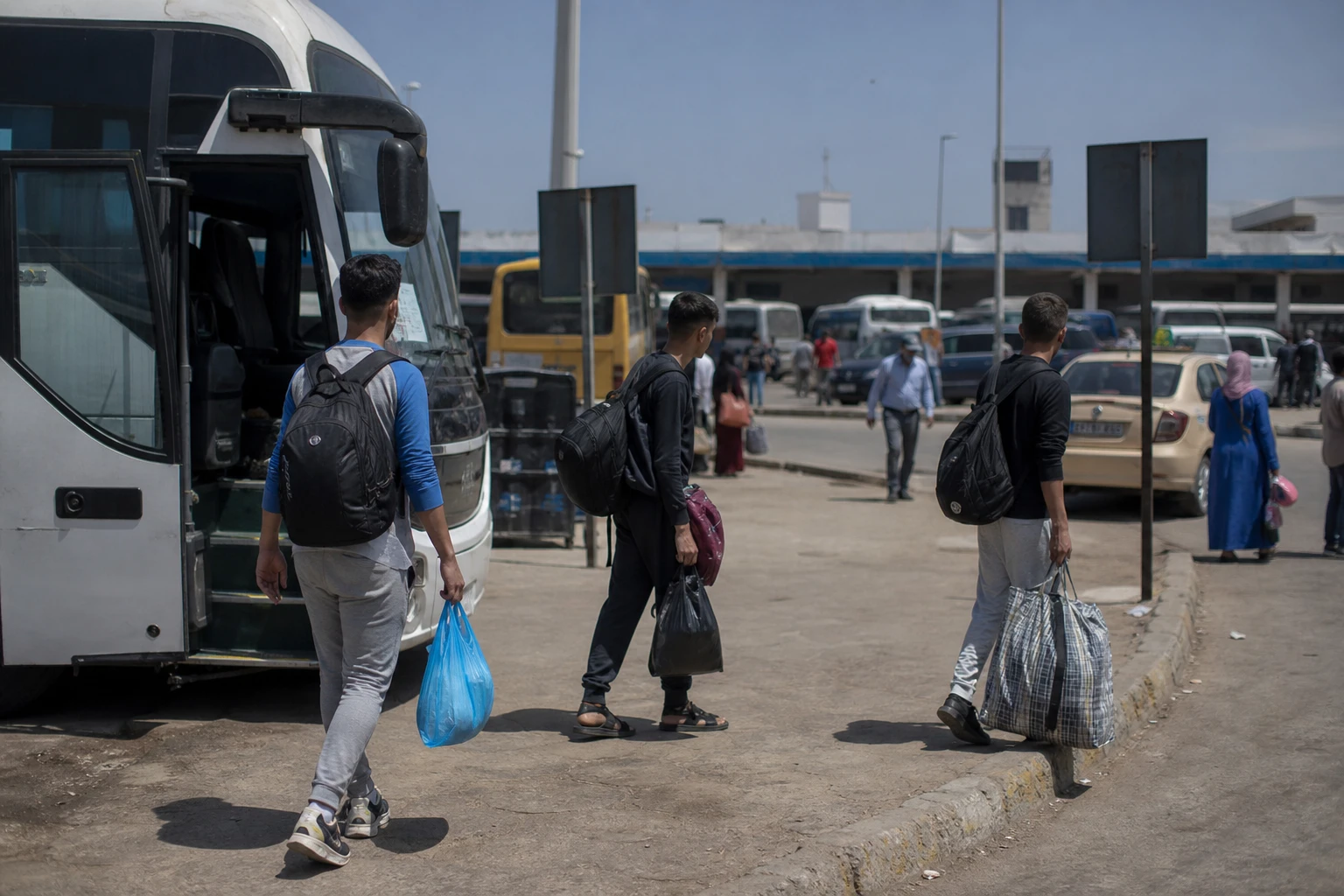
In Fnideq, very close to Rabat in Morocco’s political narrative but, above all, just a few kilometres from Ceuta, young people returning to Morocco experienced a brutal awakening. Many had believed a window to Europe had opened. Instead, they found coaches, checks and, for some, visible marks of blows. This episode speaks less of a “rush” than of collective dismay, born of a sudden easing of passage followed just as quickly by a tightening.
The issue is set in a very particular area. Ceuta, a Spanish enclave on the Mediterranean coast, borders Morocco’s M’diq-Fnideq prefecture. The area depends on small businesses, daily movement and cross-border exchanges. When the border closes, the local economy immediately takes the hit. When it opens up, it also draws the most fragile hopes. It is this reality, far more than the slogans, that needs to be understood here.
What happened between Ceuta and Fnideq
On 17 and 18 May 2021, thousands of people crossed the border between Morocco and Ceuta. Spanish authorities spoke of around 10,000 entries in less than two days, while the Spanish government described an unprecedented crisis. Other figures reported later put the number of crossings at more than 8,000 in 48 hours. At the same time, Madrid stepped up returns to Morocco and strengthened its security measures.
In accounts collected on the Moroccan side, several young people say they returned of their own accord after an experience they describe as violent and psychologically distressing. Some say they were shoved, beaten or pursued. Others say they saw minors gathered together and then sent back to Morocco. These accounts are statements by people interviewed on the ground and should be understood as such. The key point lies elsewhere: for many, the episode shattered the idea of a simple, risk-free crossing.
The situation on the ground also revealed a very human geography. Fnideq is not just a border town. It is a starting point for workers, vendors, families and young people whose lives depend on proximity to Ceuta. When the border tightens, informal movement collapses. When it loosens, it sometimes resumes in the form of crowds. In this crisis, the most exposed remain adolescents, precarious workers and families with no financial cushion.
A migration episode, but also a diplomatic and social one
The events of May 2021 went beyond migration alone. Madrid spoke of an attack on territorial integrity, language that shows how sensitive a place Ceuta and Melilla hold in Spanish politics. On the Moroccan side, the issue was also viewed through the management of the border, social pressure in the north and the broader relationship with Spain. The European Union, meanwhile, saw in this movement the fragility of an entry point that acts as a pressure valve, but also as leverage in broader power struggles.
Morocco is in a familiar but delicate position. The kingdom is a country of origin, transit and reception. This reality is already documented in Moroccan public policies on migration and asylum, which have sought to establish a more structured approach to rights and integration. But the northern border remains an area of recurring tensions, where security, local employment and the movement of people intersect without being easily resolved.
For residents of the Tangier-Tetouan-Al Hoceima region, the impact is tangible. A crowd at the border can disrupt trade, transport and daily life within hours. For the state, the challenge is twofold: to contain irregular departures without turning the northern coastline into a permanent zone of tension. For young people in particular, the episode is a reminder that “nearby Europe” remains a very distant promise when it depends on the chance of a police let-up or a rumour.
What this episode says about the Maghreb and the continent
At regional level, Ceuta is a bellwether. The Moroccan-Spanish border does not function in isolation: it is connected to migration dynamics in the Maghreb, pressure on Mediterranean routes and the growing role of African countries in managing mobility. The May 2021 episode showed that a simple change in controls could produce a mass movement within hours. It is a lesson for the entire southern shore of the Mediterranean.
It also shows that migration cannot be viewed solely from Brussels or Madrid. For Morocco, it touches on sovereignty, youth employment, pressure on northern cities and the management of an unequal but indispensable neighbourly relationship. For North Africa, it is a reminder that a border is never just a line on a map. It is a social, economic and political space where security, rights and survival strategies all play out at once.
The next thing to watch at the time was not only the number of returns to Morocco. It was the ability of both sides to bring the crisis to a close without shifting it elsewhere, towards other crossing points, other coasts and other young people tempted by the same gamble. In the following weeks, the handling of unaccompanied minors and the resumption of bilateral dialogue confirmed that the episode extended far beyond the single day of mass crossings.