Algeria
 Egypt
 Libya
 Morocco
 Sudan
 Tunisia
 Benin
 Burkina Faso
 Cabo Verde
 Côte d'Ivoire
 Ghana
 Guinea
 Guinea-Bissau
 Liberia
 Mali
 Mauritania
 Niger
 Nigeria
 Senegal
 Sierra Leone
 The Gambia
 Togo
 Central African Republic
 Chad
 DR Congo
 Equatorial Guinea
 Gabon
 Republic of the Congo
 São Tomé and Príncipe
 Burundi
 Comoros
 Djibouti
 Eritrea
 Ethiopia
 Kenya
 Madagascar
 Malawi
 Mauritius
 Mozambique
 Rwanda
 Seychelles
 Somalia
 South Sudan
 Tanzania
 Uganda
 Angola
 Botswana
 Eswatini
 Lesotho
 Namibia
 South Africa
 Zambia
 Zimbabwe
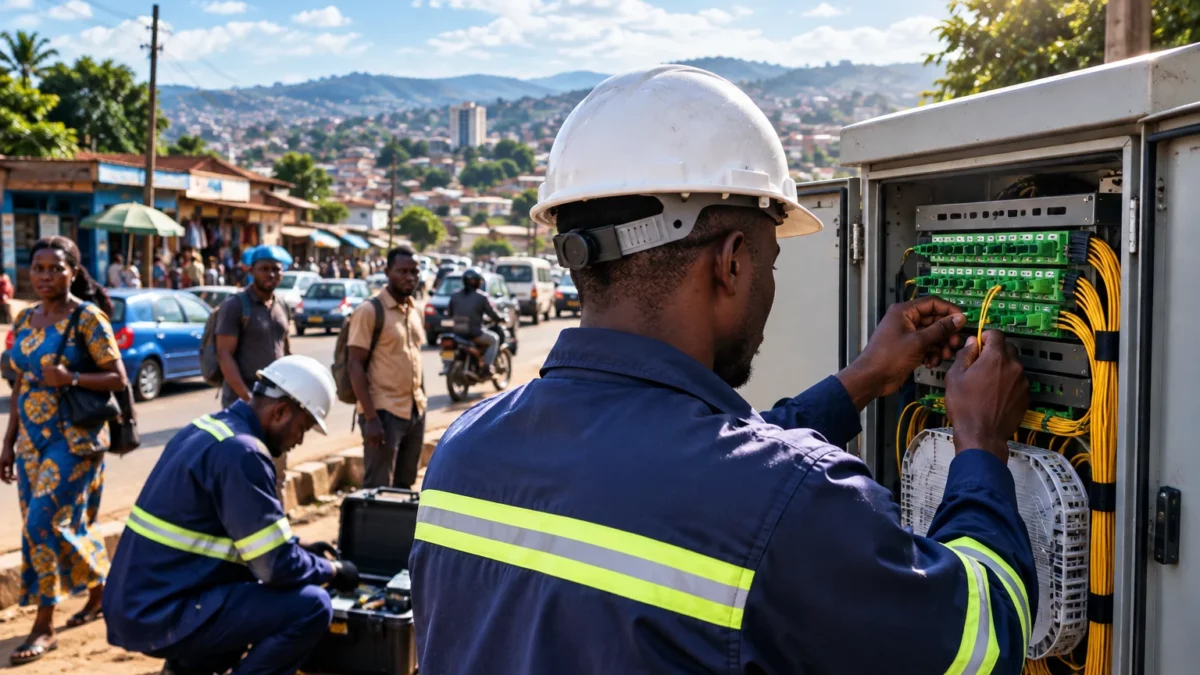
When a fibre cut affects the national network, the consequences extend beyond the operator responsible for maintaining the cable. Calls, mobile connections and data exchanges can all suffer. In Cameroon, the disagreement between CAMTEL and the regulator therefore raises a practical question: who should fund the reliability of infrastructure used by the entire sector?
A shared network under scrutiny
The national fibre-optic network, or backbone, carries communications between regions and connects operators’ sites, among other things. CAMTEL, the state-owned telecommunications company, manages it under a concession. Mobile operators buy capacity to carry their services. Its availability therefore matters to businesses across the sector and their subscribers, in cities and in less densely served areas alike.
The dispute comes amid increased scrutiny. On 10 November 2026, the Telecommunications Regulatory Agency (ART) published findings concerning CAMTEL, MTN Cameroon and Orange Cameroun. The regulator asked them to remedy certain shortcomings within 15 days, ahead of a follow-up inspection that could lead to sanctions. The fibre network was the subject of a separate audit, launched in 2025.
In its statement, the ART says it examined 112 sections of the backbone. It reports recurrent cuts, sections that are partly unavailable and failures affecting optical equipment or civil engineering structures. The regulator attributes the observed deterioration to CAMTEL and says it affects the continuity of communications transport and the quality of services. These are the authority’s findings; the company disputes them. The ART statement on operators and the fibre audit specifies that the network audit was still being completed.
CAMTEL disputes findings and questions tariffs
On 16 November, CAMTEL responded by highlighting the cost of operating the infrastructure. The operator estimates its shortfall over 10 years at CFAF 311 billion, or about CFAF 31 billion a year. It attributes this sum to the tariffs charged to other operators for using its network and says they do not sufficiently cover maintenance and operating costs.
This figure is CAMTEL’s estimate, not a loss established by the ART. The company says it has repeatedly sought a revision of the economic terms since 2024, without receiving what it considers a satisfactory response. It also cites vandalism, roadworks and difficulties related to the network’s initial construction to explain some outages. These points set out the operator’s position; they do not, on their own, determine responsibility for each failure.
The debate therefore involves two issues that intersect but are not the same. The regulator requires the infrastructure to operate in line with the obligations of its manager. CAMTEL argues that the revenue generated by making it available is insufficient to fund that role properly. The published information does not provide a breakdown of costs, tariffs by operator or outages by section. Without these data, it remains difficult to independently assess the claimed shortfall and the funding needed for maintenance.
Investing in expansion without neglecting existing infrastructure
CAMTEL has also highlighted the fourth phase of the national backbone, known as BB4, which it puts at CFAF 148 billion and plans to complete over three years. The company says funding is available. But the announced overall cost does not specify what share would go towards repairing degraded sections, maintenance or network expansion. The scale of the project is therefore not enough to establish that the reported problems will be resolved.
The funding question warrants further clarification, particularly as an investigation published on 17 November points to a gap between the announced cost and a loan of 1.3509 billion yuan, or about CFAF 108.4 billion, whose signing was authorised by decree in March 2026. That authorisation does not prove that the agreement was signed or that the funds were disbursed. CAMTEL says the necessary resources are available, but the information reviewed does not detail their composition. Published information on BB4’s cost and funding highlights these unresolved questions.
Another project could reduce the cost of some deployments. On 16 October, CAMTEL and the Cameroon Electricity Company (SOCADEL) signed a memorandum in Yaoundé to study the sharing of their infrastructure. The agreement launches technical, legal and economic studies; it is not yet an implementation agreement. The idea is to bring CAMTEL’s fibre network closer to SOCADEL’s electricity supports and rights of way. The statement on the proposed CAMTEL-SOCADEL infrastructure-sharing project says the arrangements have yet to be defined.
A Cameroonian issue with regional effects
For subscribers, the tariff debate is less visible than its possible consequences: outages, uneven connection quality or delays in restoring service. Businesses that rely on digital exchanges are also affected. Conversely, tariffs more closely aligned with costs could support maintenance, but the effect on prices paid by operators — and, indirectly, by users — would depend on the rules adopted by the ART. No available information yet makes it possible to quantify the impact.
The issue extends beyond national borders without removing Cameroon’s responsibilities. The country is a member of the Central African Economic and Monetary Community (CEMAC), a framework for economic cooperation among six Central African states. The reliability of national links matters for regional exchanges and connectivity, but the published findings concern Cameroon’s network. In Yaoundé, the next steps will therefore be decisive: follow-up on the corrective measures requested of operators, the ART’s response to CAMTEL’s tariff requests and the publication of further details on BB4’s funding and priorities.