
 Algeria
 Egypt
 Libya
 Sudan
 Tunisia
 Benin
 Burkina Faso
 Cabo Verde
 Côte d'Ivoire
 Ghana
 Guinea
 Guinea-Bissau
 Liberia
 Mali
 Mauritania
 Niger
 Nigeria
 Senegal
 Sierra Leone
 The Gambia
 Togo
 Cameroon
 Central African Republic
 Chad
 DR Congo
 Equatorial Guinea
 Gabon
 Republic of the Congo
 São Tomé and Príncipe
 Burundi
 Comoros
 Djibouti
 Eritrea
 Ethiopia
 Kenya
 Madagascar
 Malawi
 Mauritius
 Mozambique
 Rwanda
 Seychelles
 Somalia
 South Sudan
 Tanzania
 Uganda
 Angola
 Botswana
 Eswatini
 Lesotho
 Namibia
 South Africa
 Zambia
 Zimbabwe
A short border under intense strain
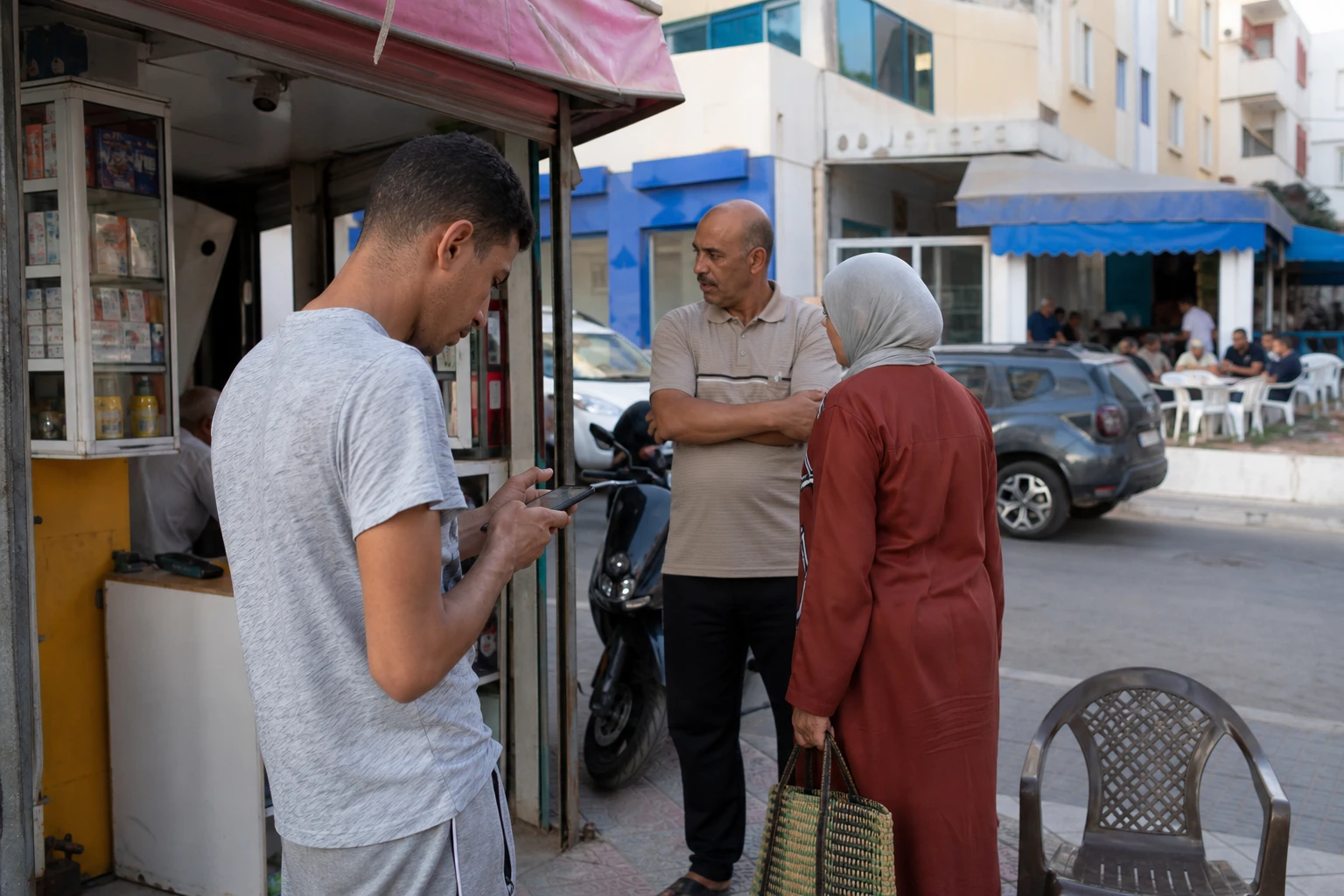
In Fnideq, the sea seems close. The border is even closer. Yet between northern Morocco and the Spanish enclave of Ceuta, a few metres can be enough to turn a rumour into a mass movement. Since the beginning of August, calls have been circulating on Facebook, Instagram and in private WhatsApp groups to revive a mass crossing on 15 August. The messages urge people seeking to migrate irregularly to converge on the border area and organise in advance.
This latest episode follows the dramatic surge in late July, when Ceuta came under heavy migration pressure originating in northern Morocco. Spanish authorities and several international media outlets described the rapid arrival of thousands of people by land and sea, amid confusion fuelled by social media.
In this case, the speed at which information spreads matters as much as the crossing itself. The Moroccan context helps explain why: the country has become a place where Facebook, YouTube, Instagram, WhatsApp and TikTok largely shape the flow of news and rumours. This digital landscape makes periods of tension more fragile, especially when messages combine promises, images taken out of context and misreadings of administrative texts.
Rabat tightens security, without detailed official comment
So far, the Moroccan authorities have not issued a detailed statement on the latest wave of calls for a crossing on 15 August. On the ground, however, security has been stepped up in Fnideq and around the border crossing with Ceuta. Videos circulating online show larger numbers of security force vehicles, while local sources have confirmed an increased police presence in the area.
This heightened vigilance is not isolated. After the July crisis, Morocco’s Interior Ministry had already highlighted the role of false information, smuggling networks and misinterpretations of legal and administrative data. The idea was simple: to make people believe that easy access to Ceuta was possible, without immediate consequences.
Arrests have also been reported in this context. Moroccan media have reported the arrest in Tetouan of a young man suspected of spreading false information and content encouraging irregular migration via digital platforms. Here, too, Moroccan law is clear: incitement to clandestine immigration can lead to prosecution.
The security reinforcement in Fnideq also has political significance. The city’s livelihood depends on its proximity to Ceuta, its shops, workers’ shuttle crossings and a highly sensitive border ecosystem. When tensions rise at the border, small-scale transporters, vendors, cross-border families and informal networks are the first to bear the brunt.
Ceuta, a point of friction for Morocco, Spain and Europe
Ceuta is not merely a matter of border policing. It is a Spanish enclave on the southern shore of the Mediterranean, directly bordering Morocco, and therefore a crossing point, a symbol and a diplomatic issue. Every surge in migration there highlights the interdependence of the two shores: Moroccan control on the land side, Spain’s response in the enclave, and, in the background, the European Union’s gaze.
Recent precedents show how quickly the situation can turn. In 2021, Ceuta had already seen a mass arrival. In July 2026, pressure surged again. Spanish authorities spoke of an emergency, while Morocco attributed the episode to criminal networks and disinformation. The shared framing by Rabat and Madrid of the traffickers’ role does not erase other factors: youth unemployment, a fragile border economy, the viral spread of rumours and the knock-on effect of images posted online.
The issue therefore goes beyond security alone. It touches on information governance, border management and the protection of minors and young adults drawn by a crossing presented as quick or risk-free. In several accounts from the area, residents and community groups have described a strong presence of minors and young people in areas near Ceuta after the viral calls. This also says something about the relationship between social aspirations and digital illusion.
What this episode says about Morocco and the region
For Morocco, there are two issues at stake. On the one hand, it must contain an attempt to force a crossing that could trigger a new crisis on the northern border. On the other, it must prevent a local movement, fuelled by videos and private groups, from becoming a lasting diplomatic problem with Spain. Rabat knows that the slightest image of a crowd in Ceuta can turn into a European issue within hours.
The question also points to a broader reality in North Africa: borders are often places of movement, work and social pressure all at once. In this region, managing flows depends not only on walls, but also on trust in information, police coordination, bilateral cooperation and the ability to offer alternatives to young people in border areas.
At the continental level, this issue is also a reminder that irregular migration cannot be understood solely through images of arrivals in Europe. It is also set in motion in African cities, through promises circulating on social media, smuggling networks and local economic disparities. For Morocco and its neighbours, the real issue in the coming days will therefore be less the rumour itself than whether it can become reality despite the measures deployed around Fnideq and Ceuta.



